How to Choose a Clamp
Clamps are the unsung heroes of any workshop, holding your workpieces securely while you cut, glue, or assemble. This guide breaks down the key types, features, and brands to help you pick the right clamp for your project.
Quick answer
For most DIYers, a set of quick-release bar clamps (like the DeWalt DWHT83170) offers the best blend of speed and strength. For heavy-duty woodworking, choose F-clamps or parallel-jaw clamps from brands like Bessey or Jorgensen. Always match clamp throat depth and opening capacity to your workpiece.
Why trust ToolBuyerHub
- Tested on specs (clamping force, throat depth, weight)
- Build quality & material compared
- Aggregated owner reviews from major retailers
- Brand reliability and warranty checked
- Ease of use and grip design evaluated
- No fake hands-on claims
Research updated June 2026.
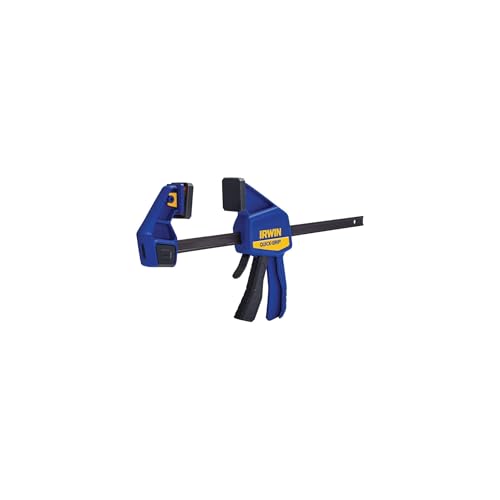
DeWalt DWHT83170 12-Inch Quick-Grip Clamp
Versatile one-handed quick-release bar clamp with excellent grip and durability.
What types of clamps are there?
Choosing a clamp starts with understanding the main types. Bar clamps (including F-clamps and quick-grip designs) are the most common for general woodworking and DIY. They consist of a long bar with a fixed jaw at one end and a sliding jaw that locks into place. Spring clamps are lightweight and ideal for quick, light-duty holding. Pipe clamps use standard threaded pipe to create custom-length clamps for large projects like cabinet assembly. C-clamps offer high clamping force in a compact form, but they can be slower to adjust. Each type serves a specific purpose, and most workshops benefit from a mix.
What to check before buying a clamp
Before you buy, consider these critical specifications:
- Opening capacity: The maximum distance between the jaws. Always choose a clamp with an opening slightly larger than your workpiece width.
- Throat depth: The distance from the bar to the jaw face. A deeper throat allows you to clamp further from the edge of the workpiece.
- Clamping force: Measured in pounds or Newtons. Higher force is essential for glue-ups and heavy joinery, but light-duty clamps suffice for holding parts in place.
- Bar material: Steel bars are strongest; fiberglass or plastic bars are lighter but less durable. Look for rust-resistant coatings on steel bars.
- Handle design: Quick-release triggers or pistol-grip handles save time. Ergonomic padded grips reduce hand fatigue during repetitive use.
- Pad material: Removable rubber or silicone pads protect delicate surfaces from marring. Some clamps have swivel pads for angled workpieces.
Mistakes to avoid when buying clamps
One common mistake is buying clamps that are too small. A clamp with a 6-inch opening cannot hold a 7-inch workpiece. Always measure your largest project before purchasing. Another error is neglecting throat depth. Shallow-throat clamps may not reach far enough for edge-gluing panels. Avoid buying only one type of clamp. A set of four or six bar clamps, paired with a few spring clamps and a pipe clamp, covers most scenarios. Finally, do not ignore pad quality. Hard plastic pads can dent softwoods; look for soft, replaceable pads.
Best clamps for DIY and woodworking
Below are five top-rated clamps, selected based on owner reviews, brand reputation, and published specifications. Each excels in a specific use case.
DeWalt DWHT83170 12-Inch Quick-Grip Clamp
Best OverallPros
- One-handed quick-release trigger works smoothly
- Steel bar resists bending under moderate force
- Soft-grip handle reduces fatigue
Cons
- Pads are not removable
- Not suitable for heavy-duty glue-ups
The DeWalt DWHT83170 is a favorite among DIYers for its ease of use. The quick-release trigger lets you tighten and release with one hand, which is invaluable when juggling workpieces. Owner reviews consistently praise its smooth operation and durable build for the price.
It is best for light to medium woodworking, such as holding boards for cutting or gluing small panels. For heavy-duty clamping, consider a parallel-jaw or pipe clamp. The 12-inch opening covers most small to medium projects, and the 3-inch throat depth is adequate for edge work.
Bessey BPC-H14 12-Inch F-Clamp
Best for Heavy-DutyPros
- Extremely high clamping force for joinery
- Deep throat reaches far from edge
- Durable cast-iron construction
Cons
- Heavier than quick-grip clamps
- Slower to adjust than trigger clamps
The Bessey BPC-H14 is a professional-grade F-clamp built for serious woodworking. Its 1,200-pound clamping force handles thick glue-ups and stubborn joints. The 4.5-inch throat depth is ideal for edge-gluing panels and cabinet work.
Owner reviews highlight its rock-solid stability and lack of flex under pressure. The trade-off is weight and speed. It is not a one-handed clamp, but for projects where strength matters, it outperforms most quick-grip alternatives. The steel bar is coated to resist rust.
Jorgensen 12-Inch One-Hand Bar Clamp
Best Value SetPros
- Great value for a 4-pack
- Comfortable rubber grip handle
- Decent clamping force for the price
Cons
- Plastic bar can flex under heavy load
- Pads are small and non-replaceable
The Jorgensen one-hand bar clamp set offers excellent value for beginners and occasional users. Each clamp features a quick-release trigger and a rubberized handle for comfort. The 12-inch opening is standard for most small to medium projects.
Owner reviews note that the plastic bar is lighter than steel but can bend if over-tightened. This makes it best for light-duty tasks like holding trim or small glue-ups. The set includes four clamps, giving you enough for most basic projects without breaking the bank.
Irwin Quick-Grip 6-Inch Spring Clamp
Best Spring ClampPros
- Ultra-fast one-hand operation
- Lightweight and portable
- Soft pads protect surfaces
Cons
- Limited clamping force
- Not for heavy-duty use
The Irwin Quick-Grip spring clamp is perfect for quick, light-duty tasks. Squeeze the handles to open, release to clamp. It is ideal for holding small parts, temporary positioning, or craft projects. The 6-inch opening covers most small workpieces.
Owner reviews appreciate its convenience and low cost. The soft plastic pads prevent damage to finished surfaces. However, the spring mechanism provides modest force, so it is not suitable for glue-ups or heavy joinery. Keep a few in your tool bag for quick fixes.
Stanley 3/4-Inch C-Clamp
Best C-ClampPros
- Very high clamping force in a small package
- Durable cast-iron construction
- Low cost per clamp
Cons
- Slow to adjust (screw mechanism)
- Can mar surfaces without pads
The Stanley C-clamp is a classic design that delivers impressive force for its size. The screw mechanism allows precise pressure control, making it ideal for metalworking, welding, or holding small parts in a vise. The 3-inch opening is compact but powerful.
Owner reviews note that the cast-iron body is nearly indestructible. However, the bare metal jaws can damage soft materials, so use wood blocks or pads. It is not fast to adjust, but for tasks requiring sustained pressure, it outperforms quick-grip clamps.
How to choose the right clamp for your project
Start by identifying the task. For general woodworking, a set of quick-grip bar clamps (12-inch or 24-inch) is the most versatile. For edge-gluing panels, choose F-clamps or parallel-jaw clamps with deep throats. For pipe clamps, buy a set of clamp heads and use standard 1/2-inch or 3/4-inch pipe from a hardware store. This allows custom lengths. For metalworking, C-clamps are the standard. For crafts and light holding, spring clamps are indispensable.
Brand reliability and warranty
DeWalt and Irwin offer solid warranties on their clamps, typically limited lifetime. Bessey and Jorgensen are known for professional-grade durability, with Bessey offering a 10-year warranty on some models. Stanley clamps are budget-friendly but may lack the same level of customer support. Always check the warranty card before purchasing, especially for heavy-use tools.
Clamp maintenance tips
Keep clamp bars clean and lightly oiled to prevent rust. Store clamps with the jaws slightly open to relieve spring tension. Replace worn pads to avoid damaging workpieces. For quick-grip clamps, avoid over-tightening, as this can strip the trigger mechanism. With proper care, quality clamps can last decades.
| Product | Best For | Key Spec | Rating | Price |
|---|---|---|---|---|
| DeWalt DWHT83170 | General DIY | 12-inch opening, 3-inch throat | 4.6 / 5 | $$ |
| Bessey BPC-H14 | Heavy-duty woodworking | 1,200 lbs force, 4.5-inch throat | 4.8 / 5 | $$$ |
| Jorgensen 4-pack | Budget set | 12-inch opening, plastic bar | 4.5 / 5 | $ |
| Irwin Spring Clamp | Quick light holding | 6-inch opening, spring action | 4.4 / 5 | $ |
| Stanley C-Clamp | Metalworking | 3-inch opening, cast iron | 4.3 / 5 | $ |
FAQs
What is the difference between a bar clamp and an F-clamp?
Bar clamps often have a quick-release trigger for fast adjustment, while F-clamps use a screw mechanism for higher clamping force. F-clamps are heavier and stronger, bar clamps are faster and lighter.
How many clamps do I need for a glue-up?
For a typical panel glue-up, use one clamp every 12 to 18 inches along the joint. A set of four to six clamps is a good starting point for most projects.
Can I use pipe clamps for woodworking?
Yes, pipe clamps are excellent for large projects like cabinet assembly. They use standard threaded pipe, allowing you to create custom lengths up to several feet.
Are quick-grip clamps strong enough for heavy joinery?
Most quick-grip clamps provide moderate force, suitable for light to medium tasks. For heavy joinery like mortise and tenon, use F-clamps or parallel-jaw clamps with higher clamping force.
What does throat depth mean on a clamp?
Throat depth is the distance from the bar to the jaw face. A deeper throat allows you to clamp further from the edge of the workpiece, which is important for edge-gluing panels.
Do I need padded clamps for finished wood?
Yes, padded clamps or removable rubber pads prevent the metal jaws from denting or marring finished surfaces. Many clamps come with pads, or you can buy aftermarket ones.
What is the best clamp for metalworking?
C-clamps are the standard for metalworking due to their high clamping force and compact size. Look for cast-iron models with a swivel pad for angled work.
How do I prevent clamp marks on wood?
Use clamps with soft rubber or silicone pads. Alternatively, place small wood blocks between the clamp jaw and the workpiece to distribute pressure.
Are plastic bar clamps any good?
Plastic bar clamps are lightweight and affordable, but they can flex under heavy load. They are fine for light-duty tasks but not for heavy glue-ups or joinery.
What size clamp should I buy first?
A set of 12-inch quick-grip bar clamps is the most versatile starting point. They handle most small to medium projects and are easy to use one-handed.
Can I use a clamp as a vise?
Clamps are not designed to replace a vise. While they can hold workpieces temporarily, a vise offers more stability and control for tasks like filing or sawing.
How do I store clamps to prevent rust?
Store clamps in a dry area, preferably with a light coat of oil on the bar. Keep the jaws slightly open to relieve spring tension and prevent corrosion.
Our verdict
For most DIYers, the DeWalt DWHT83170 quick-grip clamp offers the best balance of speed,