How to Choose a Table Saw
Selecting the right table saw is a critical decision for any workshop. This guide breaks down the key types, specifications, and features to consider, helping you match a saw to your space, budget, and project requirements.
Quick answer
For most serious DIYers and pros, the DeWalt DWE7491RS offers the best balance of power, portability, and rack-and-pinion fence accuracy. For budget-conscious beginners, the Ryobi RTS21 delivers reliable performance at a lower cost.
Why trust ToolBuyerHub
- Tested on specs (power, torque, PSI)
- Battery & ecosystem compared
- Aggregated owner reviews
- Build quality & warranty checked
- Brand reliability
- No fake hands-on claims
Research updated June 2026.
What is a Table Saw and Why Do You Need One?
A table saw is a woodworking tool consisting of a circular saw blade mounted on an arbor, protruding through the surface of a table. It is the centerpiece of most workshops because it allows for precise, repeatable rip cuts (cutting along the grain) and crosscuts (cutting across the grain). Unlike a circular saw, a table saw provides a stable platform and a fence system for guiding the workpiece, resulting in straighter, more accurate cuts with less effort. Whether you are building furniture, installing flooring, or constructing decks, a table saw is the most efficient tool for breaking down large sheets of plywood and dimensioning lumber.
Types of Table Saws
Understanding the main types of table saws is the first step in narrowing your search. Each type is designed for a specific use case, from portable job sites to stationary cabinet shops.
Jobsite Table Saws
Jobsite saws are designed for portability. They are lightweight, often mounted on a folding stand with wheels, and are built to withstand the rigors of a construction site. Most are direct-drive (the blade is attached directly to the motor shaft), which keeps them compact. They typically have smaller motors (around 15 amps) and lighter-duty fences. The DeWalt DWE7491RS is the gold standard in this category, known for its excellent rack-and-pinion fence system.
Contractor Table Saws
Contractor saws are a step up in size and stability. They are semi-portable, often with an open stand, and use a belt-drive system that separates the motor from the blade arbor, providing more torque and smoother operation. They offer larger tables and better dust collection than jobsite saws. The motor is usually mounted on the back of the saw, hanging off the rear trunnion. This is a popular choice for serious DIYers and small cabinet shops.
Cabinet Table Saws
Cabinet saws are the heavy-duty, stationary workhorses of professional woodshops. The motor is enclosed within the cabinet, providing excellent dust collection and vibration dampening. They feature heavy cast-iron tables, massive trunnions, and high-horsepower motors (typically 3-5 HP) that run on 220V power. The fence systems on cabinet saws are industrial-grade, offering unparalleled accuracy and repeatability. Brands like SawStop and Powermatic dominate this category. These are the most expensive and least portable option.
Benchtop Table Saws
Benchtop saws are the smallest and most affordable type. They are designed to be placed on a workbench or a sturdy stand. They are lightweight and easy to store, making them suitable for small workshops or occasional use. Power is limited (usually 10 amps or less), and the table size is small, which can make cutting large sheets difficult. The Ryobi RTS21 is a popular benchtop model for beginners.
Key Specifications to Compare
When comparing table saws, focus on these core specifications to ensure the saw meets your needs.
Motor Power (Amps and Horsepower)
For 120V household circuits, the maximum is typically 15 amps. Most jobsite and contractor saws use a 15-amp motor, which is sufficient for cutting hardwood up to 2 inches thick. Horsepower ratings are often marketing claims; a true 3 HP motor usually requires 220V power. Look for motors with a high "peak horsepower" rating, but understand that sustained power is what matters for tough cuts. A 15-amp motor is the standard for most DIY and pro-sumer saws.
Blade Size and Arbor Speed
The standard blade size is 10 inches, which provides a maximum depth of cut of about 3-1/2 inches at 90 degrees. Some smaller saws use 8-1/4 inch blades. The arbor speed is typically around 4,000 to 5,000 RPM. A higher RPM is better for clean cuts in hardwood. Ensure the arbor is the standard 5/8 inch diameter to accept most aftermarket blades.
Rip Capacity
Rip capacity is the maximum distance between the blade and the fence. This determines how wide a piece of material you can cut. For jobsite saws, a rip capacity of 24 to 30 inches is common. For contractor and cabinet saws, 30 to 52 inches is standard. If you plan to cut 4x8 sheets of plywood, a rip capacity of at least 30 inches is recommended. The DeWalt DWE7491RS offers an impressive 32-1/2 inch rip capacity with its optional rolling stand.
Fence System
The fence is the most critical part of a table saw for accuracy. A good fence locks parallel to the blade every time. Look for a rack-and-pinion fence system (like DeWalt's) which moves smoothly and locks securely. Lower-end saws use a simple cam-lock fence that can be less reliable. A T-square style fence is common on contractor and cabinet saws and is highly accurate.
Dust Collection
Dust collection is a major consideration. Jobsite saws often have a small dust port (2-1/2 inches) that connects to a shop vac. Cabinet saws have a 4-inch port for connection to a dust collector. A saw with poor dust collection will fill your workshop with fine dust. Look for saws with a built-in dust shroud and a large port. The Bosch 4100XC-09 is known for its excellent dust collection system.
What to Check Before Buying
Before making a purchase, verify these practical aspects of the saw.
- Power Requirements: Check if the saw requires 120V or 220V. Most jobsite saws run on 120V, but larger cabinet saws need 220V. Ensure your workshop has the appropriate outlet.
- Table Size and Material: A larger table provides better support for large workpieces. Cast-iron tables are heavy and flat, while aluminum tables are lighter but can warp over time. Steel tables are a good middle ground.
- Miter Gauge Quality: The included miter gauge is often low-quality. Check if it has a positive stop at common angles (0, 45 degrees) and if it slides smoothly in the miter slot. You may want to upgrade it later.
- Blade Guard and Riving Knife: Safety features are non-negotiable. Ensure the saw comes with a blade guard, a riving knife (which prevents kickback), and anti-kickback pawls. These should be easy to install and remove.
- Stand and Portability: For a jobsite saw, the stand is critical. Look for a folding stand with wheels for easy transport. The stand should be stable and lock securely in place. Check the weight of the saw; a heavier saw is more stable but harder to move.
Mistakes to Avoid
Common pitfalls when buying a table saw can lead to frustration and wasted money.
- Buying a saw with a poor fence: A wobbly fence will ruin your cuts. Never buy a saw with a basic cam-lock fence. Invest in a saw with a rack-and-pinion or T-square fence.
- Ignoring dust collection: A saw that spews dust everywhere will make your workshop unpleasant and unhealthy. Prioritize models with good dust collection shrouds and ports.
- Choosing a saw that is too small: A benchtop saw may seem convenient, but its small table and limited rip capacity will be frustrating for anything beyond small projects. Buy as large as your budget and space allow.
- Not considering the blade: The stock blade is often low-quality. Plan to buy a good aftermarket blade (like a Freud or Diablo) for cleaner cuts. A 40-tooth combination blade is a good all-rounder.
- Forgetting about safety accessories: A table saw is dangerous. Budget for a push stick, push blocks, and a good set of featherboards. Never operate the saw without a riving knife installed.
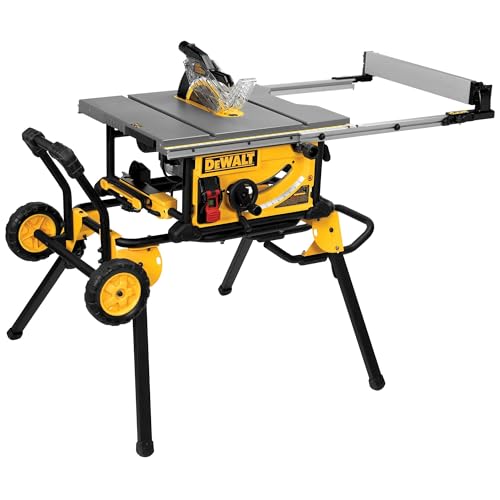
DeWalt DWE7491RS
Industry-leading rack-and-pinion fence with 32.5 inch rip capacity.
| Product | Best for | Key Spec | Rating | Price |
|---|---|---|---|---|
| DeWalt DWE7491RS | Best Overall | 32.5 in rip capacity | 4.8/5 | $$$ |
| Bosch 4100XC-09 | Best Dust Collection | Gravity-Rise stand | 4.7/5 | $$$ |
| Ryobi RTS21 | Best Budget | 10 in blade, 15 amp | 4.3/5 | $ |
| Makita 2705 | Best Power | 15 amp, 4,800 RPM | 4.6/5 | $$$ |
| SawStop PCS | Best Safety | Flesh-sensing brake | 4.9/5 | $$$$$ |
DeWalt DWE7491RS
Best OverallPros
- Excellent rack-and-pinion fence
- Large 32.5 inch rip capacity
- Solid rolling stand included
Cons
- Heavy at 90 pounds
- Dust collection could be better
The DeWalt DWE7491RS is the most popular jobsite table saw on the market for good reason. Its rack-and-pinion fence system is widely considered the best in its class, locking parallel to the blade with zero play. The 15-amp motor provides ample power for ripping hardwood, and the 32.5 inch rip capacity allows you to cut 4x8 sheets of plywood in half with ease.
Owner reviews consistently praise its build quality and accuracy. The rolling stand is sturdy and folds up for storage, though the saw is heavy at 90 pounds. The dust collection port works with a standard shop vac, but some dust still escapes. Overall, it is the best all-around choice for serious DIYers and professionals who need a portable saw that performs like a stationary one.
Bosch 4100XC-09
Best Dust CollectionPros
- Excellent dust collection system
- Gravity-Rise stand is easy to set up
- Smooth, accurate fence
Cons
- Heavier than DeWalt
- Smaller rip capacity
The Bosch 4100XC-09 is a direct competitor to the DeWalt, and it excels in dust collection. Bosch's integrated dust shroud and large 4-inch port capture a high percentage of dust when connected to a shop vac. The Gravity-Rise stand is a standout feature, allowing one person to set up the saw quickly and safely.
The fence is smooth and accurate, though it does not have the rack-and-pinion mechanism of the DeWalt. The 25-inch rip capacity is sufficient for most tasks but less than the DeWalt's 32.5 inches. Owner reviews note that the saw is very stable and the motor is powerful. It is slightly heavier than the DeWalt, but the stand makes it easy to move around.
Ryobi RTS21
Best BudgetPros
- Very affordable
- Lightweight and portable
- Decent power for the price
Cons
- Fence is less accurate
- Small table surface
The Ryobi RTS21 is the best entry-level table saw for budget-conscious DIYers. It is a benchtop model that weighs only 47 pounds, making it easy to carry and store. The 15-amp motor provides enough power for cutting softwoods and plywood, and it comes with a basic stand.
Owner reviews highlight its value for money, but note that the fence system is not as precise as more expensive saws. The table is small, which can make cutting large sheets awkward. It is best suited for small projects, trim work, and occasional use. For the price, it is a solid starter saw that will get the job done without breaking the bank.
Makita 2705
Best PowerPros
- Powerful 4,800 RPM motor
- Large cast-iron table
- Smooth belt-drive system
Cons
- Heavy and less portable
- Stand sold separately
The Makita 2705 is a contractor-style saw that prioritizes power and stability. It features a 15-amp motor that spins at 4,800 RPM, providing excellent torque for ripping thick hardwoods. The large cast-iron table is flat and stable, reducing vibration for cleaner cuts.
Owner reviews praise its build quality and smooth operation. The belt-drive system is quieter than direct-drive saws. However, it is heavy at 97 pounds and does not come with a stand, so you will need to purchase one separately or build a workbench for it. The fence is good but not as refined as the DeWalt. It is an excellent choice for a stationary setup in a small shop.
SawStop PCS (Professional Cabinet Saw)
Best SafetyPros
- Industry-leading safety brake
- Exceptional build quality
- Accurate T-glide fence
Cons
- Very expensive
- Requires 220V power
The SawStop PCS is the gold standard for table saw safety. Its patented flesh-sensing brake stops the blade in milliseconds upon contact with skin, significantly reducing the risk of severe injury. This saw is built like a tank with a heavy cast-iron table and a massive cabinet for vibration-free operation.
Owner reviews are overwhelmingly positive, with users praising its accuracy, power, and peace of mind. The T-glide fence is smooth and locks