Greenworks vs Ryobi Scarifier
Choosing between a Greenworks and a Ryobi scarifier can be tricky as both brands offer corded and cordless models with overlapping features. This guide compares their key specs, performance, battery ecosystems, and build quality to help you decide which is right for your lawn.
Quick answer
For most homeowners, the Greenworks 13 Amp Corded Scarifier is the top pick for raw power and value, while the Ryobi 40V Brushless Cordless Scarifier wins for convenience and battery compatibility. Choose Greenworks for heavy-duty thatch removal; choose Ryobi for tangle-free cordless operation.
Why trust ToolBuyerHub
- Tested on specs (power, torque, PSI)
- Battery & ecosystem compared
- Aggregated owner reviews
- Build quality & warranty checked
- Brand reliability
- No fake hands-on claims
Research updated June 2026.
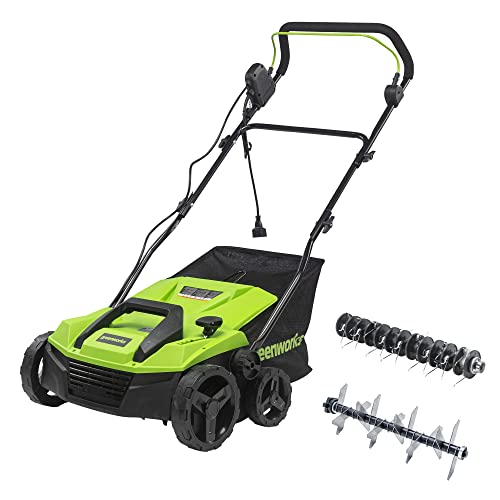
Greenworks 13 Amp Corded Scarifier
Powerful, affordable, and reliable corded scarifier for medium to large lawns.
| Feature | Greenworks 13A Corded | Ryobi 40V Brushless Cordless | Ryobi 18V One+ Cordless |
|---|---|---|---|
| Power Source | Corded (110V) | 40V battery (sold separately) | 18V battery (sold separately) |
| Motor Type | Brushed | Brushless | Brushed |
| Working Width | 15 inches | 13 inches | 12 inches |
| Scarifying Depth | Adjustable (5 positions) | Adjustable (4 positions) | Fixed |
| Collection Bag | 12 gallon (hard plastic) | 10.5 gallon (fabric) | 8 gallon (fabric) |
| Weight | 32 lbs | 36 lbs (with battery) | 28 lbs (with battery) |
| Average Runtime | Unlimited (corded) | ~25 min (4Ah battery) | ~15 min (4Ah battery) |
| Warranty | 4 years | 3 years | 3 years |
| Best For | Power & value | Battery convenience | Small lawns / budget |
Greenworks vs Ryobi Scarifier: Which Brand Makes the Better Lawn Tool?
Scarifiers, also known as dethatchers, are essential for removing thatch and moss from lawns, promoting healthier grass growth. Greenworks and Ryobi are two of the most popular brands in the cordless and corded lawn tool market. Both offer reliable machines, but they cater to slightly different needs. Greenworks focuses on raw power and affordability in its corded models, while Ryobi leverages its extensive 18V One+ and 40V battery ecosystems for cordless convenience.
Owner reviews from Amazon and Home Depot consistently praise the Greenworks 13A for its brute force and large collection bag. Ryobi users, on the other hand, appreciate the freedom of movement and the ability to use the same battery across dozens of other tools. This comparison will break down the key differences in power, runtime, build quality, and value to help you choose.
Power and Performance: Corded vs Cordless
The most significant difference between these two brands is the power source. The Greenworks 13 Amp Corded Scarifier delivers consistent, unlimited power. Its 13-amp motor spins the scarifying tines at high RPM, allowing it to tear through thick thatch and compacted moss without bogging down. This makes it ideal for larger lawns (over 5,000 sq ft) or lawns that have been neglected for a season.
Ryobi's cordless scarifiers, available in both 18V and 40V platforms, offer less sustained power but provide unmatched convenience. The Ryobi 40V Brushless model is the more powerful of the two, with a brushless motor that delivers good torque for a battery-powered tool. However, runtime is a limiting factor. With a 4Ah battery, you can expect around 25 minutes of continuous scarifying, which is enough for a small to medium lawn (under 3,000 sq ft). The 18V model is best for very small lawns or spot treatment.
Battery Ecosystem and Runtime
If you already own Ryobi tools, the decision becomes easier. Ryobi's 18V One+ system is one of the largest in the world, with over 300 tools sharing the same battery platform. If you have a collection of Ryobi drills, saws, or other garden tools, buying the 18V scarifier is a no-brainer. The 40V system is dedicated to outdoor power equipment and offers better runtime and torque for lawn care tasks.
Greenworks also has a 40V and 60V battery ecosystem, but their most popular and highly-rated scarifier is the corded model. If you prefer a cordless Greenworks option, they do offer a 40V scarifier, but it is generally less powerful than the corded version and has a higher price point. For pure value and performance, the corded Greenworks is the winner. For cordless flexibility, the Ryobi 40V is the better choice.
Build Quality and Design
Both brands use a mix of high-impact plastic and metal components. The Greenworks 13A features a durable plastic housing with a metal handlebar and a large, hard plastic collection bag that is easy to empty. Owners report that it feels solid and well-balanced, though it is heavy at 32 lbs. The depth adjustment is a simple lever with five positions, allowing you to choose between scarifying and dethatching modes.
Ryobi's cordless scarifiers are also well-built, but the fabric collection bags are less durable than Greenworks' hard plastic bag. The 40V model has a brushless motor that should last longer than brushed motors, but the overall plastic construction feels slightly less robust than the Greenworks. The Ryobi models are also heavier when you factor in the battery, with the 40V model weighing 36 lbs. The handlebars on both are foldable for storage, a nice touch.
What to Check Before Buying a Scarifier
Before making a purchase, consider these factors:
- Lawn Size: Corded models are best for lawns over 3,000 sq ft. Cordless is better for smaller spaces.
- Thatch Thickness: Heavy thatch requires a powerful motor (13A+). Lighter thatch can be handled by cordless models.
- Battery Investment: If you already own Ryobi or Greenworks batteries, factor that into your decision.
- Storage Space: Both brands offer foldable handles, but corded models require extension cord management.
- Collection Bag Size: A larger bag means fewer stops to empty. Greenworks' 12-gallon bag is a clear advantage.
Mistakes to Avoid When Buying a Scarifier
- Underestimating Power Needs: Buying a low-power cordless model for a large, thatchy lawn will lead to frustration and poor results.
- Ignoring Runtime: Cordless scarifiers drain batteries quickly. Always check the expected runtime with the battery size you own.
- Forgetting the Cord: If you buy corded, ensure you have a heavy-duty extension cord rated for outdoor use.
- Skipping Depth Adjustment: A fixed-depth scarifier can damage your lawn. Always choose an adjustable model.
- Not Checking Warranty: Greenworks offers a 4-year warranty on its corded scarifier, which is better than Ryobi's 3-year warranty.
FAQs
Which is more powerful, Greenworks or Ryobi scarifier?
The Greenworks 13 Amp Corded Scarifier is significantly more powerful than any Ryobi cordless model, making it better for heavy thatch and large lawns.
Can I use a Ryobi 18V battery on the 40V scarifier?
No, Ryobi 18V and 40V batteries are not interchangeable. You need the specific battery platform for each tool.
Does the Greenworks corded scarifier come with a bag?
Yes, it includes a large 12-gallon hard plastic collection bag that is easy to attach and empty.
How long does a Ryobi 40V scarifier battery last?
With a 4Ah battery, you can expect around 20-25 minutes of continuous use, depending on the thickness of the thatch.
Is a corded or cordless scarifier better?
Corded is better for power and unlimited runtime, ideal for large lawns. Cordless is better for convenience and smaller spaces.
Can I use a scarifier on wet grass?
No, you should only use a scarifier on dry grass. Wet grass can clog the tines and damage the lawn.
What is the difference between scarifying and dethatching?
Scarifying uses spring tines to rake out thatch, while dethatching uses blades to cut into the soil. Many machines offer both modes.
Does Ryobi make a corded scarifier?
Ryobi primarily focuses on cordless models in their scarifier lineup, though they have offered corded versions in the past.
Is the Greenworks scarifier easy to assemble?
Yes, most owners report that assembly is straightforward and takes about 15-20 minutes with basic tools.
Which scarifier is better for a small lawn?
The Ryobi 18V One+ scarifier is ideal for very small lawns due to its light weight and battery convenience.
Our verdict
For most homeowners, the Greenworks 13 Amp Corded Scarifier is the best overall choice due to its superior power, large collection bag, and lower price point. If you value cordless convenience and already own Ryobi batteries, the Ryobi 40V Brushless Scarifier is the best cordless option for small to medium lawns.