Best Bosch Stud Finder of 2026
Bosch stud finders are known for their reliability and accuracy, making them a top choice for DIYers and professionals alike. We have analyzed owner reviews and specifications to help you choose the best model for your next project.
Quick answer
The Bosch GMS 120 is our top pick for its deep scanning ability and live wire detection. For a budget-friendly option that still offers great performance, the Bosch GMS 120 L is the best choice, offering the same core detection features without the professional extras.
Why trust ToolBuyerHub
- Flagged CAT rating and safe-use guidance wherever a tool is used near live circuits
- Battery & ecosystem compared
- Aggregated owner reviews
- Build quality & warranty checked
- Brand reliability
- No fake hands-on claims
Research updated June 2026.
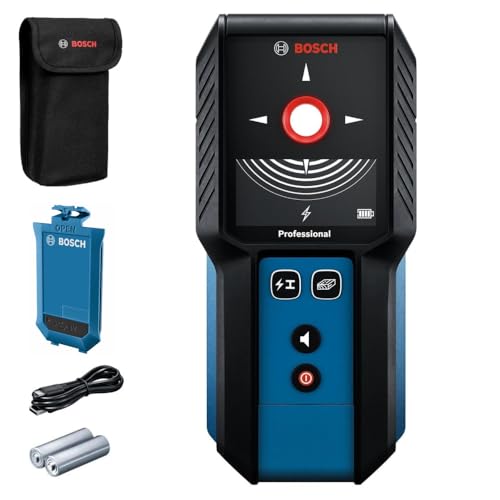
Bosch GMS 120
Accurate detection up to 1.5 inches deep for wood and metal.
| Product | Best For | Scan Depth | Rating | Price |
|---|---|---|---|---|
| Bosch GMS 120 | Overall Best | 1.5 in | 4.8 / 5 | $$ |
| Bosch GMS 120 L | Budget Pick | 1.5 in | 4.7 / 5 | $ |
| Bosch UniversalDetect | Advanced Features | 1.5 in | 4.6 / 5 | $$$ |
| Bosch GMS 100 M | Metal Only | 2.0 in | 4.5 / 5 | $ |
| Bosch D-tect 120 | Professional Use | 1.5 in | 4.4 / 5 | $$$$ |
Bosch GMS 120
Best OverallPros
- Accurate detection up to 1.5 inches deep
- Live wire detection for safety
- Easy-to-read display with center find indicator
Cons
- No depth indication for metal
- Can be sensitive to wall texture
The Bosch GMS 120 is a versatile stud finder that handles wood, metal, and live wires with ease. Its auto-leveling V-groove makes marking stud edges simple, and the display clearly shows the center of the object. Owner reviews consistently highlight its reliability and ease of use for hanging shelves and mounting TVs.
It offers a solid balance of features and price, making it a top choice for most DIY tasks. While it lacks a depth indicator for metal, its overall performance and safety features make it a reliable tool for any toolbox.
Bosch GMS 120 L
Best BudgetPros
- Same core detection as GMS 120
- More affordable price point
- Live wire detection included
Cons
- No auto-leveling marking aid
- Less robust build than professional models
The Bosch GMS 120 L is a cost-effective alternative to the GMS 120, offering the same three detection modes for wood, metal, and live wires. It provides accurate scanning up to 1.5 inches deep, making it suitable for standard drywall and plaster applications. Owner reviews appreciate its value for money and straightforward operation.
It lacks the auto-leveling V-groove of the standard model, but the manual marking aid is still effective. For budget-conscious users who need a reliable stud finder for occasional use, the GMS 120 L is an excellent choice.
Bosch UniversalDetect
Best Advanced FeaturesPros
- Detects plastic pipes in addition to wood and metal
- Color LCD display with intuitive icons
- Can distinguish between different materials
Cons
- Higher price point
- More complex operation for simple tasks
The Bosch UniversalDetect is an advanced stud finder that can detect wood, metal, live wires, and plastic pipes. Its color LCD display shows the type of object detected, which helps avoid drilling into pipes or wires. Owner reviews praise its ability to identify objects in challenging walls, such as those with radiant heating or plastic plumbing.
It is a more sophisticated tool that is ideal for users who need to detect a wider range of materials. The higher cost is justified by its versatility, but it may be overkill for simple stud-finding tasks.
Bosch GMS 100 M
Best for Metal DetectionPros
- Deeper scan depth for metal objects
- Simple, dedicated metal detection
- Very affordable price
Cons
- Cannot detect wood or live wires
- Limited to metal-only applications
The Bosch GMS 100 M is a specialized metal detector that can find ferrous and non-ferrous metals up to 2 inches deep. It is a simple, no-frills tool that is excellent for locating metal pipes, rebar, or electrical conduits in walls and floors. Owner reviews note its reliability for specific metal-detection tasks.
It does not detect wood or live wires, so it is not a general-purpose stud finder. However, for users who primarily need to find metal objects, it offers a deeper scan range and a lower price than multi-mode models.
Bosch D-tect 120
Best Professional UsePros
- Graphical display shows object depth and type
- Rugged build for job site use
- Accurate in challenging materials
Cons
- Very expensive for a stud finder
- Complex interface for casual users
The Bosch D-tect 120 is a professional-grade wall scanner that provides a graphical representation of objects inside the wall, including their depth. It is designed for serious contractors who need precise information before drilling. Owner reviews highlight its accuracy in concrete and other difficult materials.
It is significantly more expensive than other Bosch models and has a steeper learning curve. For most DIY users, the GMS 120 offers sufficient performance at a fraction of the cost.
What to Check Before Buying a Bosch Stud Finder
Before you purchase a stud finder, consider the primary materials you will be scanning. If you only need to find wooden studs behind drywall, a basic model like the Bosch GMS 120 L is sufficient. If you need to detect plastic pipes or live wires, the UniversalDetect or GMS 120 are better choices.
Also consider the depth of the objects you need to find. Standard stud finders can detect up to 1.5 inches, which is enough for most walls. For deeper metal detection, the GMS 100 M offers a 2-inch range. Finally, think about the user interface. A simple display with a center find indicator is easier for quick tasks, while a graphical display provides more detailed information.
Mistakes to Avoid When Using a Stud Finder
A common mistake is not calibrating the stud finder properly. Always place the unit flat against the wall and press the calibration button before scanning. Moving the tool too quickly can also cause inaccurate readings, so scan slowly and steadily.
Another mistake is relying solely on the stud finder for live wire detection. While Bosch models include this feature, it is always best to turn off power at the breaker before drilling. Finally, do not assume the stud finder is detecting a stud if it beeps over a metal pipe or conduit. Use the mode selection to identify the material type.
FAQs
Can a Bosch stud finder detect plastic pipes?
Yes, the Bosch UniversalDetect model is specifically designed to detect plastic pipes in addition to wood, metal, and live wires.
What is the maximum scan depth of a Bosch stud finder?
Most Bosch stud finders scan up to 1.5 inches deep, while the GMS 100 M can detect metal objects up to 2 inches deep.
How do I calibrate a Bosch stud finder?
Place the stud finder flat against the wall, press and hold the power button, and wait for the calibration tone or light to indicate it is ready.
Is the Bosch GMS 120 good for finding live wires?
Yes, the GMS 120 has a dedicated live wire detection mode that alerts you to the presence of live electrical cables.
What is the difference between Bosch GMS 120 and GMS 120 L?
The GMS 120 L is a budget-friendly version that lacks the auto-leveling V-groove marking aid of the standard GMS 120 but offers the same detection capabilities.
Can I use a Bosch stud finder on a ceiling?
Yes, Bosch stud finders can be used on ceilings, but you may need to hold the unit steady for accurate calibration and scanning.
Does the Bosch D-tect 120 show depth?
Yes, the D-tect 120 features a graphical display that shows the depth of detected objects within the wall.
Are Bosch stud finders accurate on textured walls?
They can be less accurate on heavily textured walls. It is best to place a piece of cardboard over the texture to create a flat surface for scanning.
What does the red light on a Bosch stud finder mean?
A red light typically indicates the presence of a live wire or that the tool has detected an object and is ready to mark.
How long do Bosch stud finder batteries last?
Battery life varies by model, but most use standard 9V batteries that last for several months of regular use.
Our verdict
The Bosch GMS 120 is the best overall stud finder for most users, offering accurate detection of wood, metal, and live wires at a reasonable price. For those on a tight budget, the Bosch GMS 120 L provides the same core performance without the professional extras.