Best Cable Cutter for Electricians
A cable cutter is a shear-type tool built to slice cleanly through soft copper and aluminum conductors without crushing the strands or work-hardening the end you are about to terminate. This guide covers the models electricians actually reach for, what each one is rated to cut, and the jobs each one should never be used on.
Quick answer
The Klein Tools 63050 High-Leverage Cable Cutter is the best all-round choice for electricians. Klein rates the 9-1/2 inch tool for 4/0 AWG aluminum, 2/0 AWG soft copper and 100-pair 24 AWG communications cable. For large service conductors and overhead ACSR, step up to the Milwaukee 48-22-6104 Ratcheting ACSR Cable Cutter. Armored cable is a different job entirely: use a rotary armor cutter such as the Klein Tools 53725, not a shear-type cable cutter.
Why trust ToolBuyerHub
- Manufacturer cutting-capacity charts checked model by model
- Capacities quoted in AWG and MCM, not vague "heavy duty" claims
- Published owner feedback read for durability patterns
- Build quality & warranty checked
- Brand reliability across professional trades
- No fake hands-on claims and no invented test scores
Research updated August 2026.
Klein Tools 63050
High-leverage 9-1/2 inch shear cutter rated for 4/0 AWG aluminum and 2/0 AWG soft copper.
| Product | Best For | Rated Capacity | Cutting Action | Price |
|---|---|---|---|---|
| Klein Tools 63050 | Best Overall | 4/0 AWG Al, 2/0 AWG soft Cu | High-leverage shear | Mid |
| Milwaukee 48-22-6104 | Large Conductors & ACSR | Large-gauge Cu, Al and ACSR | Ratcheting | High |
| Channellock 911 | Best Value | Copper and aluminum cable | Shear, 11 in handles | Low |
| Knipex 95 12 200 | Best Compact | 70 mm² (about 2/0 AWG) | Shear, 8 in | Mid |
| Klein Tools 53725 | Armored Cable (BX/MC) | Common BX and MC sizes | Rotary armor slitter | Low |

Klein Tools 63050
Best OverallPros
- Shear-type jaws leave a clean, round end that is easy to terminate
- High-leverage design cuts 4/0 aluminum one-handed
- Klein limited lifetime warranty
Cons
- Soft copper rating stops at 2/0, below the aluminum rating
- Not rated for steel, ACSR or hardened wire
The 63050 is Klein's standard-issue high-leverage cable cutter and the model most electricians mean when they say "Klein cable cutters." Klein publishes three separate ratings for it: 4/0 AWG aluminum, 2/0 AWG soft copper and 100-pair 24 AWG communications cable. Those numbers matter, because the aluminum and copper limits are not the same. Copper is harder, so the tool tops out two sizes lower on copper than it does on aluminum.
The curved shear jaws pull the conductor into the cut rather than pushing it out, which is why the finished end stays round instead of flattening into an oval. That saves time at the lug. At 9-1/2 inches the tool still fits a pouch, though it is a full-size plier, not a pocket cutter. Klein is explicit that it must not be used on steel, ACSR or any hardened wire, and cutting those will notch the edges permanently.
Milwaukee 48-22-6104
Large Conductors & ACSRPros
- Ratchet multiplies force so large conductors cut in stages
- Rated for ACSR, which shear-type cutters are not
- Far less hand strain on repetitive large-gauge cuts
Cons
- Heavy and slow compared with a plier-style cutter
- Overkill and awkward for branch-circuit wire
The 48-22-6104 is Milwaukee's ratcheting ACSR cable cutter. The ratchet is the point: instead of one hard squeeze, you take a series of light strokes and the mechanism holds the progress between them, so a conductor that would defeat a shear cutter comes apart without a cheater bar. The ACSR rating means it is built to handle the steel-reinforced overhead conductor that will destroy a copper-and-aluminum-only tool.
Check Milwaukee's published capacity chart for the exact conductor you are cutting, because the ratings differ between copper, aluminum and ACSR of the same nominal size. What this tool is not is an armored cable cutter. BX and MC armor needs to be slit, not sheared, and shearing it drives the cut steel edge into the conductors inside.
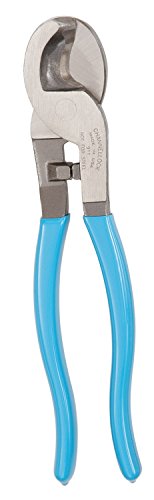
Channellock 911
Best ValuePros
- Long 11 inch handles give real leverage for the money
- Straightforward shear jaws, nothing to service
- US-made tool at a budget-tool price
Cons
- Handle length makes it clumsy inside a crowded panel
- No ratchet, so large conductors take a hard squeeze
Channellock's 911 is an 11 inch shear-type cable cutter for copper and aluminum. The extra handle length is where the value sits: leverage scales with handle length, so a longer cheap cutter often out-cuts a shorter expensive one on the same conductor. Owner feedback is consistent that the jaws stay sharp as long as they only ever see soft metal.
The trade-off is bulk. Eleven inches of handle needs swing room, and in a tight junction box or a loaded panel you will find yourself reaching for something shorter. Like every shear cutter here, it is a copper and aluminum tool only. Steel, ACSR, screws and nails will notch the edges and the notch never comes out.

Knipex 95 12 200
Best CompactPros
- Short enough to work inside a loaded panel
- Precision-ground jaws leave a very clean strand face
- Induction-hardened cutting edges hold an edge well
Cons
- Capacity is quoted in mm², so you have to convert
- Tops out around 2/0 AWG, well short of the Klein on aluminum
Knipex publishes capacity in metric, which trips up US buyers: 70 mm² multi-strand works out to roughly 2/0 AWG, and the 20 mm diameter limit is about 0.79 inches over the conductor. Inside that envelope it is the cleanest cutter here. The jaws are precision ground and the strands come apart square rather than splayed.
At 8 inches it is genuinely usable one-handed in a panel where an 11 inch cutter cannot open. Do not buy it as your only cable cutter if you regularly pull 4/0 aluminum feeders, because you will be at the top of its range every time. Buy it as the cutter that lives in the pouch for everything up to 2/0.
Klein Tools 53725
Armored Cable (BX/MC)Pros
- Slits the spiral armor instead of crushing it flat
- Adjustable depth keeps the blade off the conductors
- Cheap next to the damage a mis-cut armor edge causes
Cons
- Single purpose, it does nothing else
- Takes practice to set blade depth for each cable size
This entry corrects the most common mistake in cable cutter shopping. Armored cable is not cut with a shear-type cable cutter. A rotary armor cutter clamps the cable, and a crank turns a shallow blade that slits one turn of the spiral steel so the armor twists off. The conductors underneath are never touched.
Shearing BX or MC with a plier-style cutter flattens the armor and drives the cut steel edge inward against the insulation, which is exactly the fault that shows up later as a ground fault. Set the blade depth so it just breaks through the armor, run the crank, and snap the slit section off. Deburr or fit an anti-short bushing before you pull the conductors through.
What to check before buying a cable cutter
Separate copper and aluminum ratings. Manufacturers publish two different numbers because copper is harder. The Klein 63050 is rated 4/0 AWG on aluminum but only 2/0 AWG on soft copper. Read the rating that matches the metal you actually cut.
Shear versus ratchet. Shear-type cutters are fast and light and cover branch-circuit work up to roughly 2/0 to 4/0. Ratcheting cutters are slower and heavier but multiply force, which is what you need for large feeders, MCM conductors and ACSR.
Handle length and leverage. Cutting force scales with handle length. An 11 inch cutter beats an 8 inch cutter on the same conductor, but the 8 inch tool is the one that fits inside a loaded panel. Most electricians end up owning both.
The right tool for the sheathing. Armored cable, ACSR and steel messenger wire each need a tool rated for them. A copper-and-aluminum cable cutter used on any of the three will end up with a notched edge.
Mistakes to avoid when choosing a cable cutter
Buying a wire stripper and expecting a cable cutter. Combination strippers such as Klein's 11055 handle roughly 10 to 18 AWG solid and 12 to 20 AWG stranded wire. That is branch-circuit conductor territory, nowhere near the 2/0 to 4/0 range a true cable cutter covers. The two tools are not interchangeable.
Cutting steel or ACSR with a soft-metal cutter. One cut is enough to notch a shear edge, and the notch stays there for the life of the tool. Use a cutter specifically rated for ACSR.
Shearing armored cable. Crushing BX or MC armor pushes a sharp steel edge into the insulation. Slit it with a rotary armor cutter and fit an anti-short bushing.
Ignoring handle ergonomics. A cutter that is too heavy or has slippery grips causes hand fatigue and reduces control. Check the grip texture and the handle opening before you buy.
FAQs
What is the best cable cutter for electricians?
The Klein Tools 63050 high-leverage cable cutter is the best all-round pick. Klein rates it for 4/0 AWG aluminum, 2/0 AWG soft copper and 100-pair 24 AWG communications cable.
Is the Klein 11055 a cable cutter?
No. The 11055 is a Klein-Kurve wire stripper and cutter for roughly 10 to 18 AWG solid and 12 to 20 AWG stranded wire. It is a branch-circuit tool, not a cable cutter for 2/0 or 4/0 conductors.
Can I use a cable cutter on steel wire?
No. Shear-type cable cutters are rated for copper and aluminum only. Steel, ACSR and hardened wire will notch the edges. Use a cutter specifically rated for ACSR instead.
What does AWG mean in cable cutters?
AWG is American Wire Gauge, the sizing system for conductor thickness. A higher AWG number means thinner wire, and sizes above 1 AWG run 1/0, 2/0, 3/0 and 4/0, getting thicker as the number rises.
Why is the copper rating lower than the aluminum rating?
Copper is harder than aluminum, so the same jaws cut a smaller copper conductor. That is why manufacturers publish separate figures, such as 4/0 aluminum and 2/0 soft copper on the Klein 63050.
Are ratcheting cable cutters worth it?
For large conductors and repetitive cuts, yes. The ratchet multiplies force across several strokes so you can cut MCM-sized cable without a cheater bar. For branch-circuit work a shear cutter is faster.
Can I cut armored cable with a standard cable cutter?
No. Shearing BX or MC flattens the armor and drives the cut steel edge into the conductors. Use a rotary armor cutter such as the Klein Tools 53725, then fit an anti-short bushing.
How do I maintain my cable cutter?
Keep the jaws clean and dry, put a drop of light oil on the pivot, and store it out of damp. Never use the cutter as a hammer or a pry bar, which is what knocks the jaws out of alignment.
Can I cut live wire with a cable cutter?
No. Disconnect and verify the circuit is dead first. Standard cable cutters are not insulated tools. Only a VDE-rated 1000V insulated cutter is designed for work near energised conductors, and even then only within its rating.
What is the difference between a cable cutter and a wire stripper?
A cable cutter severs the whole conductor. A wire stripper removes insulation without nicking the copper underneath. Most electricians carry both plus a pair of lineman's pliers.
Our verdict
The Klein Tools 63050 is the cable cutter to buy first, rated for 4/0 AWG aluminum and 2/0 AWG soft copper in a 9-1/2 inch shear tool. Add the Milwaukee 48-22-6104 if you cut large feeders or ACSR, and the Klein Tools 53725 if you run any armored cable. The Channellock 911 is the value pick, and the Knipex 95 12 200 is the one that fits inside a crowded panel.