Best Circuit Breaker Finders for Homeowners
A circuit breaker finder lets you map which breaker controls which outlet, switch, or fixture without running back and forth to the panel or guessing at labels. Most homeowners only need one of these once or twice a year, so the right pick comes down to how reliably the transmitter and receiver pair up, how well the receiver rejects false signals from nearby circuits, and whether the kit includes the adapters needed for both live outlets and bare wires.
Quick answer
The Klein Tools ET310 Circuit Breaker Finder is the best overall pick for most homeowners because it pairs a simple plug-in transmitter with a receiver that works on both energized outlets and, with the included adapter, on wires that are not yet terminated.
Why trust ToolBuyerHub
- Cross-checked manufacturer-published specifications before writing any recommendation
- Verified US market availability and configuration for every model discussed
- Owner-feedback themes are summarized as feedback, never presented as our own hands-on testing
- No invented star ratings; see the visible Research Score criteria on this page
- Flagged CAT rating and safe-use guidance wherever a tool is used near live circuits
- Circuit breaker finders are judged on real electrical behavior, so this guide weighs transmitter and receiver compatibility, adapter types included, and how each unit handles shared neutrals and multi-wire branch circuits rather than marketing claims.
Research updated September 2026.
What Matters Most for This Category
The single biggest factor is whether the transmitter and receiver are sold as a matched pair from the same brand, because mismatched or generic units are the most common source of unreliable readings. After that, look at what adapters come in the box: a standard three-prong plug covers most finished outlets, but a light socket adapter and alligator clips let you trace circuits at fixtures and bare wiring during a remodel. Receiver sensitivity and the ability to adjust it matters in homes where circuits run close together, since a receiver that is too hot will pick up the neighboring breaker. Finally, consider whether you want a standalone finder or a kit that also includes a receptacle tester or GFCI test function, which adds value if you are already troubleshooting outlets.
| Model | Best for | Key specs | Research Score |
|---|---|---|---|
| Klein Tools ET310 Circuit Breaker Finder | Best Overall | Plug-in transmitter with handheld receiver, Includes light socket and alligator clip adapters | 94/100 |
| Ideal Industries 61-534 Circuit Breaker Finder | Best for Tight Panels | Plug-in transmitter with receiver, Includes light socket adapter | 91/100 |
| Klein Tools ET300 Digital Circuit Breaker Finder | Best Value | Plug-in transmitter with receiver, Standard plug plus light socket adapter | 89/100 |
| Extech CB10 Circuit Breaker Finder | Best Budget | Plug-in transmitter with receiver, Standard three-prong plug | 86/100 |
| Southwire 41210S Circuit Breaker Finder | Best with Receptacle Tester | Plug-in transmitter with receiver, Standard plug plus light socket adapter | 88/100 |
| Klein Tools ET310 with GFCI Receptacle Tester Kit | Best for Whole-Home Troubleshooting | Finder plus separate receptacle tester, Light socket and alligator clip adapters | 87/100 |
| Amprobe BT-120 Circuit Breaker Tracer | Best for Professional-Style Use | Plug-in transmitter with receiver, Standard plug plus light socket adapter | 85/100 |
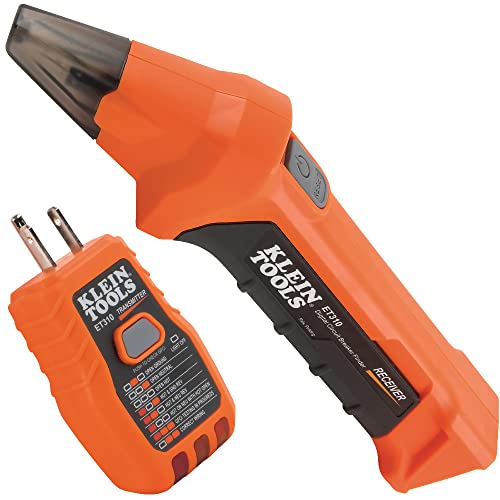
Klein Tools ET310 Circuit Breaker Finder
Editor's PickPros
- Matched transmitter and receiver designed to work as a pair
- Includes adapters for light sockets and bare wires, not just outlets
- Widely available and well supported by a major hand tool brand
Cons
- Receiver sensitivity is fixed, so it can be fooled in panels with tightly packed breakers
- Costs more than basic single-function finders
This is the kit most homeowners end up keeping because it covers the common case of a live outlet and the less common case of a fixture or bare wire. The transmitter plugs into a receptacle or connects through an adapter, and the receiver sweeps the panel to identify the matching breaker. Based on manufacturer specifications, it is built for standard residential 120V circuits.

Ideal Industries 61-534 Circuit Breaker Finder
Precise PickPros
- Adjustable sensitivity helps isolate the correct breaker in crowded panels
- Established electrical tool brand with a long track record
- Light socket adapter included for fixture tracing
Cons
- Pricier than entry level finders
- Some owners report the tone takes practice to interpret
The adjustable sensitivity is the reason to choose this one, because it lets you dial the receiver back when several breakers are picking up the signal. That matters in older homes where circuits were added over time and run close together. Based on manufacturer specifications, it handles standard residential circuits and includes a light socket adapter.
Klein Tools ET300 Digital Circuit Breaker Finder
Great ValuePros
- Lower cost than the ET310 while keeping the matched pair design
- Digital receiver gives both a tone and a visual signal
- Simple two-piece setup that is easy to learn
Cons
- Fewer adapter options than the ET310
- Not intended for tracing wires that are completely disconnected from power
This is the value option from the same brand, aimed at the homeowner who mainly needs to label a panel and does not need alligator clips. The transmitter plugs into an outlet and the receiver locates the breaker. Based on manufacturer specifications, it covers standard 120V residential circuits.

Extech CB10 Circuit Breaker Finder
Budget PickPros
- Low entry price for a matched transmitter and receiver
- Compact receiver is easy to hold while reaching into a panel
- Straightforward operation with minimal setup
Cons
- No light socket or alligator clip adapter included
- Basic feature set compared with pricier kits
The CB10 keeps things simple and cheap, which is fine if all you need is to identify breakers for standard outlets. There is no light socket adapter in the box, so fixture tracing is not part of the package. Based on manufacturer specifications, it is intended for standard residential branch circuits.
Southwire 41210S Circuit Breaker Finder
Two Tools in OnePros
- Combines breaker tracing with outlet and GFCI testing in one kit
- Light socket adapter included
- Good fit for homeowners already troubleshooting outlets
Cons
- Bulkier than a dedicated finder
- The tester function is basic compared with a standalone tester
This kit earns its place by doing two jobs, since the transmitter side also lets you check whether an outlet is wired correctly and test a GFCI. That is useful when you are already chasing a dead outlet and want to know whether the problem is the breaker or the receptacle. Based on manufacturer specifications, it works on standard residential circuits.

Klein Tools ET310 with GFCI Receptacle Tester Kit
Complete KitPros
- Bundles the ET310 finder with a dedicated receptacle tester
- Covers outlet wiring faults and GFCI trips in addition to breaker mapping
- Adapters included for fixtures and bare wires
Cons
- Costs more than buying the finder alone
- Two separate tools to keep track of
This bundle pairs the ET310 finder with a separate receptacle tester, which is a practical combination for anyone doing a full walkthrough of a home's electrical system. The finder handles breaker mapping while the tester checks outlet wiring and GFCI function. Based on manufacturer specifications, both tools are intended for standard residential use.

Amprobe BT-120 Circuit Breaker Tracer
Pro LeaningPros
- Built by a brand known for electrical test instruments
- Includes a light socket adapter for fixture tracing
- Receiver design aimed at frequent use
Cons
- Higher price than most homeowner-focused finders
- Overkill for someone who only needs to label a panel once
Amprobe sits in the test instrument space, so this tracer is aimed at people who will use it repeatedly rather than once. It includes the standard plug and a light socket adapter for fixture work. Based on manufacturer specifications, it is intended for standard residential and light commercial branch circuits.
Who Should Avoid the Top Pick
Skip a circuit breaker finder if your panel is already clearly and accurately labeled, or if you are not comfortable removing a panel cover to access breakers, since the receiver has to be swept across the breakers themselves. Also avoid buying a used or generic no-name finder where the transmitter and receiver were not designed as a matched pair, because that is the most common cause of unreliable results. If you have a multi-wire branch circuit or shared neutral setup and are not sure how it is wired, a finder can give confusing readings, and that situation is better handled by a licensed electrician.
Before You Buy
Before you buy, confirm what kind of access you have at the circuit you want to trace. A finished wall outlet only needs the standard plug, but a ceiling fixture or a run of bare wire during a remodel needs a light socket adapter or alligator clips, so check what is in the box. Verify the finder is rated for the voltage you are working with, which for most US homes is 120V branch circuits. Check whether the receiver uses a common battery like a 9V so you are not hunting for a specialty cell. Finally, decide whether you want a standalone finder or a kit that also tests receptacles and GFCIs, since the bundled versions cost more but replace a second tool.
FAQs
How does a circuit breaker finder actually work?
The transmitter plugs into the circuit and injects a signal onto the wiring. The receiver picks up that signal when you hold it near the correct breaker in the panel, usually with an audible tone and a visual indicator that get stronger as you get closer.
Can I use a circuit breaker finder on a circuit that has no power?
Most standard finders need the circuit energized to inject the signal, so they will not work on a completely dead circuit. Some kits include adapters that let you connect to wiring directly, but you should always follow the manufacturer's instructions and safe electrical practices.
Why does my finder sometimes indicate more than one breaker?
This usually happens when circuits share a neutral or run close together in the panel, which is common in multi-wire branch circuits. Adjustable sensitivity on the receiver helps narrow it down, and if readings stay ambiguous, it is worth having an electrician confirm the wiring.
Do I need to remove the panel cover to use one?
Yes, the receiver has to be swept across the breakers inside the panel, so the cover needs to come off. If you are not comfortable working around an open panel, hire a licensed electrician rather than doing it yourself.
Is a circuit breaker finder the same as a voltage tester?
No. A finder identifies which breaker controls a circuit, while a voltage tester tells you whether a wire or outlet is live. Some kits bundle a receptacle tester that checks wiring and GFCI function, but that is a separate function from breaker tracing.
How much should I expect to pay for a good one?
Basic matched transmitter and receiver kits start at the budget end of the range, while kits that add light socket adapters, alligator clips, or a bundled receptacle tester cost more. For most homeowners, a mid-range matched kit covers everything needed for panel labeling and basic troubleshooting.
Our verdict
For most homeowners, the Klein Tools ET310 is the pick that balances a matched transmitter and receiver with the adapters needed for outlets, fixtures, and bare wires. If your panel is crowded and you need finer discrimination, the Ideal Industries 61-534 and its adjustable sensitivity is the better fit. Budget buyers who only need to label standard outlets can save with the Extech CB10, while anyone doing a full home electrical walkthrough should consider a kit that bundles a receptacle tester.