Best Clamp Meters for Home Electrical Testing
A clamp meter lets you measure current without breaking a circuit, which makes it the right tool for checking breakers, feeders, and appliance loads around a house. The models below cover a range of budgets and safety ratings, from basic continuity checking to true RMS and inrush measurement for modern electronics and motor loads.
Quick answer
For most homeowners, the Fluke 323 is the best overall pick because it balances a genuine CAT III safety rating, solid build quality, and simple operation without paying for features a DIYer will never use.
Why trust ToolBuyerHub
- Cross-checked manufacturer-published specifications before writing any recommendation
- Verified US market availability and configuration for every model discussed
- Owner-feedback themes are summarized as feedback, never presented as our own hands-on testing
- No invented star ratings; see the visible Research Score criteria on this page
- Flagged CAT rating and safe-use guidance wherever a tool is used near live circuits
- Every pick here is a currently sold clamp meter from a brand with real US retail and support presence, and safety category ratings are stated as published by the manufacturer rather than assumed.
Research updated September 2026.
What Matters Most for This Category
The single most important factor is the safety category rating, because you are clamping around live conductors. A CAT III 600V rating is the sensible minimum for residential panel and feeder work, while CAT II is fine only for cord connected loads. After safety, decide whether you need true RMS for accurate readings on electronics and variable speed equipment, and whether you want a jaw size that fits the conductors you actually work with. Auto ranging and a backlit display are conveniences, not requirements, and a basic continuity beeper is genuinely useful for tracing circuits.
| Model | Best for | Key specs | Research Score |
|---|---|---|---|
| Fluke 323 | Best Overall | CAT III 600V, Up to 400 A | 94/100 |
| Klein Tools CL800 | Best Value | CAT IV 600V, CAT III 1000V, Up to 600 A AC, 600 A DC | 91/100 |
| Fluke 325 | Best for DC and Temperature | CAT III 600V, Up to 400 A | 90/100 |
| Klein Tools CL390 | Best Budget | CAT III 600V, Up to 400 A | 87/100 |
| AstroAI Digital Clamp Meter 6000 Counts | Best Under $50 | CAT II 600V, CAT III 300V, Up to 600 A | 82/100 |
| Fieldpiece SC260 | Best for HVAC and Motor Loads | CAT III 600V, Up to 400 A | 89/100 |
| Extech MA445 | Best for Thin Conductors | CAT III 600V, Up to 400 A AC, 400 A DC | 84/100 |

Fluke 323
Top pickPros
- Trusted Fluke build and accuracy reputation
- True RMS readings for modern loads
- Simple two button operation with auto ranging
- Compact enough for a homeowner tool bag
Cons
- No DC current measurement
- No inrush or temperature functions
The Fluke 323 is the clamp meter most electricians recommend to homeowners who want one reliable tool and no confusion. It measures AC current, AC and DC voltage, resistance, and continuity, with a CAT III 600V rating that covers residential panel work. Based on manufacturer specifications, it is a true RMS meter, which matters when you are reading distorted waveforms from electronics or LED drivers.
Klein Tools CL800
Feature richPros
- Very high safety rating for the price
- Measures both AC and DC current
- Inrush mode helps diagnose motor and compressor startup
- Includes temperature and low impedance modes
Cons
- Larger and heavier than basic models
- Menu driven functions take time to learn
Klein Tools is a name most US homeowners already recognize from hand tools, and the CL800 packs a serious feature set for the money. It carries a CAT IV 600V and CAT III 1000V rating, measures AC and DC current, and includes inrush, temperature, and low impedance voltage modes. Owner feedback themes suggest the main complaint is the learning curve on the function menu rather than the measurements themselves.

Fluke 325
Step upPros
- Adds DC current for solar and automotive work
- Temperature probe included
- Same trusted Fluke accuracy and build
- True RMS across AC functions
Cons
- Costs noticeably more than the 323
- Still limited to a 400 A range
The Fluke 325 is the natural upgrade from the 323 for anyone who also works on DC systems such as solar, RV, or automotive wiring. It keeps the CAT III 600V rating and true RMS AC measurement while adding DC current, temperature, and frequency. Based on manufacturer specifications, the jaw and current range are the same as the 323, so the extra money buys features rather than capacity.
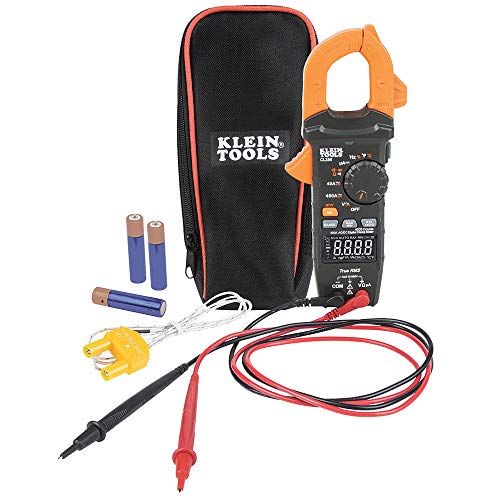
Klein Tools CL390
Budget pickPros
- True RMS at a budget price
- CAT III 600V rating for panel work
- Backlit display and built in worklight
- Auto ranging keeps operation simple
Cons
- No DC current measurement
- Fewer advanced modes than the CL800
The Klein Tools CL390 is a straightforward auto ranging clamp meter aimed at homeowners and apprentices. It offers true RMS AC current up to 400 A, AC and DC voltage, resistance, continuity, and a CAT III 600V rating, plus a backlit display and worklight that help in dim basements and panels. Owner feedback themes point to it being easy to use out of the box.

AstroAI Digital Clamp Meter 6000 Counts
Cheap starterPros
- Very low cost for the feature list
- True RMS and 6000 count display
- Measures capacitance and diodes
- Fine for cord connected loads and hobby work
Cons
- Lower safety category than pro grade meters
- Build quality is not in the same class as Fluke or Klein
AstroAI sells a range of low cost clamp meters, and the 6000 count true RMS version is the one worth considering if budget is the hard limit. It measures AC current up to 600 A along with voltage, resistance, continuity, capacitance, and diodes. The tradeoff is a lower safety category rating, so it belongs on cord connected loads and low energy circuits rather than inside a live service panel.
Fieldpiece SC260
Trade favoritePros
- Built for HVAC and motor diagnostics
- Inrush current capture for compressors
- Microamp measurement for flame sensors
- Compact swivel head design
Cons
- Overkill for basic household wiring checks
- Price sits above general purpose meters
Fieldpiece is a brand built around the HVAC trade, and the SC260 shows it with inrush current capture, microamp measurement, capacitance, and temperature in a compact body. It carries a CAT III 600V rating and true RMS AC measurement. If your home electrical testing includes air conditioning, well pumps, or other motor driven loads, the inrush function is the reason to pick this over a general purpose meter.

Extech MA445
Compact jawPros
- Slim jaw fits crowded panels and small conductors
- Measures AC and DC current
- True RMS with CAT III 600V rating
- Includes capacitance and frequency
Cons
- Less common at big box stores
- Not as rugged as trade grade meters
The Extech MA445 is a compact true RMS clamp meter with a slimmer jaw than most competitors, which helps when conductors are packed tightly in a panel or junction box. It measures AC and DC current up to 400 A plus voltage, resistance, capacitance, and frequency, with a CAT III 600V rating. Based on manufacturer specifications it is a reasonable middle ground between budget meters and premium trade tools.
Who Should Avoid the Top Pick
Skip this category entirely if you plan to open a live service panel and have no electrical experience, because a clamp meter does not make live work safe. Also avoid unbranded clamp meters with no published safety category rating, and avoid any meter marketed only by current range with no mention of CAT rating, since that usually signals a tool that was never designed for panel work.
Before You Buy
Confirm the safety category rating matches the work you will actually do, with CAT III 600V as the practical minimum for residential panels and feeders. Check the jaw opening against the largest conductor you expect to clamp, decide whether you need true RMS and DC current, and make sure the meter ships with test leads you trust. A carrying case and a backlit display are small extras that make a real difference in daily use.
FAQs
What safety rating do I need for home electrical testing?
For anything at the panel or on feeders, look for CAT III 600V at minimum. CAT II rated meters are only appropriate for cord connected loads and plug in devices.
Do I need true RMS on a clamp meter?
True RMS matters when you measure non linear loads such as electronics, LED drivers, and variable speed motors. For simple resistive loads a averaging meter is close enough, but true RMS is worth having.
Can a clamp meter measure DC current?
Only if the meter is specifically rated for DC current, which is a separate function from AC current. Models like the Fluke 325 and Klein CL800 include it, while the Fluke 323 does not.
Is a clamp meter a replacement for a multimeter?
No. A clamp meter is best for current, while a multimeter with test leads is better for detailed voltage, resistance, and continuity probing. Many homeowners end up owning both.
How do I measure current on a household circuit?
Clamp the jaw around a single conductor, either the hot or the neutral, never around the whole cable. Clamping around both conductors at once cancels the magnetic fields and gives a false zero reading.
Are cheap clamp meters safe?
A low cost meter can be safe for low energy hobby work, but meters without a published CAT rating should not be used near a service panel. Safety ratings are the one place you should not cut corners.
Our verdict
The Fluke 323 remains the safest default for most homeowners thanks to its CAT III 600V rating, true RMS measurement, and simple operation. If you want more features for the money, the Klein Tools CL800 adds DC current, inrush, and a higher safety rating, while the Klein CL390 covers the basics at a budget price. Match the meter to the work you actually do, and treat the safety category rating as the first spec you check.