Best Klein Socket Tester
The Klein Tools RT210 GFCI Outlet Tester is the best Klein tool for diagnosing a suspect 120V household outlet, since it plugs directly into the receptacle and lights up the specific wiring fault. The mistake most buyers make is treating one of Klein's non-contact voltage pens, like the NCVT-1 or NCVT-2, as proof that an outlet is safely wired or de-energized, when a pen only detects the presence of an AC field and cannot confirm correct wiring or a truly dead circuit.
Quick answer
For diagnosing outlet wiring problems and GFCI function on standard 120V receptacles, the Klein Tools RT210 GFCI Outlet Tester is the top pick. Add a Klein Tools MM400 multimeter for a numeric, documented voltage reading, and use an NCVT pen like the NCVT-2 only as a quick first warning check, never as final proof.
Why trust ToolBuyerHub
- Cross-checked manufacturer-published specifications before writing any recommendation
- Verified US market availability and configuration for every model discussed
- Owner-feedback themes are summarized as feedback, never presented as our own hands-on testing
- No invented star ratings; see the visible Research Score criteria on this page
- Flagged CAT rating and safe-use guidance wherever a tool is used near live circuits
- We call out when a Klein test tool is a non-contact presence detector rather than a contact-based wiring tester, since confusing the two is a common reason people assume an outlet is safe to work on when it has not actually been verified.
Research updated September 2026.
What Matters Most for This Category
The real trade-off in Klein's outlet-testing lineup is contact versus non-contact test method, not price or brand trust. The RT210 plugs directly into a standard 120V, 3-wire duplex outlet and reads the actual wiring condition through its own internal circuit, so it can tell you the hot and neutral are reversed or the ground is open, something no pen-style tester can do. Klein's NCVT pens never touch a live conductor and only sense the presence of an AC field, which makes them fast and safe for a first pass but useless for confirming correct wiring or a fully dead circuit. The ET310 solves a different problem entirely, tracing which breaker feeds a given outlet, and a multimeter like the MM400 solves yet another, giving a numeric voltage reading you can document before you start work. Buy based on which of these three jobs you actually need done, not on which tool looks the most like a universal socket tester.
| Model | Best for | Key specs | Research Score |
|---|---|---|---|
| Klein Tools RT210 | Best overall Klein socket tester for diagnosing outlet wiring | Standard 120V, 3-wire duplex receptacles, Multiple conditions via LED indicator pattern, including open ground and reversed wiring | 95/100 |
| Klein Tools MM400 | Best for a documented, numeric voltage reading before working on a circuit | True-RMS AC/DC voltage, resistance, and continuity, Digital LCD numeric readout | 90/100 |
| Klein Tools ET310 | Best for identifying which breaker feeds a specific outlet | AC circuit breaker finder and outlet circuit tracer, Outlet-plug transmitter plus handheld receiver wand | 84/100 |
| Klein Tools NCVT-2 | Best everyday non-contact pre-check pen | Non-contact, senses AC voltage field near tip, Dual range, low and high, via slide switch | 82/100 |
| Klein Tools NCVT-6 | Best for pros working in crowded electrical panels | Non-contact, senses AC voltage field near tip, Adjustable dial for fine-tuned detection range | 80/100 |
| Klein Tools NCVT-1XR | Best for recessed outlets and tight panel gaps | Non-contact, senses AC voltage field near tip, Extended, slim reach for recessed outlets and tight gaps | 77/100 |
| Klein Tools NCVT-1 | Best budget entry point into Klein's tester line | Non-contact, senses AC voltage field near tip, Single fixed level | 73/100 |
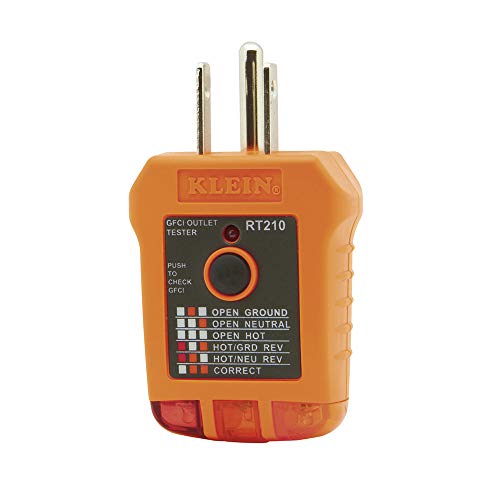
Klein Tools RT210
Best OverallPros
- Instantly flags the exact wiring fault instead of just a pass or fail light
- Dedicated GFCI trip and reset test built into the same tool
- No batteries needed since it draws power from the outlet under test
Cons
- Only works on standard 120V 3-wire outlets, not 240V dryer or range receptacles
- Does not give a numeric voltage reading like a multimeter
The RT210 is a plug-in receptacle tester built specifically for standard 120V, 3-wire duplex outlets. It reads the internal wiring through its own LED indicator pattern and flags conditions like an open ground, open neutral, or reversed hot and neutral wires. It also includes a dedicated GFCI test button that trips a GFCI-protected outlet or breaker so you can confirm the protection resets correctly.
Klein Tools MM400
Best for Verified Voltage ReadingsPros
- Gives an exact numeric voltage reading instead of presence or absence only
- Works across both 120V and 240V circuits, unlike the plug-in RT210
- Doubles as a general-purpose multimeter for continuity and resistance checks
Cons
- Requires touching test leads to live contacts, so proper procedure matters
- Slower to use for a quick outlet check than a plug-in tester
The MM400 is a true-RMS digital multimeter that reads AC and DC voltage, resistance, and continuity with a numeric LCD display instead of a simple LED indicator. Touching its probes across an outlet's hot, neutral, and ground terminals gives an exact voltage reading, which is the closest thing to documented proof that a circuit is live or dead. It also functions as a general electrical multimeter well beyond outlet checks, covering continuity testing on switches, fuses, and wiring runs.
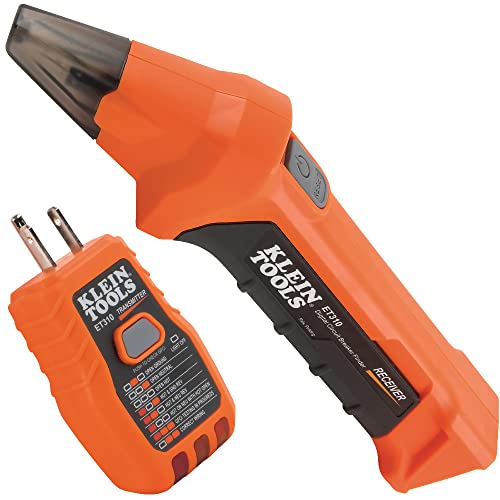
Klein Tools ET310
Best for Tracing BreakersPros
- Finds the correct breaker without guessing and flipping switches one at a time
- Transmitter plugs directly into a standard outlet, no wiring required
- Handheld receiver gives a clear audible signal at the correct breaker
Cons
- Does not diagnose wiring faults or GFCI function at the outlet itself
- Still requires manually switching the identified breaker off to de-energize
The ET310 is an AC circuit breaker finder built around two pieces, a transmitter that plugs into the outlet you want to trace and a handheld receiver you sweep across the breaker panel. The receiver signals when it passes the breaker feeding that specific outlet, which saves time compared to flipping breakers one at a time and checking a lamp. It is designed for tracing circuits, not for diagnosing wiring faults at the outlet itself.

Klein Tools NCVT-2
Best Everyday Pre-Check PenPros
- Dual sensitivity range reduces false triggers compared to single-range pens
- Built-in flashlight helps when checking outlets in dim areas
- Pocket clip design makes it easy to carry on a jobsite
Cons
- Only confirms voltage presence, not correct outlet wiring
- Cannot serve as the sole proof of a de-energized circuit
The NCVT-2 is a non-contact voltage tester with a dual sensitivity switch, letting you choose a lower setting for closer-range checks or a higher setting to detect voltage through an outlet cover or wall. It includes a built-in flashlight and a pocket clip, and it alerts with both a flashing red LED tip and an audible beep when it senses an AC field. Like every non-contact pen, it never touches a live conductor, so it only indicates that voltage may be present near its tip.

Klein Tools NCVT-6
Best for Panel WorkPros
- Adjustable sensitivity dial gives finer control than a two-position switch
- Bright built-in flashlight for checking panels or dim outlets
- Positioned as Klein's higher-sensitivity option for demanding jobsite use
Cons
- Costs more than basic NCVT pens for a tool that still cannot confirm safe isolation
- Sensitivity dial adds a setup step non-electricians may forget to adjust
The NCVT-6 is positioned as Klein's higher-sensitivity non-contact tester, using an adjustable dial instead of a simple two-position switch to fine-tune detection range. It carries the same audible-plus-visual alert pattern as the rest of the NCVT line along with a built-in flashlight. It is still a proximity detector, so the finer sensitivity control helps reduce false triggers in crowded electrical panels but does not turn it into a wiring or voltage-value tester.
Klein Tools NCVT-1XR
Best for Recessed OutletsPros
- Slim extended tip reaches recessed outlets a standard pen cannot access
- Simple single-button operation with no settings to configure
- Compact enough to carry as a dedicated second pen for tight spots
Cons
- Single fixed sensitivity carries the same false-trigger risk as the base NCVT-1
- Narrower use case than a dual-range everyday pen
The NCVT-1XR uses an extended, slimmer tip compared to the standard NCVT-1, designed to reach into recessed outlets, deep panel gaps, and other tight spots a bulkier pen cannot access. It keeps the same single-sensitivity, single-button operation as the base NCVT-1. It is best thought of as a specialty second pen for awkward locations rather than a primary everyday tester.
Klein Tools NCVT-1
Best Budget PickPros
- Lowest cost entry point into Klein's non-contact tester line
- Simple one-button operation with no settings to configure
- Compact enough to keep in every toolbag as a backup pen
Cons
- Single fixed sensitivity can misread near other live wiring in walls
- No flashlight for checking outlets in low light
The NCVT-1 is Klein's entry-level non-contact voltage tester, using a single fixed sensitivity level and one-button operation. It alerts with a flashing red LED tip and an audible beep when it detects an AC field, running on two AAA batteries. It has no flashlight or sensitivity adjustment, which keeps the price down but makes it more likely to misread in crowded wiring situations than the dual-range models above it.
Who Should Avoid the Top Pick
The RT210 only tests standard 120V, 3-wire receptacles and cannot check 240V dryer or range outlets, and it does not give a numeric voltage reading. Anyone working on 240V appliance circuits or needing a documented voltage value should add a Klein Tools MM400 multimeter, or use it as their primary tool instead.
Before You Buy
Decide whether you need a plug-in wiring tester for diagnosing an existing outlet, a non-contact pen for a quick pre-check before removing a cover plate, or a multimeter for a documented voltage reading, since Klein splits these into separate tools. Confirm any GFCI outlet you plan to test has a standard test and reset button compatible with the RT210's design. Keep spare AAA batteries on hand for any NCVT pen, since a dead battery gives no warning at all.
FAQs
Is a Klein non-contact voltage pen a safe substitute for confirming an outlet is de-energized?
No. It only detects the presence of an AC field near its tip and can miss voltage or false-trigger from nearby wiring, so treat it as a first warning step and verify with a contact tester or a multimeter like the Klein MM400 before touching any conductors.
Should I trust the specifications listed on a third-party Amazon or marketplace listing?
Cross-check the model number and key specs against Klein Tools' own product page or printed manual, since third-party listings sometimes carry outdated photos, mismatched bundled accessories, or a discontinued revision of the tool.
Does ToolBuyerHub test these Klein testers in-house before recommending them?
This page is built from manufacturer-published specifications and recurring owner-feedback themes rather than in-house lab testing, so for a safety-critical purchase like a voltage tester, confirm the exact model's current spec sheet on Klein's site before relying on it.
How often is this page reviewed?
We recheck it periodically since Klein periodically updates or replaces individual models in the NCVT line, and a model can be discontinued or revised without an obvious name change.
What does the RT210's GFCI test button actually confirm?
Pressing it creates a small ground fault that should trip a GFCI-protected outlet or upstream GFCI breaker within its rated trip time, confirming the protection is functioning, after which you reset the GFCI at its own reset button, not on the tester.
Our verdict
For most homeowners and electricians checking standard outlets, the Klein Tools RT210 GFCI Outlet Tester is the top pick because it plugs directly into a 120V receptacle and identifies the exact wiring fault or confirms GFCI trip function in seconds. Pair it with a Klein Tools MM400 multimeter when you need a numeric, documented voltage reading before working on a circuit, since neither the RT210 nor any NCVT pen can replace that final contact-based check.