Best Multimeters for Homeowners
A multimeter is one of those tools that sits in a drawer for months and then saves you an afternoon the moment an outlet dies or a battery keeps draining. For homeowners, the right meter is less about laboratory accuracy and more about safe voltage handling, easy-to-read results, and features that match basic electrical troubleshooting.
Quick answer
The Fluke 117 is the top pick for most homeowners who want a safe, accurate, no-guesswork meter, while the Klein Tools MM400 is the best value for routine household checks.
Why trust ToolBuyerHub
- Cross-checked manufacturer-published specifications before writing any recommendation
- Verified US market availability and configuration for every model discussed
- Owner-feedback themes are summarized as feedback, never presented as our own hands-on testing
- No invented star ratings; see the visible Research Score criteria on this page
- Flagged CAT rating and safe-use guidance wherever a tool is used near live circuits
- Every pick here is a currently sold US model from a brand with real retail presence, and safety ratings are reported from manufacturer specifications rather than copied from retailer listings.
Research updated September 2026.
What Matters Most for This Category
The single most important factor is safety rating, specifically a CAT III or CAT IV rating for any meter you might use on household wiring, panels, or outlets. After that, look at whether you need true RMS for accurate readings on modern electronics, a non-contact voltage detector for quick checks, and a backlit display for dim basements or crawlspaces. Auto-ranging saves time for beginners, while manual-ranging meters can be fine for simple continuity and battery tests. Budget meters are acceptable for low-voltage work, but they should never be your primary tool on a live 120V or 240V circuit.
| Model | Best for | Key specs | Research Score |
|---|---|---|---|
| Fluke 117 Electrician's Multimeter | Best Overall | CAT III 600V, Yes | 95/100 |
| Klein Tools MM400 Auto-Ranging Digital Multimeter | Best Value | CAT III 600V, Yes | 91/100 |
| AstroAI Digital Multimeter TRMS 6000 | Best Budget | CAT III 600V, Yes | 86/100 |
| Fluke 107 Palm-Sized Digital Multimeter | Best Compact | CAT III 600V, Yes | 89/100 |
| Klein Tools MM600 Auto-Ranging Digital Multimeter | Best for Advanced Homeowners | CAT III 600V, Yes | 88/100 |
| INNOVA 3320 Auto-Ranging Digital Multimeter | Best Simple Display | CAT II 600V, No | 84/100 |
| Southwire 10030S Digital Multimeter | Best for Basic Electrical Checks | CAT III 600V, No | 82/100 |

Fluke 117 Electrician's Multimeter
Top pickPros
- Excellent safety rating for residential electrical work
- True RMS gives accurate readings on modern loads
- Non-contact voltage detection adds a quick safety check
Cons
- Higher price than most homeowner meters
- More meter than some casual users need
The Fluke 117 is a professional-grade electrician's meter that also happens to be one of the safest choices for a homeowner who wants to work around live circuits. It combines true RMS accuracy, a CAT III 600V rating, and built-in non-contact voltage detection in a package that is still reasonably compact. Based on manufacturer specifications, it is the meter most likely to outlast the house.
Klein Tools MM400 Auto-Ranging Digital Multimeter
Best valuePros
- True RMS and CAT III rating at a mid-range price
- Auto-ranging simplifies use for beginners
- Backlit display helps in low light
Cons
- No non-contact voltage detection built in
- Continuity beeper is not the loudest
Klein Tools is a name most homeowners already associate with hand tools, and the MM400 brings that same practical approach to a digital multimeter. It offers true RMS readings and a CAT III 600V safety rating without the premium price of a Fluke. For routine outlet, switch, and battery testing, it covers the essentials well.
AstroAI Digital Multimeter TRMS 6000
Budget friendlyPros
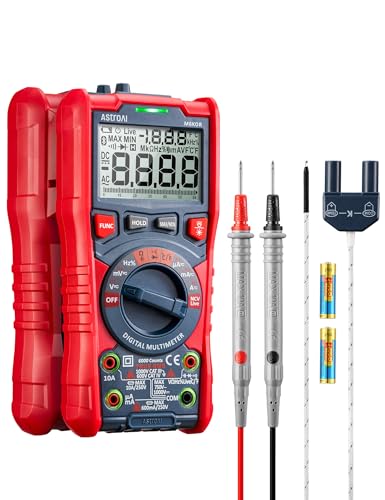
- Very affordable for a true RMS meter
- Large backlit display is easy to read
- Includes common functions like continuity and diode test
Cons
- Build quality is lighter than pro-grade meters
- Leads are basic and may be worth upgrading
AstroAI has become a common budget option on Amazon, and the TRMS 6000 packs true RMS and a CAT III 600V rating into a very low price point. It is a reasonable choice for low-voltage projects, automotive checks, and basic outlet testing. Owners frequently note that it does the job for occasional use, though it is not built like a professional meter.

Fluke 107 Palm-Sized Digital Multimeter
Pocket sizePros
- Very compact for a tool bag or kitchen drawer
- Fluke build quality and safety rating
- Simple interface with essential functions
Cons
- Fewer advanced features than full-size Fluke models
- No non-contact voltage detection
The Fluke 107 is a smaller, simplified meter aimed at users who want Fluke reliability in a pocket-friendly size. It keeps the CAT III 600V rating and true RMS readings that matter for household work. If you want a meter that disappears into a drawer until you need it, this is a strong option.
Klein Tools MM600 Auto-Ranging Digital Multimeter
Step upPros
- Adds temperature and capacitance functions
- True RMS and CAT III rating
- Good middle ground between basic and pro meters
Cons
- Slightly more expensive than the MM400
- Some functions are rarely needed by casual users
The Klein Tools MM600 builds on the MM400 with extra functions like temperature and capacitance, which can be useful for HVAC checks and motor capacitors. It keeps the true RMS and CAT III 600V safety rating that homeowners should look for. This is a good pick if you want room to grow into more advanced troubleshooting.
INNOVA 3320 Auto-Ranging Digital Multimeter
Easy readPros
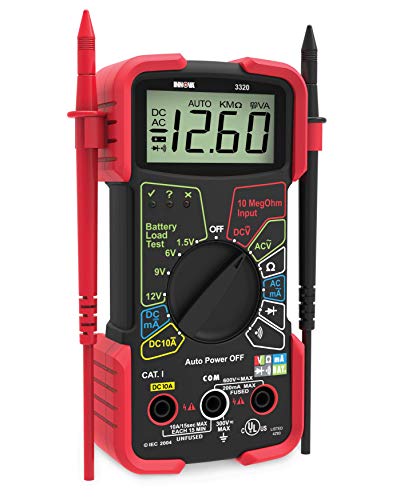
- Large, easy-to-read display
- Color-coded leads help prevent mix-ups
- Very affordable
Cons
- CAT II rating is not ideal for panel work
- Not true RMS
The INNOVA 3320 is a longtime budget favorite thanks to its big display and color-coded leads, which make it approachable for beginners. It is fine for battery tests, continuity checks, and low-voltage projects. Just note the CAT II rating, which means it should not be your first choice for live household panel work.
Southwire 10030S Digital Multimeter
Basic pickPros
- CAT III 600V rating at a low price
- Compact and lightweight
- Simple controls for basic measurements
Cons
- Not true RMS
- Limited advanced functions
Southwire is a familiar name in residential electrical products, and the 10030S is a straightforward meter for basic voltage, continuity, and resistance checks. It carries a CAT III 600V rating, which is a meaningful safety point at this price. It is not a feature-rich meter, but it covers the fundamentals.
Who Should Avoid the Top Pick
Avoid no-name meters with vague or missing safety ratings, especially if you plan to use them on live household circuits. Also skip meters that only list a CAT II rating if your work involves electrical panels or fixed wiring, since those are not designed for the higher energy available at those points.
Before You Buy
Before buying, decide whether you need true RMS, which matters for accurate readings on modern electronics and variable-speed motors. Check the safety category rating and make sure it matches the work you plan to do, with CAT III being a sensible minimum for household electrical tasks. Finally, consider whether a non-contact voltage detector, backlight, or auto-ranging will make the meter easier for you to use safely.
FAQs
What safety rating should a homeowner look for?
A CAT III 600V rating is a good minimum for household electrical work, while CAT II meters are better limited to low-voltage and plug-in device testing.
Do I really need true RMS?
True RMS helps with accurate readings on modern electronics and non-linear loads, but for basic continuity and battery checks a standard averaging meter can be sufficient.
Can a cheap multimeter be dangerous?
A cheap meter without a legitimate safety rating can be dangerous on live circuits, so stick with known brands and clear CAT ratings for anything involving household voltage.
What is the difference between auto-ranging and manual-ranging?
Auto-ranging meters select the correct measurement range for you, which is easier for beginners, while manual-ranging meters require you to pick the range yourself.
Do I need a non-contact voltage tester built into my multimeter?
It is a convenient safety extra for quick checks, but it does not replace proper meter testing or turning off power before working on circuits.
How much should a homeowner spend on a multimeter?
A safe, capable meter for household use generally starts around the budget to mid-range price band, with professional-grade options costing more for better accuracy and durability.
Our verdict
For most homeowners, the Fluke 117 offers the best mix of safety, accuracy, and ease of use, while the Klein Tools MM400 delivers strong value for routine checks. If you are on a tight budget, the AstroAI TRMS 6000 is a reasonable starter meter as long as you respect its limits. Whichever you choose, prioritize a real CAT III safety rating over extra features.