Best Multimeters for Professional Electricians
A multimeter is one of the few tools an electrician uses on every single job, so the gap between a hobby-grade meter and a true professional instrument shows up fast in safety, speed, and confidence. This guide compares seven genuinely distinct meters sold in the US, from daily-driver True RMS workhorses to specialty clamp and insulation testers, using manufacturer specifications and common owner-feedback themes rather than lab testing.
Quick answer
The Fluke 117 is the best overall pick for most professional electricians thanks to its True RMS accuracy, non-contact voltage detection, and proven durability in commercial and residential work.
Why trust ToolBuyerHub
- Cross-checked manufacturer-published specifications before writing any recommendation
- Verified US market availability and configuration for every model discussed
- Owner-feedback themes are summarized as feedback, never presented as our own hands-on testing
- No invented star ratings; see the visible Research Score criteria on this page
- Flagged CAT rating and safe-use guidance wherever a tool is used near live circuits
- Every meter here is a real, currently sold US model from a brand with a documented safety rating (CAT III or CAT IV), which matters more than any feature list when you are working near live panels.
Research updated September 2026.
What Matters Most for This Category
Safety rating comes first: a meter used on industrial or commercial panels should carry at least CAT III 600V, and CAT IV if you work at the service entrance. After that, True RMS matters for accurate readings on variable-frequency drives and modern electronics, while non-contact voltage detection, a low-impedance mode to defeat ghost voltage, and a bright backlit display are the features electricians actually use daily. Budget also shapes the choice, since a $60 meter and a $250 meter can both be safe, but the expensive one usually adds ruggedness, better leads, and longer calibration stability.
| Model | Best for | Key specs | Research Score |
|---|---|---|---|
| Fluke 117 Electrician's Multimeter | Best Overall | CAT III 600V, Yes | 95/100 |
| Klein Tools MM700 Auto-Ranging Digital Multimeter | Best Value | CAT IV 600V, Yes | 90/100 |
| Fluke 87V Industrial Multimeter | Best for Industrial Work | CAT III 1000V / CAT IV 600V, Yes | 94/100 |
| Fluke T6-1000 Electrical Tester | Best for Speed and Convenience | CAT III 1000V, Yes | 89/100 |
| Klein Tools CL800 Digital Clamp Meter | Best Clamp Meter Option | CAT IV 600V, Yes | 88/100 |
| AstroAI Digital Multimeter TRMS 6000 | Best Budget | CAT III 600V, Yes | 82/100 |
| Extech EX330 Autoranging Mini Multimeter | Best Compact Option | CAT III 600V, No, averaging | 80/100 |

Fluke 117 Electrician's Multimeter
Top PickPros
- True RMS accuracy for reliable readings on modern loads
- Built-in non-contact voltage detection speeds up box checks
- Compact, rugged body with a strong reputation for surviving job sites
Cons
- Premium price compared with general-purpose meters
- No current clamp, so high-current work needs a separate accessory
The Fluke 117 is the meter most electricians reach for on service calls because it combines True RMS measurement, non-contact voltage detection, and a low-impedance mode that clears ghost voltage readings. It is built for commercial and residential troubleshooting rather than heavy industrial current measurement.
Klein Tools MM700 Auto-Ranging Digital Multimeter
Great ValuePros
- CAT IV rating at a mid-range price
- True RMS and auto-ranging simplify everyday measurements
- Backlit display and built-in work light help in dark panels
Cons
- Lead quality is a common upgrade point for daily users
- Not as refined as premium meters for low-level electronics work
Klein Tools built the MM700 for the electrical trade, pairing a CAT IV 600V rating with True RMS and auto-ranging at a price well below premium brands. It covers voltage, current, resistance, continuity, and capacitance for typical service work.

Fluke 87V Industrial Multimeter
Industrial GradePros
- High resolution and accuracy for demanding diagnostics
- Filtered mode handles noisy variable-frequency drive signals
- Very rugged and widely trusted in industrial environments
Cons
- Expensive for residential-only work
- Heavier and bulkier than compact electrician meters
The Fluke 87V is a long-standing industrial standard, offering high resolution, True RMS, and a selectable filter that stabilizes readings on motor drives and noisy equipment. It is overkill for simple outlet checks but excellent for troubleshooting machinery.

Fluke T6-1000 Electrical Tester
Fast ChecksPros
- Measures voltage and current without opening a circuit
- Open-fork design speeds up panel and wire checks
- True RMS readings in a compact tester format
Cons
- Not a full multimeter replacement for resistance and capacitance
- FieldSense current measurement has usage nuances owners should learn
The T6-1000 is a tester rather than a full multimeter, letting electricians read voltage and current by placing the fork around a conductor. It is ideal for quick verification work where opening a circuit or hunting for a clamp is slow.
Klein Tools CL800 Digital Clamp Meter
Clamp PickPros
- Measures current without breaking the circuit
- True RMS and CAT IV rating suit service work
- Includes temperature and capacitance functions
Cons
- Clamp jaw limits measurement to conductors it can surround
- Bulkier than a pocket multimeter for tight spaces
The CL800 combines a clamp meter with multimeter functions, letting electricians measure load current safely around conductors while still checking voltage and resistance. It suits panel work and load balancing where a standard meter would require disconnecting wiring.
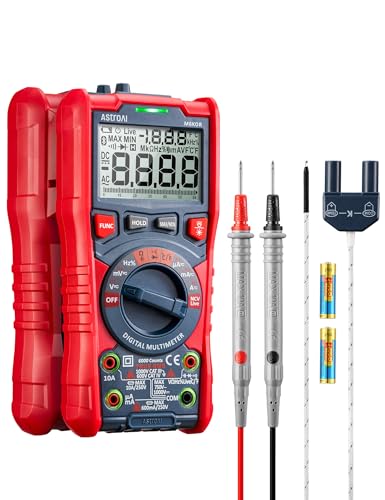
AstroAI Digital Multimeter TRMS 6000
Budget PickPros
- Very low cost for a True RMS auto-ranging meter
- Good feature set for apprentices and backup use
- Backlit display and basic continuity buzzer
Cons
- Build quality and leads are not on par with pro-grade meters
- Not the first choice for daily commercial or industrial work
The AstroAI TRMS 6000 offers True RMS and auto-ranging at a budget price, making it a reasonable starter or backup meter. It handles basic voltage, resistance, and continuity checks for light-duty use.

Extech EX330 Autoranging Mini Multimeter
CompactPros
- Small enough to keep in a pouch or pocket
- Includes non-contact voltage detection and temperature
- Affordable price for a name-brand compact meter
Cons
- Not True RMS, so readings on non-sinusoidal loads are less accurate
- Lower resolution than full-size professional meters
The Extech EX330 is a compact autoranging meter with a built-in non-contact voltage detector and temperature function. It fits well as a secondary meter for quick checks when a full-size unit is inconvenient.
Who Should Avoid the Top Pick
Skip unbranded meters with vague or missing safety ratings, since a meter that fails internally on a live panel can expose you to arc flash or shock. Also avoid paying for premium industrial features like high resolution and drive filtering if your work is almost entirely residential service calls, because a mid-range True RMS meter will cover those jobs safely.
Before You Buy
Confirm the CAT safety rating matches the highest-energy environment you actually work in, then check whether you need True RMS, a clamp for current, or non-contact voltage detection. Factor in lead quality and replacement cost, since good silicone leads and fused protection are part of the real price of ownership. Finally, verify the meter ships with a calibration certificate if your employer or clients require documented accuracy.
FAQs
Do professional electricians really need True RMS?
True RMS matters when measuring non-sinusoidal waveforms such as variable-frequency drive outputs, dimmer circuits, or modern electronics. For simple sinusoidal voltage checks it makes little difference, but most working electricians encounter distorted waveforms often enough that True RMS is worth having.
What CAT rating should an electrician's multimeter have?
CAT III 600V is the practical minimum for panel and distribution work, while CAT IV is appropriate for service-entrance and outdoor utility-side measurements. Always match the rating to the highest category and voltage you might encounter, never the other way around.
Is a clamp meter better than a standard multimeter?
A clamp meter measures current without breaking the circuit, which is safer and faster for load checks. A standard multimeter is better for detailed voltage, resistance, and component testing, so many electricians carry both or choose a clamp meter with full multimeter functions.
How often should a multimeter be calibrated?
Many employers and industrial clients expect annual calibration, while some standards allow longer intervals based on use and manufacturer guidance. For safety-critical work, follow your company policy and keep the certificate on file.
Can a cheap multimeter be safe for professional use?
A low-cost meter can be safe if it carries a legitimate CAT rating from a known brand and is used within that rating. The trade-offs are usually build quality, lead durability, and long-term accuracy rather than immediate safety, so budget meters suit light duty and backup roles best.
What accessories are worth adding to a multimeter?
Quality silicone test leads, a magnetic hanging strap, alligator clip adapters, and a spare fuse are the upgrades electricians mention most. A carrying case also protects the meter and leads between jobs.
Our verdict
For most professional electricians, the Fluke 117 hits the best balance of True RMS accuracy, non-contact voltage detection, and job-site durability. Step up to the Fluke 87V if industrial diagnostics are routine, or choose the Klein MM700 if budget matters more than brand prestige. Whichever you pick, let the CAT safety rating and your actual daily tasks drive the decision.