Best Socket Tester for Beginners
A socket tester is the quickest way to check if a wall outlet is wired correctly. We have reviewed the best options for beginners that are safe, easy to read, and reliable.
Quick answer
The Klein Tools RT250 is the best socket tester for beginners. It offers clear GFCI testing, a bright LED display, and a rugged build. For a budget pick, the Sperry Instruments GFI6302 provides reliable basic wiring checks at a lower price point.
Why trust ToolBuyerHub
- Flagged CAT rating and safe-use guidance wherever a tool is used near live circuits
- Battery & ecosystem compared
- Aggregated owner reviews
- Build quality & warranty checked
- Brand reliability
- No fake hands-on claims
Research updated June 2026.

Klein Tools RT250
Clear diagnostics with a rugged design, perfect for beginners.
| Product | Best For | Key Spec | Rating | Price |
|---|---|---|---|---|
| Klein Tools RT250 | Overall Best | 7 Faults, GFCI | 4.8/5 | $$ |
| Sperry Instruments GFI6302 | Budget Pick | 6 Faults, GFCI | 4.5/5 | $ |
| Southwire 41010T | Auto Ranging | 7 Faults, GFCI | 4.6/5 | $$ |
| Klein Tools RT210 | Compact Size | 6 Faults, GFCI | 4.7/5 | $ |
| Gardner Bender GFI-3501 | Value Durability | 6 Faults, GFCI | 4.4/5 | $ |
Klein Tools RT250
Best OverallPros
- Detects 7 wiring faults
- Built-in GFCI test
- Bright LED indicators
Cons
- Slightly larger than basic models
- No backlight on LEDs
The Klein Tools RT250 is the top choice for beginners due to its comprehensive fault detection. It identifies seven common wiring issues, including open ground, reverse polarity, and missing neutral. The GFCI test button works well, and the device is built to withstand drops on a job site.
Owner reviews consistently praise its clear labeling and ease of use. The LED lights are bright enough for most indoor conditions. It is a reliable tool that gives a beginner confidence when checking outlets.
Sperry Instruments GFI6302
Best BudgetPros
- Very affordable
- Simple one-button operation
- Includes GFCI test
Cons
- Detects only 6 faults
- Plastic feels less rugged
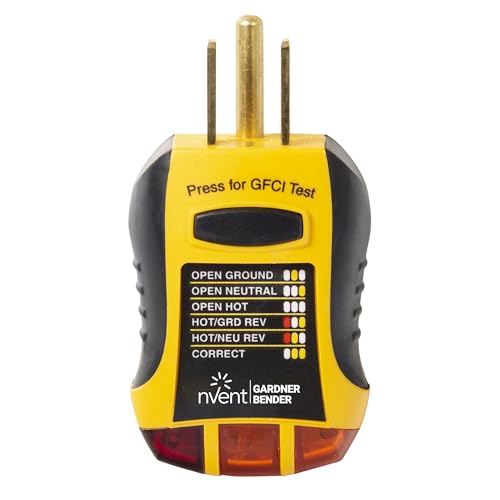
The Sperry Instruments GFI6302 is the best budget-friendly socket tester for beginners. It covers the six most common wiring faults and includes a GFCI test function. The design is straightforward, with a single button to cycle through tests.
User reviews highlight its value for money. It is a great tool for a homeowner who wants to check outlets occasionally. The build quality is adequate for light use, but it may not survive a heavy drop as well as the Klein RT250.
Southwire 41010T
Best Auto RangingPros
- Auto-ranging voltage detection
- Detects 7 faults
- Ergonomic grip
Cons
- Slightly more expensive than basic models
- LEDs can be hard to read in direct sunlight
The Southwire 41010T stands out with its auto-ranging voltage detection, which helps beginners confirm the outlet is live before testing. It detects seven wiring faults and includes a GFCI test. The ergonomic grip makes it comfortable to hold and plug in.
Owner feedback notes that the tool is accurate and easy to interpret. The auto-ranging feature is a nice addition for those unsure about voltage levels. It is a solid choice for a beginner who wants a few extra features without a steep learning curve.
Klein Tools RT210
Best CompactPros
- Small and portable
- Klein Tools build quality
- Easy to read LED chart
Cons
- Detects only 6 faults
- No auto-ranging feature
The Klein Tools RT210 is a compact version of the RT250. It is smaller and lighter, making it easy to carry in a pocket. It still detects six common wiring faults and has a GFCI test function. The LED chart on the side is clear and simple to read.
Users appreciate the portability and the trusted Klein brand. It is a great choice for a beginner who wants a reliable tool that takes up minimal space. The trade-off is that it does not detect the seventh fault (open neutral) that the RT250 can find.

Gardner Bender GFI-3501
Best Value DurabilityPros
- Durable construction
- Clear LED indicators
- Good value for the price
Cons
- Detects only 6 faults
- No auto-ranging
The Gardner Bender GFI-3501 is a durable and affordable socket tester. It detects six wiring faults and includes a GFCI test. The body is built to withstand some abuse, making it a good option for a beginner who might be rough on tools.
Owner reviews mention that it is straightforward to use and provides accurate readings. It is a reliable budget option that does not feel cheap. For the price, it offers solid performance and peace of mind.
What is a Socket Tester and Why Do Beginners Need One?
A socket tester is a small handheld device that plugs into a standard electrical outlet. It checks for common wiring errors such as open ground, reverse polarity, and missing neutral. For a beginner, it is the safest and easiest way to verify that an outlet is wired correctly without using a multimeter.
Using a socket tester can prevent electrical shocks and equipment damage. It gives a beginner immediate feedback on the condition of an outlet. Most models use a simple chart of LED lights to indicate the wiring status, making them very user-friendly.
What to Check Before Buying a Socket Tester
Number of Faults Detected: Most testers detect 6 or 7 common wiring faults. A 7-fault tester is more comprehensive and can identify issues like an open neutral that a 6-fault tester might miss.
GFCI Test Function: Ground Fault Circuit Interrupter (GFCI) outlets are required in bathrooms and kitchens. A tester with a GFCI test button allows you to verify that the outlet's safety mechanism works properly.
Build Quality: Look for a tester with a rugged casing that can withstand accidental drops. A compact size is also beneficial for storage and portability.
Voltage Range: Ensure the tester is rated for the voltage in your region (110-125V AC for North America). Some models also offer auto-ranging voltage detection for added safety.
Ease of Use: A clear LED chart and simple one-button operation are ideal for beginners. The tester should provide unambiguous results without requiring interpretation.
Mistakes to Avoid When Using a Socket Tester
Relying Solely on the Tester: A socket tester can only check the wiring of the outlet. It cannot detect all electrical issues, such as a loose connection behind the wall. If you suspect a serious problem, consult a licensed electrician.
Ignoring the GFCI Test: Many beginners skip the GFCI test. This test is crucial for outlets in wet areas. Always press the GFCI test button to ensure the outlet will trip in a fault condition.
Using a Damaged Tester: Inspect the tester for cracks or damage before each use. A damaged tester can give false readings or pose a safety hazard. Replace it if you notice any issues.
Not Reading the Chart: Each tester has a unique LED pattern for different faults. Always refer to the chart on the side of the tester to correctly interpret the results. Guessing can lead to a misdiagnosis.
FAQs
Can a socket tester detect a bad ground?
Yes, most socket testers can detect an open ground or a bad ground connection. They will indicate this with a specific LED pattern.
Do I need a GFCI tester for every outlet?
No, GFCI testers are specifically for outlets with GFCI protection. Standard outlets do not have this feature, so the test is not applicable.
Are socket testers safe for beginners?
Yes, socket testers are designed to be safe for beginners. They do not require direct contact with live wires and provide clear visual feedback.
What does an open neutral mean on a socket tester?
An open neutral means the neutral wire is not connected properly. This can cause appliances to malfunction and is a safety hazard that needs immediate attention.
Can I use a socket tester on a 220V outlet?
No, standard socket testers are rated for 110-125V AC. Using them on a 220V outlet can damage the tester and pose a safety risk.
How often should I test my outlets?
It is a good practice to test outlets when you move into a new home, after any electrical work, or annually as part of a home safety check.
What is the difference between a 6-fault and 7-fault tester?
A 7-fault tester can detect an open neutral, while a 6-fault tester cannot. The 7-fault model is more comprehensive and recommended for thorough checks.
Do socket testers work on USB outlets?
Some socket testers can work on outlets with USB ports, but they only test the AC wiring, not the USB charging functionality.
Can a socket tester detect a reversed polarity?
Yes, detecting reversed polarity is one of the primary functions of a socket tester. It will indicate if the hot and neutral wires are swapped.
Is a Klein Tools socket tester worth the extra cost?
For most beginners, yes. Klein Tools offers superior build quality and more comprehensive fault detection, which justifies the higher price for long-term reliability.
Our verdict
The Klein Tools RT250 is the best socket tester for beginners due to its comprehensive 7-fault detection and rugged build. For a budget-friendly option, the Sperry Instruments GFI6302 provides reliable basic testing at a lower cost. Both are excellent tools for verifying outlet safety.