Best Socket Tester for Home Use
A socket tester, sold in the US as an outlet tester or receptacle tester, is one of the cheapest safety tools you can own. It plugs into a standard 120V wall outlet and uses indicator lights to show whether the hot, neutral and ground wires are landed correctly, flagging faults like reversed polarity or an open ground.
Quick answer
For US homes, the Klein Tools RT210 is the best all-round socket tester: it covers the six most common wiring conditions and has a real GFCI trip button. If you want the same job done for less, the Sperry Instruments GFI6302 reads seven wiring conditions and also trips GFCIs, usually for around ten dollars.
Important: buy a tester built for NEMA 5-15R outlets. UK and EU testers with BS1363 or Schuko plugs will not fit a US receptacle at all.
Why trust ToolBuyerHub
- Specs checked against manufacturer data sheets
- Only testers actually sold for US NEMA 5-15R outlets
- GFCI trip capability verified per model
- Build quality & warranty checked
- Brand reliability
- No fake hands-on claims
Research updated August 2026.
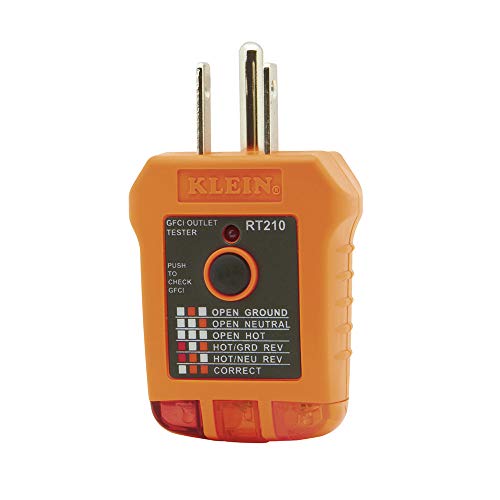
Klein Tools RT210
Three LEDs, a printed fault legend and a GFCI test button that actually trips the outlet.
| Product | Best For | Key Spec | Rating |
|---|---|---|---|
| Klein Tools RT210 | Overall / GFCI Testing | 6 wiring conditions + GFCI trip | 4.8 / 5 |
| Sperry Instruments GFI6302 | Budget | 7 wiring conditions + GFCI trip | 4.6 / 5 |
| Fluke ST120+ | Professional / Durability | Rugged GFCI socket tester | 4.6 / 5 |
| Klein Tools RT250 | Seeing actual voltage | LCD line-voltage readout | 4.7 / 5 |
| Gardner Bender GFI-3501 | Compact / drawer tool | Pocket-sized 3-light body | 4.4 / 5 |
Klein Tools RT210
Best Overall Socket TesterPros
- Covers the six wiring conditions homeowners actually hit
- GFCI test button genuinely trips the receptacle
- Tough molded housing, standard Klein build
Cons
- Lights and legend take a moment to learn
- Costs more than a plain three-light tester
The Klein Tools RT210 is the default recommendation for residential outlet testing in the US. It uses three indicator lights rather than a screen, and the light pattern is decoded by the legend printed on the body: correct wiring, open ground, open neutral, open hot, hot and ground reversed, and hot and neutral reversed. That is six conditions, which covers essentially everything a homeowner will run into.
The GFCI test button is the reason to pick it over a basic tester. Pressing it creates a small controlled leakage to ground, which should trip a working GFCI receptacle or a GFCI breaker feeding that circuit. That is the only practical way to confirm ground fault protection is live on bathroom, kitchen, garage and outdoor outlets. Note that on a correctly wired outlet with no ground, the GFCI test will not work, which is normal rather than a defect.
Sperry Instruments GFI6302
Best Budget Socket TesterPros
- Usually the cheapest tester that still trips GFCIs
- Reads seven wiring conditions
- Wiring legend molded into the case
Cons
- Lighter build than pro-grade testers
- Small LEDs are harder to read in bright daylight
The Sperry Instruments GFI6302 is the budget pick that does not force you to give up the feature that matters. It indicates seven wiring conditions and includes a GFCI test button, so it does the same core job as testers costing several times more. For a tool that lives in a kitchen drawer and gets used a few times a year, that is the right trade.
The compromise is build quality rather than function. The housing is lighter and the LEDs are smaller than the Klein, so it is less pleasant to use all day on a job site. For a homeowner checking outlets after a remodel, moving into a new place, or verifying a newly installed receptacle, it is plenty.
Fluke ST120+
Best Professional Socket TesterPros
- Built to survive daily professional use
- GFCI trip test on a compact body
- Fluke service and support behind it
Cons
- Costs more than any homeowner needs to spend
- No numeric voltage display
The Fluke ST120+ is the tester to buy if outlet checks are part of your job rather than an occasional chore. It performs the same wiring-fault indication and GFCI trip test as the others, but in a housing designed for a tool bag that gets thrown in a van every day. Fluke back-up and availability of replacements is a genuine consideration for trade use.
For a homeowner, the honest answer is that it does not test anything the Klein RT210 misses. You are paying for durability, brand support and the confidence that a tester used dozens of times a week keeps reading accurately. If it is going in a drawer instead, buy one of the cheaper picks.
Klein Tools RT250
Best for Seeing Actual VoltagePros
- LCD shows the actual line voltage at the outlet
- GFCI test button included
- Useful for chasing voltage-drop complaints
Cons
- More expensive than the RT210
- Bulkier than a plain three-light tester
The Klein Tools RT250 is the RT210 with a screen. Alongside the wiring-fault indication and GFCI test button, it displays the line voltage present at the receptacle, so you can see whether an outlet is sitting near a healthy 120V or sagging under load. Standard three-light testers cannot tell you that at all.
That readout is genuinely useful if you are troubleshooting dimming lights, a long run of undersized wire, or an outlet on an overloaded circuit. If none of that applies to you, the extra cost buys a number you will glance at once. Most homeowners are better served by the RT210.
Gardner Bender GFI-3501
Best Compact Socket TesterPros
- Small enough for a pocket or glovebox
- Simple plug-in-and-read operation
- Widely stocked and inexpensive
Cons
- Basic indication compared with the Klein testers
- Small legend text is hard to read in dim light
The Gardner Bender GFI-3501 is a compact receptacle tester with a GFCI test button, aimed at people who want the check available rather than a tool they study. Plug it in, read the light pattern against the legend, press the button on GFCI-protected outlets, and you are done.
It is the tester to keep in a second location: a truck, a rental property kit, or a toolbox that already has a bigger tester at home. Nothing about it is remarkable, which for a ten-dollar safety check is the point.
What to Check Before Buying a Socket Tester
First, check the plug. US outlets are NEMA 5-15R, the familiar 120V three-prong receptacle, and your tester must have matching blades. Testers sold under UK brands are built for BS1363 sockets and will not physically enter a US outlet, so region matters more than brand reputation here.
Second, decide whether you need the GFCI test button. If your home has GFCI receptacles in bathrooms, kitchen counters, garage, basement or outdoors, and modern code requires them there, the button is the single most valuable feature on the tool. It is the only simple way to confirm that ground fault protection still trips.
Third, match the fault coverage to your use. Basic testers indicate three or four conditions; the models above cover six or seven, including open hot, open neutral, open ground, and reversed hot/neutral or hot/ground. If the tester will live on a job site rather than in a drawer, pay for the tougher housing.
Common Mistakes to Avoid When Using a Socket Tester
The biggest mistake is treating a three-light tester as proof that an outlet is safe. These testers cannot detect a bootleg ground, where the ground screw is jumpered to neutral, and they cannot detect reversed polarity on a bootleg ground either. Both show a correct-wiring pattern. If a house has known DIY wiring, verify with a multimeter or call an electrician.
The second mistake is skipping the GFCI test. Many cheap testers have no button at all, so a dead GFCI can sit in a bathroom for years looking perfectly normal on the lights. Test GFCI outlets with the button on the tester, and also with the TEST button on the receptacle itself, about once a year.
The third is expecting a voltage reading. Except for models with an LCD such as the Klein RT250, a socket tester reports wiring conditions only, never how many volts are present. For numbers you need a multimeter.
FAQs
How does a socket tester work?
A socket tester plugs into a 120V outlet and lights a combination of LEDs based on which conductors carry voltage. You read the light pattern against the legend printed on the tester to identify correct wiring or a specific fault.
What faults can a socket tester detect?
Typical coverage is open ground, open neutral, open hot, hot and ground reversed, and hot and neutral reversed. The Klein RT210 covers six conditions including correct wiring, and the Sperry GFI6302 indicates seven.
Do I need a socket tester with GFCI testing?
Yes if you have GFCI receptacles in bathrooms, kitchens, garage, basement or outdoors. The GFCI button creates a small leakage current to ground, and a healthy GFCI should trip immediately. If it does not trip, the device needs replacing.
Can a socket tester check voltage?
Most cannot. Standard three-light testers only indicate wiring conditions. A few models, such as the Klein Tools RT250, add an LCD that displays the line voltage at the outlet.
Are socket testers safe to use?
Yes. They plug into the outlet like any appliance, with no exposed conductors to touch, and are insulated for normal 120V household use. Follow the manufacturer instructions and do not use a cracked or damaged tester.
What does a reversed polarity reading mean?
It means hot and neutral are swapped at the outlet. Appliances can then stay energized internally even when switched off, which is a shock hazard. It is a common fault in DIY wiring and should be corrected.
Can I use a socket tester on a 3-prong outlet?
Yes, that is exactly what they are built for. On a two-prong ungrounded outlet a three-prong tester will not fit, and there is no ground for it to evaluate.
Why does my socket tester show a fault on a new outlet?
Usually a loose terminal screw, a back-stabbed conductor that did not seat, or hot and neutral landed on the wrong side. Kill the breaker, pull the receptacle and check the terminations before assuming the tester is wrong.
Why does the GFCI test button do nothing on some outlets?
The tester needs a real ground path to create the leakage current. On an outlet with an open ground, or on a GFCI protecting an ungrounded circuit, the button will not trip it. Use the TEST button on the GFCI device itself instead.
What is the difference between a socket tester and a multimeter?
A socket tester is a fast pass/fail check on receptacle wiring. A multimeter measures actual voltage, continuity and resistance, so it can confirm what a tester only hints at, including problems like a bootleg ground.
Our verdict
For most US homeowners the Klein Tools RT210 is the best socket tester: six wiring conditions, a GFCI trip button that works, and a housing that survives a tool bag. On a tight budget the Sperry Instruments GFI6302 gives you seven conditions and the same GFCI test for a fraction of the price. Only buy the Fluke ST120+ if you test outlets for a living, and the Klein RT250 if you specifically want a voltage number on screen.