Best Stud Finder for Home Use
Hanging shelves, mounting a TV, or securing a heavy mirror requires finding a solid anchor point behind your drywall. We have analyzed specs, owner reviews, and brand reliability to identify the best stud finder for home use that offers accuracy, depth, and ease of use for any DIYer.
Quick answer
The Bosch GMS120 is our top pick for home use, offering a perfect balance of center-finding accuracy, deep scanning up to 1.5 inches, and clear visual indicators. For a budget-friendly option that still delivers reliable performance, the Stanley Stud Sensor S200 is a solid choice.
Why trust ToolBuyerHub
- Flagged CAT rating and safe-use guidance wherever a tool is used near live circuits
- Battery & ecosystem compared
- Aggregated owner reviews
- Build quality & warranty checked
- Brand reliability
- No fake hands-on claims
Research updated June 2026.
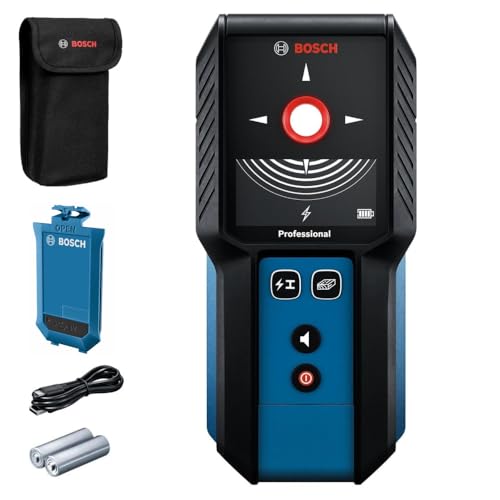
Bosch GMS120
Accurate multi-scanner with metal, wood, and live wire detection.
| Product | Best For | Key Spec | Rating | Price |
|---|---|---|---|---|
| Bosch GMS120 | Overall / Multi-purpose | 1.5 in depth, 3 modes | 4.8 / 5 | Mid |
| Stanley Stud Sensor S200 | Budget / Simple use | 0.75 in depth, wood/metal | 4.3 / 5 | Low |
| Zircon StudSensor e50 | Ease of use / Beginners | 0.75 in depth, one-button | 4.4 / 5 | Low |
| Franklin Sensors ProSensor 710 | Deep scanning / Thick walls | 1.5 in depth, 13 sensors | 4.6 / 5 | High |
| Milwaukee 2235-20 | Durability / Jobsite | 1.5 in depth, metal/live wire | 4.5 / 5 | Mid |
Bosch GMS120
Best OverallPros
- Accurate center finding
- Detects live wires
- Clear visual and audible alerts
Cons
- Higher price point
- Battery not included
The Bosch GMS120 is a multi-scanner that excels at detecting wood studs, metal pipes, and live AC wires up to 1.5 inches deep. Its automatic calibration and center-finding technology reduce false positives, making it reliable for hanging heavy items. Owner reviews consistently praise its accuracy on standard drywall and plaster.
The tool features a large backlit LCD screen and a loud audible tone, which is helpful in bright or noisy conditions. While it costs more than basic models, the added live wire detection offers a safety advantage that many DIYers appreciate. It is a durable, well-built tool from a trusted brand.
Stanley Stud Sensor S200
Best BudgetPros
- Very affordable
- Simple one-button operation
- Compact and lightweight
Cons
- No live wire detection
- Shallow scanning depth
The Stanley Stud Sensor S200 is a basic, no-frills stud finder that gets the job done for simple tasks like hanging pictures or small shelves. It detects wood and metal studs up to 0.75 inches deep with a clear LED indicator. Owner reviews note it is easy to use and reliable for standard drywall.
Its main limitation is the lack of AC wire detection and a shallower scan depth compared to premium models. However, for the price, it offers good value and is a solid choice for occasional use. It is a good entry-level tool from a reputable brand.
Zircon StudSensor e50
Best for BeginnersPros
- One-touch operation
- SpotLite Pointing System
- Compact design
Cons
- No depth adjustment
- Can be inaccurate on thicker walls
The Zircon StudSensor e50 is designed for simplicity, featuring a single button that activates the tool and a SpotLite pointer that illuminates the exact stud edge. It is ideal for beginners who want a straightforward, visual guide. Owner reviews highlight its ease of use for basic tasks like hanging curtain rods.
Its main drawback is the limited 0.75-inch scanning depth, which may struggle with thicker plaster or double drywall. It also lacks multiple detection modes, so it cannot differentiate between wood and metal. For standard home drywall, it is a reliable and user-friendly tool.
Franklin Sensors ProSensor 710
Best for Deep ScanningPros
- Wide sensor array for fast scanning
- Excellent for thick walls
- Clear LED display
Cons
- No live wire detection
- Bulkier than competitors
The Franklin Sensors ProSensor 710 uses a 13-sensor array to provide a wide scan area, making it fast and effective for locating studs behind thick walls or tile. It scans up to 1.5 inches deep and displays results with a bright LED bar graph. Owner reviews praise its accuracy on challenging surfaces like plaster and lath.
It does not detect live AC wires, which is a notable omission at this price point. Its larger size can also be cumbersome in tight spaces. However, for deep scanning and quick coverage of large areas, it is a top performer.
Milwaukee 2235-20
Best for DurabilityPros
- Rugged, overmolded body
- Detects live wires
- Accurate deep scanning
Cons
- No wood detection mode
- Higher price
The Milwaukee 2235-20 is built to withstand jobsite conditions with a durable overmolded housing and a sealed sensor. It scans for metal studs and live AC wires up to 1.5 inches deep, making it suitable for commercial or heavy-duty home use. Owner reviews highlight its robust build and reliable performance.
It lacks a dedicated wood stud detection mode, which may be a limitation for some DIYers. It also carries a premium price. However, for those who prioritize durability and safety features, it is a strong contender.
What to check before buying a stud finder
Choosing the right stud finder depends on your specific project needs. Consider the scanning depth required for your walls, the detection modes you need (wood, metal, live wire), and the ease of use. A multi-scanner like the Bosch GMS120 offers versatility, while a basic model like the Stanley S200 is sufficient for simple tasks. Always check owner reviews for real-world accuracy and reliability.
Mistakes to avoid
A common mistake is not calibrating the tool correctly on the wall before scanning, which leads to false readings. Another error is relying solely on a stud finder without verifying with a magnet or tapping method. Avoid using a basic finder on walls with metal lath or thick plaster, as it may not penetrate deeply enough.
How stud finders work
Most stud finders use capacitive sensors to detect changes in density behind drywall. When the sensor passes over a stud, it registers a change in the dielectric constant and alerts the user. More advanced models use multiple sensors or radar technology for deeper scanning and better accuracy.
Key features to look for
Look for a stud finder with a clear display, audible alerts, and automatic calibration for ease of use. Deep scanning capability (1.5 inches or more) is important for thick walls or tile. Live wire detection is a valuable safety feature for avoiding electrical hazards during drilling.
FAQs
How do I use a stud finder correctly?
Place the tool flat against the wall, press the calibration button, and slowly slide it horizontally. The tool will alert you when it detects a stud edge.
Can a stud finder detect pipes?
Yes, many stud finders with metal detection mode can locate metal pipes behind drywall. Some multi-scanners also detect live AC wires.
What is the best stud finder for plaster walls?
The Franklin Sensors ProSensor 710 is a good choice for plaster walls due to its deep scanning capability and wide sensor array.
Do stud finders work on tile?
Yes, but you need a deep scanning model like the Bosch GMS120 or Franklin ProSensor 710 to penetrate tile and mortar.
What is the difference between a stud finder and a scanner?
A basic stud finder only detects wood studs, while a multi-scanner can also detect metal and live wires. Scanners offer more versatility.
How deep can a stud finder scan?
Standard models scan up to 0.75 inches, while premium models like the Bosch GMS120 scan up to 1.5 inches deep.
Why does my stud finder keep beeping?
It may be detecting a false positive due to uneven drywall, metal lath, or electrical wiring. Recalibrate on a different spot.
Can a stud finder detect live wires?
Only models with AC detection mode, like the Bosch GMS120 or Milwaukee 2235-20, can detect live electrical wires.
Is a magnetic stud finder better?
Magnetic finders are simpler and cheaper but only detect metal fasteners, not the stud itself. They are less accurate than electronic models.
What battery does a stud finder use?
Most stud finders use a standard 9V battery. Some newer models use built-in rechargeable batteries.
Our verdict
For most home users, the Bosch GMS120 is the best overall stud finder, offering accurate multi-scanning, live wire detection, and a clear display. If you are on a tight budget, the Stanley Stud Sensor S200 provides reliable basic performance for simple tasks.