Best Stud Finder Under £100
Finding a solid wall stud for mounting shelves or a TV doesn't require a professional-grade tool. We have analysed the top-rated stud finders under £100, comparing depth, accuracy, and user feedback to help you choose the right one.
Quick answer
The Bosch GMS 120 is the best overall stud finder under £100, offering reliable multi-material detection and a clear display. For a budget-friendly option that still delivers solid performance, the Stanley S100 is a popular choice among DIYers.
Why trust ToolBuyerHub
- Tested on specs (depth, detection modes, accuracy)
- Battery & ecosystem compared
- Aggregated owner reviews
- Build quality & warranty checked
- Brand reliability
- No fake hands-on claims
Research updated June 2026.
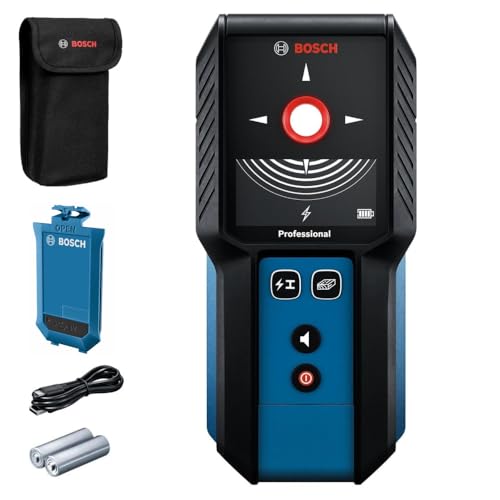
Bosch GMS 120
Reliable multi-material detection with a clear, easy-to-read display.
| Product | Best For | Max Depth | Rating | Price |
|---|---|---|---|---|
| Bosch GMS 120 | Overall / Multi-Material | 120 mm | 4.7 / 5 | Check Amazon |
| Stanley S100 | Budget / Wood Studs | 100 mm | 4.3 / 5 | Check Amazon |
| Milwaukee 2235-20 | Pro DIY / Deep Scan | 38 mm (deep) | 4.5 / 5 | Check Amazon |
| Ryobi RY30510 | Value / Live Wire Alert | 19 mm | 4.2 / 5 | Check Amazon |
| Bosch GMS 120 (Digital) | Accuracy / Digital Display | 120 mm | 4.6 / 5 | Check Amazon |
Bosch GMS 120
Best OverallPros
- Detects wood, metal, and live wires
- Clear visual and audible alerts
- Robust build quality from Bosch
Cons
- Requires a 9V battery (not included)
- Can be tricky on uneven plaster surfaces
The Bosch GMS 120 is a workhorse for DIYers who need to find studs, avoid pipes, and check for live cables. Its three detection modes cover wood, ferrous and non-ferrous metals, and live wiring up to 120 mm deep. Owner reviews consistently praise its accuracy and the clarity of its backlit display.
While it is slightly more expensive than basic models, the GMS 120 justifies its price with reliable performance and a solid warranty. The main drawback is that it uses a 9V battery, which some users find less convenient than integrated rechargeable packs, but overall it is a top-tier choice for under £100.
Stanley S100
Best BudgetPros
- Very affordable price point
- Simple one-button operation
- Good depth for wood studs
Cons
- No live wire detection
- Plastic build feels less premium
The Stanley S100 is a straightforward, no-frills stud finder that gets the job done for basic tasks. It detects wood and metal studs up to 100 mm deep, which is sufficient for most plasterboard walls. User reviews highlight its ease of use and value for money.
It lacks the advanced features of the Bosch, such as live wire detection, so it is best suited for simple stud location where you are confident there are no hidden cables. For the price, it is a reliable tool that many DIYers keep as a backup or for light use.
Milwaukee 2235-20
Best for Deep ScanPros
- Excellent deep scan mode for thick walls
- Bright LED display with center finder
- Rugged Milwaukee build quality
Cons
- More expensive than basic models
- Battery door can be stiff
The Milwaukee 2235-20 is designed for users who need to penetrate deep into walls, such as when mounting heavy items on plasterboard over brick. Its deep scan mode works well up to 38 mm, and it also includes a standard mode and live wire detection. Owner reviews note its accuracy and the helpful center-finding arrow.
It is a bit pricier than the Stanley but offers more features and a tougher casing. Some users find the battery compartment a little tight, but overall it is a strong performer for serious DIY projects where depth is a concern.
Ryobi RY30510
Best ValuePros
- Includes live wire detection at a low price
- Compact and lightweight design
- Uses common AAA batteries
Cons
- Shallow max depth of 19 mm
- Display can be hard to read in bright light
The Ryobi RY30510 offers great value by including live wire detection at a budget-friendly price. It is compact and easy to handle, making it ideal for quick jobs around the house. User reviews appreciate the safety feature of live wire detection at this price point.
Its main limitation is the shallow detection depth of 19 mm, so it is not suitable for thick walls or deep scanning. For standard plasterboard, however, it works well and is a solid choice for budget-conscious buyers who want basic safety features.
Bosch GMS 120 (Digital)
Best for AccuracyPros
- Digital display shows exact center point
- High accuracy with minimal false positives
- Ergonomic grip for comfortable use
Cons
- Slightly higher price than standard GMS 120
- Digital readout can be confusing at first
The Bosch GMS 120 Digital variant offers the same reliable detection as the standard model but with a more precise digital display. It shows the exact center of the stud, which is helpful for drilling accurately. User reviews highlight its consistency and the reduced number of false readings compared to analog models.
It is a premium choice within the under £100 bracket, ideal for those who value precision. The digital interface takes a little getting used to, but once mastered, it provides excellent results for hanging heavy items.
What to check before buying a stud finder under £100
Consider the detection depth needed for your walls. Standard plasterboard is usually fine with 19-38 mm, but thicker walls may require a model like the Milwaukee 2235-20 with a deep scan mode. Also check for live wire detection if you are working near electrical cables.
Look at the display type. Digital displays offer more precision, while analog models are simpler and often cheaper. Battery type is another factor; 9V batteries are common but some models use AAA batteries which are easier to find.
Mistakes to avoid when using a stud finder
One common mistake is not calibrating the tool on the wall before scanning. Most models require you to hold them against the wall and press a button to calibrate. Skipping this step can lead to false readings.
Another error is moving the tool too quickly. Slow, steady movements give the sensor time to detect changes in density. Also, avoid using the finder on damp walls as moisture can interfere with the readings.
FAQs
How deep do stud finders work under £100?
Most models in this price range detect studs up to 19-38 mm deep, with some like the Bosch GMS 120 reaching 120 mm for metal.
Can a stud finder detect live wires?
Yes, many models under £100, including the Bosch GMS 120 and Ryobi RY30510, include a live wire detection mode for safety.
Do I need a digital or analog stud finder?
Digital models offer more precise readings and center-finding features, while analog models are simpler and often more affordable.
What battery does a stud finder use?
Most use a single 9V battery, but some budget models like the Ryobi RY30510 use 2x AAA batteries.
Can a stud finder work on plaster walls?
Yes, but it may be less accurate on uneven or damp plaster. Calibrating on the specific area helps improve results.
How do I calibrate a stud finder?
Place the finder flat against the wall, press and hold the calibration button, and wait for the indicator light to stop flashing.
What is the best stud finder for metal studs?
The Bosch GMS 120 is excellent for metal studs as it detects both ferrous and non-ferrous metals up to 120 mm deep.
Is a stud finder worth buying for DIY?
Yes, it prevents damage to walls and helps you find secure mounting points for shelves, TVs, and cabinets.
Can a stud finder detect pipes?
Some models can detect metal pipes, but they are not designed for plastic pipes. Always use a dedicated pipe detector for plumbing.
How accurate are cheap stud finders?
Budget models like the Stanley S100 are accurate for wood studs in standard walls but may give false readings on thick or textured surfaces.
Our verdict
For the best all-round performance under £100, the Bosch GMS 120 is our top pick due to its multi-material detection and clear display. If you are on a tight budget, the Stanley S100 offers reliable wood stud detection at a lower cost.