Best Wire Strippers for Small Gauge Wires
Small gauge wire work, think 22 AWG control wiring, 24 AWG thermostat cable, or 28 AWG electronics leads, punishes tools that were designed for 12 and 14 AWG house wiring. The wrong stripper nicks strands, slips off insulation, or simply has no die small enough, so this guide focuses on tools that genuinely handle the small end of the range.
Quick answer
The Klein Tools 11061 Self-Adjusting Wire Stripper is the best overall pick for small gauge work thanks to its wide jaw range and clean, repeatable stripping action.
Why trust ToolBuyerHub
- Cross-checked manufacturer-published specifications before writing any recommendation
- Verified US market availability and configuration for every model discussed
- Owner-feedback themes are summarized as feedback, never presented as our own hands-on testing
- No invented star ratings; see the visible Research Score criteria on this page
- Flagged CAT rating and safe-use guidance wherever a tool is used near live circuits
- Every pick here was checked against manufacturer-published stripping ranges, so the smallest gauge each tool actually supports is stated up front rather than assumed.
Research updated September 2026.
What Matters Most for This Category
The single most important spec is the bottom of the stripping range. Many popular strippers stop at 20 AWG or 22 AWG, which leaves 24 to 30 AWG work uncovered. Match the tool to the smallest wire you actually touch, then decide between a self-adjusting design (faster, less thinking) and a fixed-gauge or precision design (more control, better on very fine strands). Grip comfort and whether the tool also crimps or cuts matter for how often you will reach for it.
| Model | Best for | Key specs | Research Score |
|---|---|---|---|
| Klein Tools 11061 Self-Adjusting Wire Stripper | Best Overall | About 20 to 10 AWG, Self-adjusting | 94/100 |
| Klein Tools 11063W Katapult Wire Stripper | Best for Stranded Wire | About 22 to 8 AWG, Self-adjusting, spring-loaded | 91/100 |
| IRWIN VISE-GRIP Self-Adjusting Wire Stripper | Best Value | About 20 to 10 AWG, Self-adjusting | 88/100 |
| Klein Tools 1010 Long-Nose Wire Stripper | Best for Tight Spaces | About 22 to 12 AWG, Fixed-gauge, long nose | 87/100 |
| Jonard Tools ST-500 Wire Stripper | Best for Precision Electronics | Covers fine electronics gauges, Precision fixed-gauge | 86/100 |
| Klein Tools 11055 Klein-Kurve Wire Stripper | Best Ergonomic Grip | About 20 to 10 AWG, Fixed-gauge, curved handle | 85/100 |
| Capri Tools Precision Wire Stripper | Best Budget Precision | Fine gauge precision sizes, Precision fixed-gauge | 83/100 |

Klein Tools 11061 Self-Adjusting Wire Stripper
Top pickPros
- Self-adjusting jaw handles a wide range without swapping dies
- Clean strip on stranded and solid wire
- Also cuts and crimps, so it covers most small jobs
Cons
- Bottom of the range stops around 20 AWG, so 24 AWG and finer need a different tool
- Bulkier than a precision stripper
A long-running favorite for general electrical work, this self-adjusting model clamps and pulls insulation in one motion. Based on manufacturer specifications it covers roughly 20 to 10 AWG, which handles most low-voltage and control wiring but not the finest electronics leads.

Klein Tools 11063W Katapult Wire Stripper
Stranded specialistPros
- Spring-loaded jaw opens automatically for fast repeat work
- Designed to avoid nicking stranded conductors
- Comfortable for long sessions
Cons
- Not intended for the very finest gauge wire
- Larger frame than compact strippers
The Katapult design uses a spring action that opens the jaws after each strip, which speeds up repetitive work on stranded control wire. Manufacturer specs put the range at roughly 22 to 8 AWG, making it a strong fit for low-voltage and automotive small gauge jobs.

IRWIN VISE-GRIP Self-Adjusting Wire Stripper
Value pickPros
- Lower price than comparable self-adjusting strippers
- Comfortable handle for the money
- Handles common low-voltage sizes
Cons
- Fine gauge performance is limited
- Build feel is less premium than pro brands
A budget-friendly self-adjusting option that covers the common 20 to 10 AWG band. Based on owner-feedback themes it works well for occasional low-voltage projects, though it is not the tool for 26 AWG and finer.
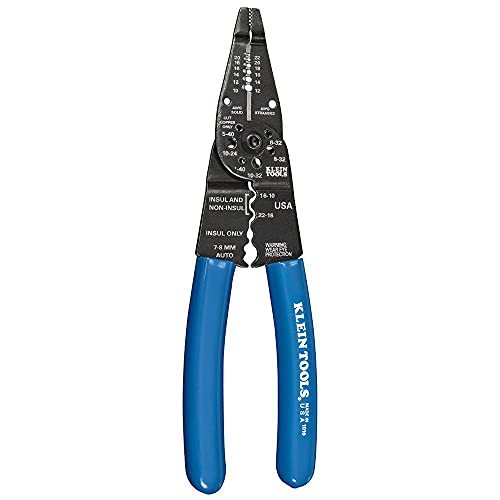
Klein Tools 1010 Long-Nose Wire Stripper
Reach pickPros
- Long nose reaches into crowded boxes and panels
- Fixed gauges give consistent strips
- Tip doubles as a light grabber
Cons
- You must match the correct gauge hole
- No self-adjusting convenience
A fixed-gauge stripper with an extended nose for getting into tight enclosures. Manufacturer specs list roughly 22 to 12 AWG, and the slim profile helps in junction boxes and control panels where a bulky self-adjusting tool will not fit.

Jonard Tools ST-500 Wire Stripper
Fine gaugePros
- Built for fine electronics wire
- Consistent, low-damage strips
- Comfortable for bench work
Cons
- Not meant for heavier building wire
- Requires selecting the right gauge
Jonard makes tools aimed at telecom and electronics bench work, and this precision stripper is built around fine conductors rather than household cable. It suits 24 to 30 AWG style work where nicking a strand is a real failure.

Klein Tools 11055 Klein-Kurve Wire Stripper
Comfort pickPros
- Curved handle reduces hand fatigue
- Multiple gauge holes plus shearing holes
- Solid, well-known build
Cons
- Fixed gauges only, no self-adjusting
- Range does not reach the finest wire
The Klein-Kurve handle is shaped to keep the wrist in a more natural position during repetitive stripping. It covers roughly 20 to 10 AWG with fixed gauge holes and adds screw-shearing holes for convenience.

Capri Tools Precision Wire Stripper
Budget fine gaugePros
- Affordable route into fine gauge stripping
- Compact and easy to store
- Clean strips on small conductors
Cons
- Limited to the gauges marked on the tool
- Not for heavier wire
A compact precision stripper aimed at small conductors at a lower price point than pro-brand equivalents. It is a sensible starter tool for hobby electronics and light low-voltage work.
Who Should Avoid the Top Pick
Skip any stripper whose published range bottoms out at 20 AWG or higher if you regularly work with 24 to 30 AWG wire, because you will end up crushing or nicking strands. Also avoid generic no-name strippers with no stated gauge range, since the marked sizes are often inaccurate and the jaws dull quickly.
Before You Buy
Confirm the smallest gauge you actually strip, then check that number against the tool's published range rather than trusting the packaging photo. Decide whether you want self-adjusting speed or fixed-gauge precision, and check whether the tool also cuts and crimps so you carry fewer tools. If you work on live-adjacent low-voltage systems, look for insulated or clearly rated handles.
FAQs
What gauge counts as small gauge wire?
In practice, small gauge usually means roughly 20 AWG and finer, with 22 to 30 AWG being the range where most general strippers start to struggle.
Can I use a standard wire stripper on 24 AWG wire?
Only if its published range reaches that low. Many common self-adjusting strippers stop around 20 AWG, so 24 AWG and finer need a precision or fine gauge tool.
Is self-adjusting or fixed-gauge better for small wire?
Self-adjusting is faster and fine for 20 to 22 AWG work, while fixed-gauge precision strippers give better control and less strand damage on very fine conductors.
Do I need a separate tool for stranded versus solid wire?
Not always, but some strippers are tuned for stranded wire and resist nicking it better. If most of your small wire is stranded, favor a tool designed for it.
Can these strippers also cut and crimp?
Several models include a cutter and crimper, which is convenient for low-voltage work, though a dedicated crimper still does a better job on terminals.
How do I avoid nicking strands on fine wire?
Use a stripper rated for that gauge, apply light pressure, and rotate slightly before pulling. A precision fixed-gauge tool reduces the risk compared with forcing a larger-gauge stripper.
Our verdict
For most small gauge jobs the Klein Tools 11061 is the safest all-round choice, while the Jonard ST-500 and Capri precision stripper cover the very fine electronics end that general tools miss. Match the tool's lowest rated gauge to your smallest wire and you will avoid the nicked-strand problem that makes small gauge work frustrating.