Klein Wire Tracing Tools Review: ET310, ET450 and NCVT-2P
Klein Tools does not sell a wall scanner that sweeps drywall for hidden cables the way a stud finder does. What Klein does make is a range of circuit-level tools: breaker finders, circuit tracers, tone-and-probe kits and non-contact voltage testers. This review explains what each one actually does so you buy the right tool instead of the wrong category.
Quick answer
If you need to follow a wire through a wall or conduit, the tool you want is the Klein ET450 circuit tracer kit, which pairs a transmitter with a receiver and works on both energized and dead wiring. If your real job is matching an outlet to its breaker, the Klein ET310 breaker finder is the cheaper, faster answer. For a pocket safety check that a wire is dead, use the NCVT-2P. None of these locate wooden studs, so buy a dedicated stud finder for that.
Why trust ToolBuyerHub
- Specs checked against manufacturer documentation
- Detection type and voltage range verified per model
- Owner feedback themes summarized, not invented
- Build quality & warranty checked
- Brand reliability
- No fake hands-on claims
Research updated August 2026.
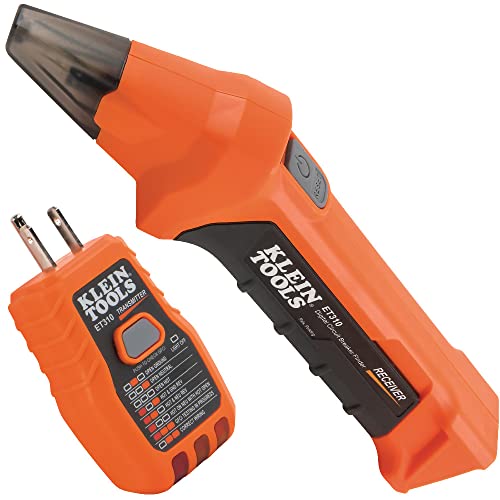
Klein Tools ET310
Plug the transmitter into an outlet, sweep the receiver across the panel, and find the breaker without guesswork.
| Model | Best For | What It Actually Does | Rating | Price |
|---|---|---|---|---|
| Klein ET450 | Tracing wires in walls | Transmitter + receiver, live or dead wiring | 4.6/5 | $$$ |
| Klein ET310 | Matching outlet to breaker | Breaker finder, 90-120V AC, GFCI test | 4.7/5 | $$ |
| Klein VDV500-820 | Coax and data cables | Tone generator + probe, RJ45/RJ11/coax | 4.5/5 | $$ |
| Klein NCVT-2P | Pocket safety check | Non-contact AC, dual range 12-1000V | 4.3/5 | $ |
| Klein RT210 | Checking the outlet itself | GFCI receptacle tester with LCD readout | 4.4/5 | $ |
Klein Tools ET450
Best for Tracing Wires in WallsPros
- Traces both energized and dead wiring
- Transmitter and receiver included
- Adjustable sensitivity cuts through interference
Cons
- Costs several times more than a voltage pen
- Requires setup and a learning curve
The ET450 is Klein's advanced circuit tracer kit. You clip or plug the transmitter onto the conductor you care about, then sweep the receiver along the wall, conduit or panel to follow that specific signal. Unlike a non-contact voltage pen, it works on de-energized wiring too, which is what makes it useful for chasing a dead run, an unlabeled circuit or a break.
Owner feedback centers on the same two themes: it does genuinely follow a conductor through drywall and conduit, and the sensitivity dial matters. Turn it too high in a panel full of parallel runs and everything reads hot, so most of the skill is in dialing it back until only one path responds.
Klein Tools ET310
Best Breaker FinderPros
- Finds the right breaker in one pass
- Built-in GFCI outlet tester saves a second tool
- Compact and durable build
Cons
- Does not trace cable runs inside walls
- Standard 120V branch circuits only
The ET310 is an AC circuit breaker finder, not a wall scanner. The transmitter plugs into a standard 120V outlet and injects a signal onto that branch circuit; you then sweep the handheld receiver down the breaker panel until it identifies which breaker feeds it. Klein rates it for 90 to 120V AC circuits, which covers normal North American residential and light commercial receptacle work.
The integrated GFCI outlet tester is the quiet value here. Before you go looking for a breaker, it tells you whether the receptacle is wired correctly and whether GFCI protection actually trips, which frequently ends the troubleshooting right there.
Klein Tools VDV500-820
Best for Coax & DataPros
- Isolates one cable out of a large bundle
- Simple operation, clear audible tone
- Durable Klein build
Cons
- No AC voltage detection at all
- Low-voltage cabling only
The VDV500-820 is a tone-and-probe kit for low-voltage cabling. The tone generator connects to one end of a coax, Ethernet or telephone run using the supplied leads, and the probe picks that tone out of a bundle at the other end. This is the standard method for identifying an unlabeled drop at a patch panel or wall plate.
Owner feedback is consistently about time saved rather than raw performance: it turns a guessing game at the patch panel into a thirty-second job. It is not a voltage tester, so it should never be your safety check before touching a conductor.
Klein Tools NCVT-2P
Best Pocket Voltage TesterPros
- Dual range covers low-voltage and mains
- Pocket-sized with a pen clip
- Bright LED plus audible alert
Cons
- Cannot follow a cable run
- Can false-trigger near parallel conductors
The NCVT-2P is a dual-range non-contact voltage tester. A button switches it between a low range of roughly 12 to 48V AC for doorbell, thermostat and landscape lighting circuits, and a high range of roughly 48 to 1000V AC for standard mains work. That dual range is the whole point of the "2P" over Klein's single-range pens, which ignore low-voltage circuits entirely.
It runs on two AAA batteries and gives both an LED and a beep on detection. Owners rate it for what it is, a fast confirmation that a conductor is dead before you touch it, and complain when they expect more from it than that. Like every non-contact tester, it can pick up induced voltage from a neighboring conductor, so confirm with a contact meter before working live.
Klein Tools RT210
Best Outlet and GFCI CheckPros
- LCD shows actual outlet voltage, not just lights
- Tests GFCI trip function
- Inexpensive and pocketable
Cons
- Not a cable or wire tracer in any sense
- Only works at the receptacle
The RT210 is a GFCI receptacle tester with an LCD display. Plug it into a standard three-prong outlet and it reports common wiring faults such as open ground, open neutral, hot/neutral reverse and hot/ground reverse, shows the measured voltage on screen, and has a button to trip GFCI protection.
It is included here because it belongs at the start of the same troubleshooting sequence, not because it locates anything behind a wall. Before you buy a tracer to hunt a fault, this tells you whether the problem is at the outlet itself, which it often is.
What to Check Before Buying
The first decision is category, not model. A breaker finder like the ET310 tells you which breaker feeds an outlet. A circuit tracer like the ET450 follows a specific conductor through a wall. A tone-and-probe kit like the VDV500-820 identifies a data or coax run in a bundle. A non-contact tester like the NCVT-2P only tells you whether a conductor is live. Buying the wrong category is the single most common mistake here, and no amount of brand quality fixes it.
Second, check the voltage range against your actual work. The ET310 is specified for 90 to 120V AC branch circuits. The ET450 is built for use around energized circuits up to 600V AC. The NCVT-2P covers 12 to 1000V AC across its two ranges. The VDV500-820 has no voltage detection function at all. Klein's test and measurement instruments carry a 2-year limited warranty, separate from the lifetime warranty on the hand tools the brand is better known for.
Klein Does Not Make a Wall Stud Scanner
If you arrived here looking for a Klein tool that sweeps drywall and shows studs, pipes and live wires on a display, that product does not exist in the range. The closest Klein offering is a simple magnetic stud finder that locates the screws and nails in the framing rather than scanning electronically. For electronic multi-material wall scanning, the established options come from other brands.
This matters for safety. Several listings and roundups describe Klein circuit-level tools as if they scan walls, which leads people to sweep an ET310 receiver across drywall and conclude there is no wiring there. It is not designed for that and gives no meaningful reading in that use.
Mistakes to Avoid
Always verify the tool on a known live source before trusting a negative result. A flat battery in a non-contact tester produces exactly the same silence as a dead circuit, and that assumption is how people get hurt.
Do not rely on a non-contact tester through metal conduit, armored cable or foil-shielded runs. The shielding is doing its job and suppressing the field the tester is looking for. In the other direction, a non-contact tester held near a bundle of parallel conductors can pick up induced voltage from a neighboring live wire and beep on a conductor that is actually dead. Confirm with a contact meter before you work on it.
Who These Tools Are For
Klein's test instruments are aimed at electricians, low-voltage technicians and serious DIYers who want a tool that survives a job site. Homeowners doing occasional wiring will get the most value from the NCVT-2P and the RT210, which together cover the two questions that come up most: is this live, and is this outlet wired correctly.
Professionals chasing unlabeled circuits or faults will want the ET450, and anyone running network or coax should own a tone-and-probe kit. Klein is not the cheapest brand in this space, but the instruments hold calibration and survive drops, which is what justifies the price over the long run.
Alternatives Worth Considering
For actual wall scanning, which Klein does not cover, the Bosch GMS 120 digital multi-scanner detects wood, ferrous and non-ferrous metal and live wiring, with wood detection to around 1.5 inches. The Franklin Sensors ProSensor 710+ is the accuracy benchmark for stud location specifically, using a row of sensors that shows stud edges and width in one pass rather than requiring a slow sweep. Zircon's MultiScanner line is the widely available middle ground and includes live AC warning.
For circuit tracing, the Fluke 2042 cable locator is the main professional alternative to the ET450, with a transmitter and receiver pair that works on energized and de-energized runs. For a straight non-contact voltage pen, the Fluke 1AC-II VoltAlert is the long-standing competitor to the NCVT range.
FAQs
Does Klein make a cable detector for walls?
Not in the wall-scanner sense. Klein makes breaker finders, circuit tracers, tone-and-probe kits and non-contact voltage testers. For sweeping drywall to map studs, pipes and wiring, you need a scanner from a brand such as Bosch, Zircon or Franklin Sensors.
What does the Klein ET310 actually do?
It is an AC circuit breaker finder with an integrated GFCI outlet tester. The transmitter plugs into a 120V outlet and the receiver identifies which breaker in the panel feeds that outlet. It does not locate wiring inside walls and it does not find studs.
What is the difference between the ET310 and the ET450?
The ET310 matches an outlet to its breaker on standard 90 to 120V AC circuits. The ET450 is a full circuit tracer kit that follows a specific conductor through walls and conduit, and works on de-energized wiring as well as live.
Is the Klein RT210 a stud finder?
No. The RT210 is a GFCI receptacle tester with an LCD display. It checks outlet wiring faults, shows voltage and trips GFCI protection. It has no stud, metal or wall-scanning function.
What voltage range does the NCVT-2P cover?
It is dual range: roughly 12 to 48V AC on the low setting for low-voltage circuits, and roughly 48 to 1000V AC on the high setting for mains work. A button switches between them.
Can these tools find wires in concrete?
A circuit tracer such as the ET450 can often follow a conductor buried in concrete because it is tracking an injected signal. A non-contact voltage pen generally cannot, as the depth and material attenuate the field it senses.
How do I test that my voltage tester is working?
Hold the tip against a known live outlet or cord before each use. It should light and beep. If it does not, replace the batteries before you trust any negative reading.
What batteries do Klein testers use?
It varies by model. The NCVT-2P uses two AAA cells. The breaker finder and tone generator style tools generally use a 9V battery. Check the manual for your specific model.
Can any of these find plastic pipes?
No. None of these tools detect plastic. Circuit tracers follow conductors, tone kits follow signal cables, and voltage testers sense electric fields. Plastic pipe requires a dedicated pipe locator with a sonde.
What warranty do Klein test instruments carry?
Klein's test and measurement instruments carry a 2-year limited warranty. That is separate from the lifetime warranty on the brand's hand tools, so do not assume one covers the other.
Our verdict
If the job is genuinely tracing a cable through a wall, the Klein ET450 circuit tracer kit is the only tool here that does it, and it is worth the higher price for that reason alone. For the far more common job of matching an outlet to its breaker, the ET310 is the better buy. Add an NCVT-2P for pocket safety checks and an RT210 for outlet faults, and use a Bosch, Zircon or Franklin Sensors scanner for anything that involves sweeping a wall.