Best Air Compressor for Home Garage
Choosing the best air compressor for your home garage means balancing tank size, SCFM output, and noise. The spec that decides everything is SCFM at 90 PSI, because that is the number your impact wrench, nailer, or spray gun actually draws. Below are five real models compared on their published figures for inflating tires, running air tools, and spraying.
Quick answer
The DeWalt D55168 is the best overall air compressor for a home garage: a 15-gallon vertical tank, 200 PSI max pressure, and roughly 5.0 SCFM at 90 PSI, which is enough air to keep an impact wrench or ratchet working instead of waiting on the pump. For a budget option, the Craftsman CMEC6150K gives you a 6-gallon pancake at 150 PSI and 2.6 SCFM at 90 PSI, which covers inflation and nailers.
Why trust ToolBuyerHub
- Compared on published specs (tank, max PSI, SCFM at 90 PSI, dBA)
- Oil-free vs oil-lubricated trade-offs explained
- Common owner-reported themes noted, not counted as statistics
- Pump type, duty cycle & warranty checked
- Brand reliability
- No fake hands-on claims
Research updated June 2026.
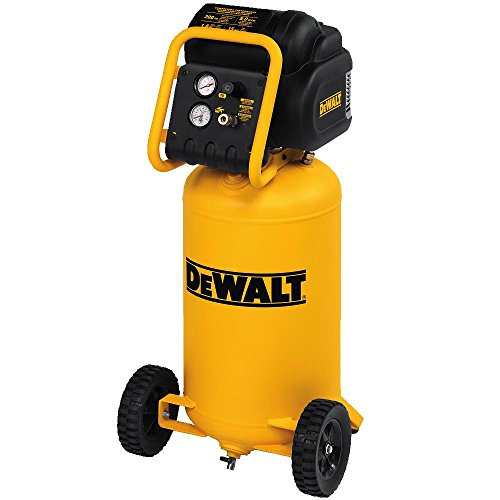
DeWalt D55168
The most usable air supply here for real garage work.
| Product | Best For | Key Spec | Rating | Price |
|---|---|---|---|---|
| DeWalt D55168 | Overall | 15 gal / 200 PSI / 5.0 SCFM | 4.7/5 | $$$ |
| Makita MAC2400 | Heavy Duty | 4.2 gal / 130 PSI / 4.2 CFM | 4.6/5 | $$$ |
| Craftsman CMEC6150K | Budget | 6 gal / 150 PSI / 2.6 SCFM | 4.4/5 | $ |
| California Air Tools 2010A | Ultra Quiet | 2 gal / 120 PSI / 2.2 CFM | 4.5/5 | $$ |
| Bostitch BTFP02012 | Portability | 6 gal / 150 PSI / 2.6 SCFM | 4.5/5 | $ |
DeWalt D55168
Best OverallPros
- 200 PSI max, so the 15-gallon tank stores far more usable air
- About 5.0 SCFM at 90 PSI runs impact wrenches and ratchets
- Oil-free pump, no oil changes
Cons
- Heavy at roughly 90 lbs, even with the wheels
- Not a quiet compressor at about 78 dBA
- Vertical tank needs dedicated floor space
The DeWalt D55168 is an oil-free vertical compressor rated at about 5.0 SCFM at 90 PSI, which is the point where a compressor stops being an inflator and starts being an air supply. Combined with the 15-gallon tank and 200 PSI max pressure, it stores enough compressed air that a 1/2-inch impact wrench can break lugs loose without you standing around waiting for the pump to catch up.
Owners commonly point to the high storage pressure and the wheel-and-handle setup as the reasons they picked it over a pancake. It is still a loud oil-free unit and it weighs around 90 lbs, so treat it as something you roll into a corner of the garage and leave there, not something you carry up a ladder.
Makita MAC2400
Best Heavy DutyPros
- Cast iron Big Bore pump built for repeat use
- 4.2 CFM at 90 PSI, strong for a twin-stack
- Long lifespan with routine oil changes
Cons
- Only 130 PSI max, so the small tank empties faster
- Requires regular oil checks and changes
- Around 80 lbs and awkward without wheels
The Makita MAC2400 is a big-bore cast iron pump compressor built for heavy use. It delivers 4.2 CFM at 90 PSI, making it suitable for framing nailers and short bursts on grinders. The 4.2-gallon twin-stack tank recovers quickly, though at 130 PSI max it stores less air than a 200 PSI unit of similar size.
Owner reviews highlight its industrial build quality and consistent recovery. The trade-off is noise at 79 dBA, so ear protection is sensible, plus the oil maintenance. The cast iron pump is the reason people keep these running for years.
Craftsman CMEC6150K
Best BudgetPros
- Cheapest sensible way into garage air
- Light at about 32 lbs, easy to shelve
- Oil-free pump, usually sold with a hose and accessory kit
Cons
- 2.6 SCFM will not sustain an impact wrench or sander
- Cycles often once you start using air continuously
The Craftsman CMEC6150K is an entry-level oil-free pancake compressor for inflating tires, blowing out dust, and running brad and finish nailers. The 6-gallon tank and 150 PSI max pressure are fine for intermittent work, and the whole unit weighs about 32 lbs so it stores on a shelf rather than eating floor space.
The honest limit is the 2.6 SCFM at 90 PSI. That is enough for a nailer that fires in short bursts, but a sander, a die grinder, or a 1/2-inch impact wrench will drain the tank faster than the pump refills it. Buy this one if air is an occasional need, not a daily one.

California Air Tools 2010A
Best Ultra QuietPros
- Rated 60 dBA, roughly half as loud as a pancake to the ear
- Oil-free low-RPM pump, very low vibration
- Light at about 35 lbs with an aluminium tank
Cons
- 120 PSI max and 2.2 CFM rule out high-demand tools
- 2-gallon tank means frequent cycling on longer jobs
The California Air Tools 2010A is built for noise-sensitive spaces. Its rated 60 dBA is about the level of ordinary conversation and well below the high-70s of a typical oil-free pancake, which is what makes it usable in a garage attached to living space or a shared building. It delivers 2.2 CFM at 90 PSI, enough for brad nailers, airbrushing, and inflation.
Owners consistently mention the low noise and how little it vibrates across the floor. The trade-off is power: with a 120 PSI ceiling and a 2-gallon tank, it cannot feed an impact wrench or a sander. It suits hobbyists who value quiet over raw output.
Bostitch BTFP02012
Best PortabilityPros
- Only about 29 lbs, the lightest 6-gallon here
- High-efficiency motor designed to start in cold weather
- Two universal couplers, so two people can work at once
Cons
- 2.6 SCFM at 90 PSI, same intermittent-use limit as any pancake
- 78.5 dBA is loud in an enclosed garage
The Bostitch BTFP02012 pairs a 6-gallon tank with an oil-free pump rated at 2.6 SCFM at 90 PSI. What sets it apart from other pancakes is weight: at roughly 29 lbs it is genuinely one-hand portable, and the high-efficiency motor is specified to start in cold weather and on an extension cord, which matters in an unheated garage.
Owners like the two couplers and the low weight, and they note the same limitation every pancake shares: it is a nailer and inflation compressor, not something that will keep a sander fed. At 78.5 dBA it is as loud as the rest of the class.
What to check before buying an air compressor for your home garage
SCFM at 90 PSI is the most important spec. It tells you how much air the compressor can actually deliver at working pressure. Brad and finish nailers need well under 1 SCFM because they fire in bursts, impact wrenches typically want 4 to 5 SCFM, and sanders or die grinders can ask for 6 or more continuously. Match the compressor to your most demanding tool, not your average one.
Tank size and max pressure work together. A tank at 200 PSI holds far more usable air than the same tank at 130 PSI, which is why the 15-gallon, 200 PSI DeWalt gives longer run time than the numbers alone suggest. A 2 to 6-gallon tank is fine for nailers and inflation. Bigger tanks also reduce motor cycling, which extends pump life.
Noise is measured in dBA, and the honest picture is that most portable compressors are loud: typical oil-free pancakes and twin-stacks land in the high 70s regardless of pump type. Oil-lubricated cast iron pumps are usually a little smoother, but the Makita here is still 79 dBA. The only genuinely quiet machines are purpose-built low-RPM units like the California Air Tools at 60 dBA, and they trade away CFM to get there.
Mistakes to avoid when choosing a garage air compressor
Do not ignore the duty cycle. Many portable compressors are rated for a 50% or 75% duty cycle, meaning they need to rest. Continuous-use tools like spray guns and sanders want a compressor with a high duty cycle and a larger tank, not a pancake.
Avoid buying a compressor with too little CFM for your tools. A 2.6 SCFM pancake will struggle with an impact wrench that wants 4 to 5 SCFM: it will work for a few seconds, then you wait. Check the tool's air consumption before buying. Also, watch the power source. Every model on this list runs on a standard 120V outlet, but larger stationary compressors often need a 240V circuit.
FAQs
What size air compressor do I need for a home garage?
If you want to run air tools, look for 4 to 5 SCFM at 90 PSI and a tank of 15 gallons or more. If you only need inflation and nailers, a 6-gallon pancake at 2.6 SCFM is enough.
Is oil-free or oil-lubricated better for a garage?
Oil-free is cheaper and needs no maintenance, which suits occasional use. Oil-lubricated cast iron pumps generally last longer under repeat use, but they need oil changes and are not automatically quieter.
Can I run a paint sprayer with a small compressor?
Conventional and HVLP spray guns typically want 4 SCFM or more continuously, so a 2-gallon compressor will not keep up. You need a larger tank and higher SCFM.
How loud is a typical garage air compressor?
Most portable compressors sit in the high 70s dBA, oil-free and oil-lubricated alike. Dedicated quiet models using a low-RPM pump are rated around 60 dBA.
Do I need a 240V outlet for a garage compressor?
Not for portable units. Everything on this list runs on a standard 120V outlet. Larger stationary compressors, typically 60-gallon and up, usually need a dedicated 240V circuit.
What is the duty cycle on an air compressor?
Duty cycle is the share of time the compressor can run in a given period. A 50% duty cycle means roughly 30 minutes of running per hour, with the rest as rest time.
Can I use an air compressor for inflating car tires?
Yes. Car tires only need around 30 to 40 PSI and almost no volume, so any compressor here handles it easily, including the smallest 2-gallon unit.
How often should I change the oil in an oil-lubricated compressor?
Check the level before each session and change the oil roughly every 3 months or 100 hours of running, whichever comes first, or as the manual specifies.
What is the best brand for garage air compressors?
DeWalt and Makita are the strongest picks for output and durability, California Air Tools owns the quiet category, and Craftsman and Bostitch cover the budget pancake end.
Do I need to drain the tank?
Yes. Compressing air condenses water inside the tank, so open the drain valve after use. Skipping this is the fastest way to rust a tank from the inside.
Our verdict
The DeWalt D55168 is the best overall air compressor for a home garage because 15 gallons at 200 PSI plus roughly 5.0 SCFM is the point where air tools actually stay fed. It is heavy and loud, so if you want quiet in an attached garage, take the California Air Tools 2010A instead. For budget buyers who only need inflation and nailers, the Craftsman CMEC6150K is enough compressor.