Best Arc Welder Under $100: Budget Stick Welders Compared
A good budget stick welder under $100 should hold a stable arc, run on standard household power, and handle at least 1/8 inch electrodes without overheating fast. The Forney Easy Weld 298 100ST leads this list, with the AMICO ARC-160 and YESWELDER ARC-135ST close behind for thicker metal and tighter budgets. Picking one is tricky because duty cycle claims vary between brands and low prices often hide short run times. We compared published specifications, electrode compatibility, and owner reports to narrow this list to seven welders worth considering.
Quick answer
The Forney Easy Weld 298 100ST is the best overall budget stick welder, thanks to reliable arc starts and simple controls. The AMICO ARC-160 handles thicker metal with its wider amperage range, while the YESWELDER ARC-135ST suits tight budgets and light repair work.
Why trust ToolBuyerHub
- We compared amperage range and duty cycle specs listed by each manufacturer
- We prioritized dual-voltage input since garages rarely have dedicated 220V circuits
- We cross-checked electrode size compatibility against stated output ranges
- We avoided welders with vague or unverifiable duty-cycle claims
- We factored in owner reports on arc stability at low amperage settings
- We flagged models missing basic thermal overload protection
Research updated August 2026.
Forney Easy Weld 298 100ST
This transformer-style welder runs on standard 120V household power and needs no assembly beyond plugging in.
| Model | Best for | Key specs | Rating |
|---|---|---|---|
| Forney Easy Weld 298 100ST | Best overall budget stick welder | 50 to 100A, 120V | 4.8/5 |
| AMICO POWER ARC-160 | Best for thicker metal | 10 to 160A, 110V/230V dual | 4.7/5 |
| YESWELDER ARC-135ST | Best value for tight budgets | 20 to 135A, 110V/220V dual | 4.6/5 |
| SUNGOLDPOWER MINI ARC-160 | Best for beginners learning to weld | 20 to 160A, 110V/220V dual | 4.5/5 |
| HZXVOGEN ARC-160 | Best for portability and storage | 20 to 160A, 110V/220V dual | 4.4/5 |
| Reboot ARC-160 | Best for farm and home maintenance use | 10 to 160A, 110V/220V dual | 4.3/5 |
| Goplus 130Amp Stick Welder | Best ultra-budget pick | 20 to 130A, 110V | 4.3/5 |
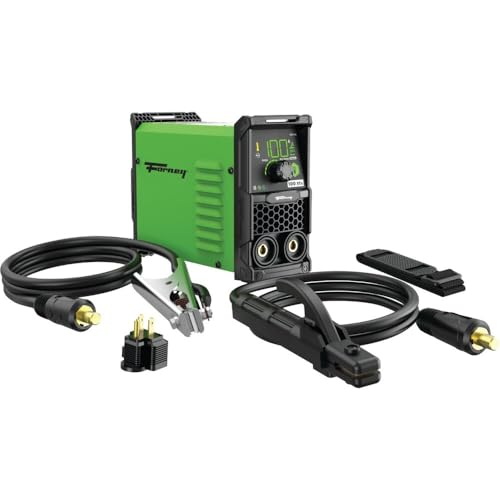
Forney Easy Weld 298 100ST
Best OverallPros
- Plugs into a standard household outlet
- Simple single-dial amperage control
- Backed by a well-known welding brand
Cons
- Low duty cycle limits long welds
- No 220V option for higher output
This transformer-style welder runs on standard 120V household power and needs no assembly beyond plugging in. It targets light-gauge steel repair and hobby projects rather than heavy fabrication.
AMICO POWER ARC-160
Best for Thick MetalPros
- Dual-voltage input adds flexibility
- Handles thicker electrodes than entry welders
- Compact and lightweight for its output
Cons
- Higher amperage settings need a 230V circuit
- Digital display can be hard to read outdoors
This inverter welder accepts both 110V and 230V input, letting it push higher amperage than most welders in this price range. It suits farm repairs and thicker mild steel joints.
YESWELDER ARC-135ST
Best ValuePros
- Very lightweight for a dual-voltage unit
- Wide amperage adjustment range
- Includes basic accessories in the box
Cons
- Cooling fan runs loud under load
- Cable length is short for larger workspaces
This mini inverter welder favors portability, weighing under seven pounds while still covering a useful amperage band. It fits light fabrication and occasional home repairs.
SUNGOLDPOWER MINI ARC-160
Best for BeginnersPros
- Hot start and arc force ease arc striking
- Dual-voltage input for home or shop use
- Compact housing with carry handle
Cons
- Included cables are shorter than average
- Manual instructions are minimal
This inverter welder uses hot start and arc force functions to make striking an arc easier for new users. It runs on dual voltage and covers common electrode sizes.
HZXVOGEN ARC-160
Best for PortabilityPros
- Compact size fits in a small toolbox
- Dual-voltage input adds flexibility
- Lightweight for on-site repair jobs
Cons
- Fewer safety certifications listed than larger brands
- Display lacks amperage memory settings
This small inverter welder fits in a toolbox and runs on either 110V or 220V power. It suits mobile repair work and tight garage storage.
Reboot ARC-160
Best for Farm UsePros
- Wide amperage range for varied jobs
- Dual-voltage input works with common outlets
- Included accessories cover basic setup
Cons
- Housing feels less rugged than pricier units
- Instructions assume some prior welding knowledge
This inverter welder covers a broad amperage range and dual voltage input, making it useful for occasional farm equipment repair. It ships with basic electrode holder and ground clamp.
Goplus 130Amp Stick Welder
Best Ultra-BudgetPros
- Lowest cost option on this list
- Simple controls with minimal setup
- Lightweight and easy to store
Cons
- No 220V option limits peak output
- Lower duty cycle than dual-voltage rivals
This entry-level inverter welder covers a modest amperage range on standard 110V power. It works best for occasional light repairs rather than frequent shop use.
What Makes a Stick Welder Good Under $100
Budget stick welders trade off features to hit a low price, but the core requirements stay the same. Look for a stable arc, adjustable amperage, and basic overload protection. Skipping these leads to frustrating arc starts and premature failure.
Amperage Range and Duty Cycle Explained
Amperage range determines which electrode sizes and metal thicknesses a welder can handle. Duty cycle tells you how long you can weld before the unit needs to cool down. A welder rated 60% at 130A can run six minutes out of every ten at that setting before overheating.
Single Voltage vs Dual Voltage Input
Single-voltage welders plug into a standard 110V outlet but cap out at lower amperage. Dual-voltage models accept 110V or 220V, unlocking higher output when a 220V circuit is available. Garage users without dedicated 220V wiring should weigh this tradeoff carefully.
Matching Electrode Size to Metal Thickness
Thinner electrodes, like 1/16 inch, suit light sheet metal and low amperage settings. Thicker electrodes, like 1/8 inch, need higher amperage and work better on structural steel. Checking a welder's stated amperage range against common electrode sizes avoids mismatched purchases.
FAQs
What is the best cheap stick welder for beginners?
The Forney Easy Weld 298 100ST is a common beginner pick due to its simple single-dial control and plug-and-weld setup on standard household power.
Can you weld thick metal with a 100 amp stick welder?
A 100 amp welder can handle thin to medium steel, generally up to about 3/16 inch, but thicker joints benefit from a welder rated closer to 160A.
How many amps do I need to weld 1/4 inch steel?
Welding 1/4 inch steel typically needs a welder capable of at least 140 to 160 amps with a 1/8 inch electrode.
Is a 110V stick welder good enough for home projects?
A 110V welder works fine for light repairs and thin metal, but dual-voltage models offer more headroom for occasional heavier jobs.
What electrode size works best with a 120V welder?
Most 120V budget welders work best with 1/16 inch to 3/32 inch electrodes, since larger sizes need more amperage than these units supply.
Do budget stick welders need a specific generator size?
Check the welder's rated input amperage and choose a generator with headroom above that figure, since welders draw more current during arc strikes.
Which is better, AC or DC output for stick welding?
DC output generally gives a smoother arc and easier starts, which is why most budget inverter welders in this price range output DC.
How long can you run a budget inverter welder before it overheats?
Run time depends on the duty cycle rating, but most budget inverters need a rest period after roughly five to six minutes of continuous welding at their rated amperage.
What safety gear do I need for stick welding at home?
Basic stick welding requires a welding helmet with proper shade lens, welding gloves, flame-resistant clothing, and adequate ventilation.
Our verdict
For most home users, the Forney Easy Weld 298 100ST offers the simplest and most reliable entry point under $100. Those needing more amperage headroom should consider the AMICO ARC-160, while the YESWELDER ARC-135ST fits tighter budgets without sacrificing dual-voltage flexibility.