Best MIG Welder Under $100: What You Actually Get at This Price
Here is the honest starting point: under $100 in the US, nobody sells a true MIG welder. Every machine at this price is a flux-cored (FCAW) welder that runs self-shielding wire with no gas bottle, and almost all of them are unbranded imports of the same transformer design. That does not make them useless, but it does change what you should expect. Below are the machines that genuinely land under $100, what they can and cannot weld, and the two step-ups that are worth the extra money if you can stretch.
Quick answer
The Goplus MIG 130 is the most consistently available flux-core welder that actually stays under $100, and it will handle 18 to 16 gauge sheet steel for light repairs. But if you can add roughly $20 to $40, the YESWELDER Flux-135 is a modern inverter that is far lighter and easier to control, and the Forney Easy Weld 261 140 FC-i at around $190 is the first machine here from an established welding brand.
Why trust ToolBuyerHub
- Specs taken from manufacturer documentation, not retailer copy
- Marketing amp figures checked against real rated output
- Process correctly identified: flux-core (FCAW) vs true MIG (GMAW)
- US voltage, circuit draw and steel thickness in inches and gauge
- Availability noted where a machine is store-exclusive
- No fake hands-on claims and no invented review counts
Research updated August 2026.
Goplus MIG 130 Flux-Core Welder
Editorial score. A basic AC transformer flux-core machine that does light sheet-steel work and nothing more.
| Product | Best For | Key Spec | Rating | Typical price |
|---|---|---|---|---|
| Goplus MIG 130 | Best under $100 | 120V, flux-core, transformer | 3.7/5 | ~$95 |
| SUNCOO MIG 130 | Backup under $100 | 120V, flux-core, transformer | 3.5/5 | ~$100 |
| Titanium Easy-Flux 125 | Best store-bought | 120V, 125A inverter | 4.2/5 | ~$130 (Harbor Freight) |
| YESWELDER Flux-135 | Best value step-up | 120V, 135A inverter | 4.1/5 | ~$120 |
| Forney Easy Weld 261 140 FC-i | Best real brand | 140A, 30% duty @ 90A | 4.6/5 | ~$190 |
Goplus MIG 130 Flux-Core Welder
Best Under $100Pros
- Genuinely lands under $100
- Simple tap-and-dial controls, nothing to learn
- Fine for 18 to 16 gauge sheet steel
Cons
- The "130" is a marketing figure, not real rated output
- Heavy AC transformer, roughly 35 lbs
- Plastic wire drive and a thin ground clamp
The Goplus MIG 130 is one of a large family of near-identical flux-core clones sold under many names. They share the same AC transformer core, the same four voltage taps, and the same ten-position wire speed dial. Understand what the model name means before you buy: the "130" is a marketing peak figure, not a rated welding output. Real usable current on these machines is well below that, and the honest working range is thin sheet steel, roughly 18 to 16 gauge.
That still covers a lot of real jobs. Patching a lawnmower deck, tacking a gate hinge, joining light bracket steel or repairing a thin bracket are all within reach. What is not within reach is structural steel, thick plate, or any continuous work. Budget separately for a decent auto-darkening helmet and gloves, because the included face shield is a passive plastic handheld and it is the weakest part of the box.
SUNCOO MIG 130 Flux-Core Welder
Backup Under $100Pros
- Same capability as the Goplus at the same price
- Useful when the Goplus listing is out of stock
- Ships with a starter spool of flux wire
Cons
- Identical limitations, including the inflated amp name
- Support is thin if something fails out of the box
The SUNCOO MIG 130 is functionally the same machine as the Goplus, built on the same reference design and sold at the same price. We list it because stock on these generic listings comes and goes, and there is no reason to pay a premium for whichever one happens to be available.
Treat the two as interchangeable and pick on price and delivery date. If you find one with a metal wire drive rather than a plastic one, take that version, because the drive assembly is where these machines usually give trouble first. Set your wire tension light and let the drive rollers slip before the wire bird-nests in the liner.

Titanium Easy-Flux 125 (Harbor Freight)
Best Store-BoughtPros
- Modern inverter, far lighter than the transformer clones
- Infinite voltage and wire speed control, not four fixed taps
- Walk-in returns and a warranty you can actually use
Cons
- Around $130, so it breaks the $100 budget
- Not sold on Amazon, so no affiliate link here
- Still flux-core only, no gas capability
If your $100 limit has any give in it, this is the machine that changes the experience. The Easy-Flux 125 is an inverter rather than an AC transformer, which means it is light enough to carry in one hand and gives you smooth continuous adjustment of voltage and wire speed instead of four fixed taps. That control is what makes thin sheet metal manageable rather than a burn-through lottery.
The catch for this site is honest to state: it is a Harbor Freight exclusive, so there is no Amazon listing and no affiliate link. We are including it because leaving it out would give you a worse recommendation. If there is a Harbor Freight near you, walk in and compare it against the generic clones before you order online.

YESWELDER Flux-135
Best Value Step-UpPros
- Very light inverter, easy to carry and store
- Smooth stepless voltage and wire speed control
- Available on Amazon, unlike the Harbor Freight unit
Cons
- Around $120, above the $100 target
- Torch and ground leads are short
- Flux-core only, so no upgrade path to gas
The Flux-135 is the Amazon-available equivalent of the Harbor Freight inverter, and it is the cheapest machine on this list we would recommend without a long list of caveats. At roughly 13 lbs it is a fraction of the weight of the transformer clones, and the stepless controls make it genuinely usable on thin steel where the four-tap machines force you to pick between too cold and blown through.
The honest limitation is the leads. Both the torch and the work lead are short, so plan your extension cord and your workpiece position accordingly. If you want a machine that will still be useful in two years rather than one you outgrow immediately, this is the sensible floor.
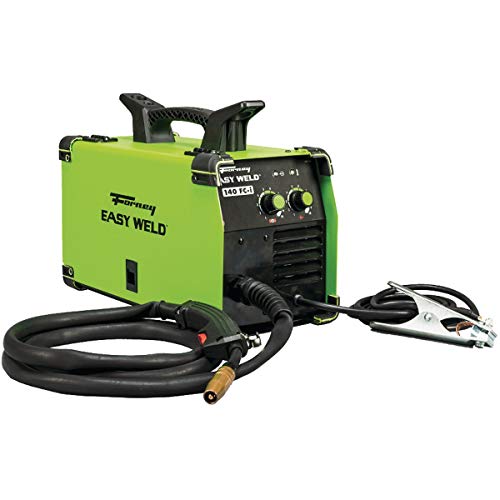
Forney Easy Weld 261 140 FC-i
Best Real BrandPros
- Published, honest duty cycle of 30% at 90A
- Welds up to 1/4 in mild steel
- Established US welding brand with real parts support
Cons
- Around $190, nearly double the budget
- Uses 0.030 in wire only
- No gas option, still flux-core
The Forney 261 is the first machine on this list from a company that has been in the welding business for decades, and it shows in the one spec that budget brands quietly omit: a published duty cycle. Thirty percent at 90 amps means three minutes of welding in every ten, which is roughly triple what the sub-$100 clones can sustain, and it is stated rather than implied.
Rated to 1/4 in mild steel at 140 amps, it covers trailer repairs, thicker bracket work and light fabrication that the cheaper machines simply cannot reach. At 19 lbs it is still portable. If you already know you will keep welding, buying here once costs less than buying a clone and replacing it.
Flux-core is not the same as MIG, and that matters under $100
Retailers list these machines as "MIG welders" because that is what people search for, but the process is different. True MIG, properly called GMAW, feeds a bare solid wire and shields the weld pool with a bottle of gas, usually a 75/25 argon-CO2 mix. Every machine under $100 instead runs flux-cored arc welding, or FCAW, where the shielding comes from flux packed inside the hollow wire itself. That is why none of these welders has a gas valve or a regulator fitting. The practical difference shows up in the weld: flux-core throws noticeably more spatter, leaves a slag layer you have to chip off, and produces a rougher bead than gas MIG. The advantage is that flux-core works outdoors in wind, where a gas shield would simply blow away, and it costs nothing beyond the wire. For fence repairs, trailer patches and general garage work, that trade is usually worth it.
What to check before buying a cheap flux-core welder
Start with the amperage claim and treat it with suspicion. A machine named "MIG 130" is almost never rated at 130 amps of usable output, and the honest working range on a sub-$100 clone is thin sheet steel around 18 to 16 gauge. Next, check the duty cycle, and note whether one is published at all. Reputable brands print a figure such as 30 percent at 90 amps, meaning three minutes of arc time in every ten. Budget imports frequently print nothing, which tells you something in itself. Third, look at the wire drive. A metal drive assembly holds tension far better than a plastic one, and the drive is where these machines usually fail first. Fourth, plan your power. All of these run on standard 120V household current, but a transformer machine at its top tap will pull enough to nuisance-trip a shared 15-amp circuit, so a dedicated 20-amp outlet is worth having. Finally, budget for safety gear separately. The included handheld face shield on a cheap kit is not adequate for anything beyond a single tack weld.
Mistakes to avoid when buying a budget welder
Do not expect structural work. A sub-$100 flux-core machine is for thin sheet metal and light repairs, and no wire speed setting will change that. Do not buy on the model name, because the number in it is marketing, not a rated output. Do not skip the auto-darkening helmet to stay under budget; a decent one costs $40 to $60 and it is the difference between welding and guessing. Do not plan on adding gas later, because these machines have no gas valve and no fitting for a regulator, and the upgrade path does not exist. Do not weld galvanized steel indoors, as the zinc coating produces fumes that cause metal fume fever, so grind the coating back first and work with ventilation. And do not run continuously; when a budget machine cuts out mid-bead it is almost always the thermal overload doing its job, so let it cool rather than cycling the power switch.
FAQs
Can you buy a real MIG welder for under $100?
No. Every machine at that price is a flux-cored (FCAW) welder with no gas capability. True MIG needs a shielding gas bottle and regulator, and the cheapest machines with a gas valve start well above $200.
Can I weld car body panels with a sub-$100 welder?
With care, yes on thin panels, but it is difficult. Flux-core runs hot and the four fixed voltage taps on a clone machine make it easy to blow through sheet metal. An inverter with stepless control, like the YESWELDER Flux-135 or Titanium Easy-Flux 125, is far better suited to body work.
What thickness of steel can these welders handle?
The sub-$100 clones are realistically good for 18 to 16 gauge sheet. The Forney 261 at 140 amps is rated up to 1/4 in mild steel. Ignore the peak amp figure in a model name when judging this.
Do these welders need a special outlet?
No, they all run on standard 120V household power. However, a transformer machine on its highest setting can nuisance-trip a shared 15-amp circuit, so a dedicated 20-amp outlet is recommended.
What wire size should I use?
0.030 in flux-cored wire is the safest default and fits every machine here. Use 0.035 in only on the heavier settings and only if your drive rollers and contact tip are sized for it.
Why does the "130" in MIG 130 not mean 130 amps?
It is a peak marketing figure, not a rated output measured at a duty cycle. Established brands quote output alongside a duty cycle, such as Forney's 30 percent at 90 amps, which is the number that actually tells you what the machine can do.
Can I use a gas bottle with a cheap flux-core welder?
No. These machines have no gas solenoid and no regulator fitting, and there is no conversion kit. If you want gas MIG, you have to buy a gas-capable machine from the start.
What safety gear do I need?
An auto-darkening welding helmet, leather welding gloves, and a flame-resistant jacket or at minimum cotton long sleeves. The passive handheld shield included with budget kits is not adequate for real work.
Why does my welder keep cutting out mid-weld?
That is the thermal overload protection. You have exceeded the duty cycle. Stop and let the machine cool for the full rest period rather than switching it off and back on.
Can I weld aluminum with one of these?
No. Self-shielding flux-cored wire is a steel process. Aluminum needs gas MIG with argon and a spool gun or push-pull torch, or AC TIG.
Why does flux-core leave slag on the weld?
The flux inside the wire burns to form a protective slag over the cooling bead. It is normal. Chip it off with a chipping hammer and wire-brush the bead before laying a second pass.
Which brands are worth trusting on a budget?
Forney, Lincoln Electric and Hobart are the established US names, though their machines start around $190 and up. Harbor Freight's Titanium line and YESWELDER are the credible options below that. Under $100 you are buying unbranded imports, so judge on the seller's return policy.
Our verdict
If $100 is an absolute ceiling, the Goplus MIG 130 (or the identical SUNCOO) will get you welding thin sheet steel today, provided you accept that the model name overstates what it does. But the more useful advice is that a small stretch changes the machine entirely: roughly $120 buys the YESWELDER Flux-135 inverter with stepless control and a fraction of the weight, and around $190 buys the Forney Easy Weld 261 with a published 30 percent duty cycle at 90 amps and genuine 1/4 in capacity. If welding is going to be more than a one-off repair, buy once at the Forney level rather than twice at the clone level.