Best MIG Welder Under $300
Under $300 is the point where a wire-feed welder stops being flux-core only and a real gas MIG setup becomes possible in the US. It is also the price bracket with the widest gap between what a spec sheet claims and what a machine does on a 120V outlet. This guide compares the models you can actually buy at that budget, what each one truly outputs, and which of them run shielding gas at all.
Quick answer
The ARCCAPTAIN MIG 200 is the best all-round pick under $300: it runs gas MIG, flux-core, stick and lift TIG, and it takes both 120V and 240V, so the machine grows with you. If you want a US name brand with a gas regulator and hose already in the box, the Lincoln Electric Handy MIG (K2185-1) is the safer, simpler buy, though it tops out at 88 amps. Note that two popular machines in this bracket, the Hobart Handler 100 and the Forney Easy Weld 261, are flux-core only and cannot run shielding gas at all.
Why trust ToolBuyerHub
- Specs checked against manufacturer data
- Real US retail availability, not import-only models
- Gas MIG vs flux-core capability verified per model
- Duty cycle and input voltage compared honestly
- Build quality & warranty checked
- No fake hands-on claims
Research updated August 2026.
ARCCAPTAIN MIG 200
Gas MIG, flux-core, stick and lift TIG in one dual-voltage cabinet, with synergic settings that do most of the dial-in for you.
| Product | Best For | Max Output | Runs Shielding Gas? | Rating |
|---|---|---|---|---|
| ARCCAPTAIN MIG 200 | Best Overall | 200A (240V) | Yes | 4.5/5 |
| Lincoln Electric Handy MIG K2185-1 | Easiest Gas Starter | 88A | Yes, kit included | 4.2/5 |
| YESWELDER MIG-205DS | Most Output for the Money | 205A (240V) | Yes | 4.3/5 |
| Hobart Handler 100 | Build Quality | 100A | No, flux-core only | 4.4/5 |
| Forney Easy Weld 261 140 FC-i | Best Value | 140A | No, flux-core only | 4.5/5 |

ARCCAPTAIN MIG 200
Best OverallPros
- Runs true gas MIG as well as flux-core, stick and lift TIG
- Dual voltage, so it moves between a garage outlet and a 240V circuit
- Synergic mode sets voltage and wire speed from material thickness
Cons
- The headline 200 amps needs 240V; on a 120V outlet output is far lower
- A lift-TIG torch is normally a separate purchase
- Manufacturer duty-cycle ratings on imported inverters run optimistic
This is the machine that makes the most sense at this budget because it is not locked into one process. Fit a spool of solid wire and a bottle of 75/25 argon-CO2 and it is a gas MIG for clean sheet metal work; swap to flux-core wire and reverse the polarity and it welds outdoors in wind. Stick and lift TIG are there when you need them.
The important caveat is voltage. Plugged into an ordinary 120V household circuit you are working with a fraction of the rated output, which is fine for panel and light bracket work. To reach the top of the range you need a 240V outlet, the same as a dryer or compressor circuit. Judge it on what your shop can actually supply.
Lincoln Electric Handy MIG (K2185-1)
Easiest Gas StarterPros
- Ships with a gas regulator and hose, so gas MIG works out of the box
- Genuine Lincoln Electric support and consumables availability in the US
- Light enough to carry in one hand at around 26 lbs
Cons
- 88 amps is the lowest output here, so 1/8 in mild steel is the sensible ceiling
- Four fixed voltage taps rather than infinite adjustment
- Short torch lead and ground cable
If your work is car body panels, brackets and thin-gauge repairs, the Handy MIG is the least frustrating way into gas MIG. Lincoln includes the regulator and hose, so the only extra you need is a cylinder of 75/25 argon-CO2 and a spool of 0.025 in solid wire. It also runs 0.035 in flux-core wire if you would rather skip gas.
The trade-off is power. Rated output runs from about 35 to 88 amps with a 20 percent duty cycle at 70 amps, meaning roughly two minutes of arc time in a ten-minute window. That covers 24 gauge sheet up to about 1/8 in steel. It will not do frame or trailer-hitch work, and no amount of wire-speed fiddling changes that.

YESWELDER MIG-205DS
Most Output for the MoneyPros
- Highest rated output in the bracket, and it sits right at the $300 line
- Dual voltage with synergic MIG control
- Handles gas MIG, flux-core and stick from one machine
Cons
- Small 2 lb wire spools unless you add a spool adapter
- TIG torch and gas kit are extra
- Support is email-based rather than a US service network
The MIG-205DS is the direct rival to the ARCCAPTAIN and covers the same processes. On 220V it is rated to 205 amps, which is more than anything else at this price, and the synergic MIG mode means you pick wire diameter and material thickness rather than guessing at voltage taps.
It is a value machine rather than a refined one. Wire-feed tension usually needs setting properly before the first weld, the supplied ground clamp is basic, and after-sales support is by email. For a home shop that welds in bursts, none of that is a dealbreaker, but the Hobart below is the machine to pick if you value backing over headline amps.

Hobart Handler 100
Build QualityPros
- Built by Hobart, with US parts and service behind it
- Backed by Hobart's 5/3/1 industrial warranty
- Smooth, forgiving arc for a 115V machine
Cons
- Flux-core only, it cannot be converted to run shielding gas
- 100 amps limits you to roughly 3/16 in steel
- Costs more than higher-amperage import machines
The Handler 100 is the one machine here you buy for longevity rather than numbers. It runs on a standard 115V outlet, welds from 24 gauge up to about 3/16 in mild steel, and is rated at a 20 percent duty cycle at 90 amps. The arc quality and wire feed are noticeably steadier than budget imports at the same output.
The critical thing to understand is that the Handler 100 is a flux-core machine only. Unlike the Handler 140 and 190, there is no gas solenoid and no gas conversion kit, so if clean, spatter-free MIG welds are the goal, this is not the model to buy. Choose it when you want a machine that will still be working in ten years.
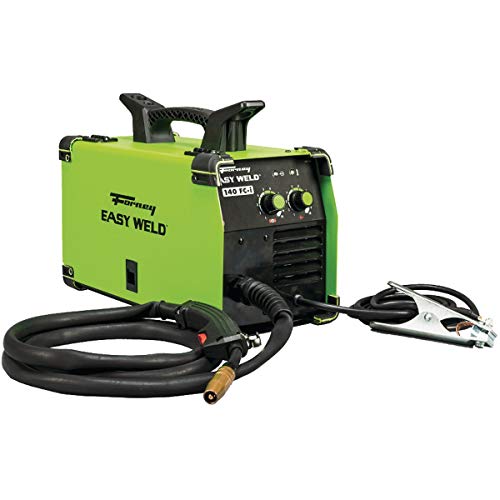
Forney Easy Weld 261 140 FC-i
Best ValuePros
- Infinitely variable voltage and wire speed, not fixed taps
- Around 19 lbs, genuinely portable
- Leaves budget for a good helmet, gloves and a grinder
Cons
- Flux-core only, no gas option
- Wants a full 20-amp 120V circuit at the top of its range
- Included clamp and torch are basic
The Forney 261 is the value benchmark under $200, and it earns a place here because spending your whole $300 on the welder alone is usually the wrong call. Buying this and putting the rest toward an auto-darkening helmet, decent gloves and an angle grinder gets more welding done than a bigger machine with no safety gear.
It is rated at 30 percent duty cycle at 90 amps, which is roughly three minutes of arc time in a ten-minute window, and it handles 1/8 in in a single pass or about 1/4 in with a bevel and multiple passes. Continuously variable controls are what let you tune out burn-through on thin panel.
What $300 actually buys you
Three things separate a $300 welder from a $150 one: shielding gas capability, dual voltage, and control resolution. Gas capability matters if you want clean, low-spatter welds on car panels. Dual voltage matters if you have, or can add, a 240V circuit, because a 120V-only machine is hard-capped at roughly 140 amps no matter what the label says. Control resolution, meaning continuously variable voltage instead of four fixed taps, is what lets you stop burning through thin steel.
Duty cycle is the spec buyers ignore most. A 20 percent rating at 90 amps means two minutes of welding in a ten-minute window, then eight minutes of cooling. That is normal and perfectly workable for repair jobs. Trouble starts when someone buys a 100-amp machine and tries to run continuous beads on thick stock. The thermal cutout stops the machine until it recovers.
Check the input requirement before you check anything else. Every 120V machine here wants a dedicated 20-amp circuit to hit its top settings, and a long or undersized extension cord noticeably weakens the arc. If a machine advertises 200 amps, that figure is on 240V, not on the outlet in your garage.
What a gas setup really costs
Going gas is not just the price of the welder. You need a cylinder of 75/25 argon-CO2, a regulator and hose if the machine did not include one, and solid wire rather than flux-core. Buying a small 40 cu ft cylinder outright plus a regulator typically adds $150 to $300 to the setup, while a local welding supplier lease is cheaper up front and charges per refill. Factor that in before deciding a gas-capable machine is the better value.
Wire is the cheaper consumable. A 2 lb spool of 0.030 in flux-core wire runs about $15 to $25, and solid MIG wire is similar. Contact tips wear out and cost a few dollars each, so buy a handful with the machine.
Mistakes to avoid
Do not assume every machine in this bracket runs gas. The Hobart Handler 100 and the Forney Easy Weld 261 are flux-core only by design, with no gas solenoid to convert. If clean welds on visible bodywork are the goal, buy a gas-capable machine from the start.
Do not size a welder by its advertised amperage alone. A dual-voltage machine rated at 200 amps delivers a fraction of that on 120V. Decide what voltage you can supply first, then shop.
Do not skip the polarity change. Flux-core wire runs electrode negative and solid wire with gas runs electrode positive. Getting this backwards produces a spitting, filthy weld that no setting change will fix, and it is the single most common beginner mistake with a machine that does both.
FAQs
Can a MIG welder under $300 weld car body panels?
Yes, and this is the bracket where it gets easy, because gas MIG becomes possible. Car body panel is roughly 24 to 20 gauge, so the limiting factor is fine low-end control rather than amperage. A machine like the Lincoln Handy MIG running 0.025 in solid wire with 75/25 gas gives the cleanest result.
Do all MIG welders under $300 run shielding gas?
No. The ARCCAPTAIN MIG 200, YESWELDER MIG-205DS and Lincoln Handy MIG do. The Hobart Handler 100 and Forney Easy Weld 261 are flux-core only, with no gas valve and no conversion kit available.
What thickness steel can these welders handle?
On a 120V outlet, expect a clean single pass up to about 1/8 in, and up to roughly 1/4 in with a bevel and multiple passes. Only the dual-voltage machines running on 240V will go meaningfully beyond that.
Do I need a 240V outlet?
Not for the Lincoln, Hobart or Forney, which are 115V or 120V machines. The ARCCAPTAIN and YESWELDER accept both, but only reach their advertised 200-plus amps on 240V.
What is duty cycle and why does it matter?
Duty cycle is the share of a ten-minute period you can weld before the machine must cool. A 20 percent rating at 90 amps means about two minutes of arc time, then eight minutes off. Exceed it and the thermal cutout shuts the machine down until it recovers.
Is gas MIG better than flux-core?
For clean, low-spatter welds indoors, yes. Flux-core wins outdoors, because there is no shielding gas for wind to blow away, and it tolerates mill scale and light surface rust better. Many people end up using both.
Can I weld aluminum with a budget MIG welder?
Realistically, no. Soft aluminum wire birdnests in a standard drive system, so you need a spool gun or push-pull torch plus pure argon. That capability is not present on any machine at this price.
How much does MIG welding wire cost?
About $15 to $25 for a 2 lb spool of 0.030 in flux-core or solid wire. Buy spare contact tips at the same time, since they wear out and cost only a few dollars each.
Which brand is most reliable under $300?
Hobart and Lincoln Electric have the strongest US service and parts networks and the longest warranties. ARCCAPTAIN and YESWELDER offer more features for the money, with email-based support rather than a dealer network.
What safety gear do I need?
An auto-darkening welding helmet, leather welding gloves, a flame-resistant jacket or natural-fibre long sleeves, safety glasses under the hood, and a fire extinguisher within reach. Flux-core smokes heavily, so ventilate the space.
Our verdict
For most buyers the ARCCAPTAIN MIG 200 is the best MIG welder under $300: gas MIG, flux-core, stick and lift TIG in one dual-voltage machine, so it is still useful after your skills outgrow sheet metal. If you want a US brand with a gas regulator already in the box and your work is thin steel, the Lincoln Electric Handy MIG is the simpler, safer buy at 88 amps. And if you would rather have build quality than features, the flux-core-only Hobart Handler 100 will outlast everything else here.