How to Use a Torque Wrench Safely
A torque wrench is a precision tool that prevents over-tightening and under-tightening fasteners. Using it incorrectly can damage components or cause joint failure; this guide covers the correct steps, common mistakes, and how to choose the right tool for your garage.
Quick answer
To use a torque wrench safely, always set the desired torque value while the tool is in its lowest setting, apply a smooth and steady pull until you hear or feel the click, and never use the wrench to loosen fasteners. Always store it at its lowest setting to preserve calibration.
Why trust ToolBuyerHub
- Checked load ratings and safety documentation before recommending lifting or jacking equipment
- Battery & ecosystem compared
- Aggregated owner reviews
- Build quality & warranty checked
- Brand reliability
- No fake hands-on claims
Research updated June 2026.
What Is a Torque Wrench and Why Do You Need One?
A torque wrench measures and applies a specific rotational force to a fastener, typically measured in foot-pounds (ft-lb) or Newton-meters (Nm). Unlike a standard ratchet, it provides a mechanical or electronic signal when the preset torque is reached. This prevents stripping threads, snapping bolts, or under-tightening critical components like wheel lugs, engine head bolts, and suspension parts. Owner reviews across major retailers consistently highlight that using a torque wrench is essential for any repair where fastener tension affects safety or performance.
Anatomy of a Torque Wrench
Understanding the parts helps you operate the tool safely. The main components include the handle (which houses the adjustment mechanism), the shaft (which contains the internal spring or beam), the head (which accepts sockets), and the scale or digital display for setting torque. On click-type wrenches, you will also find a locking collar or knurled grip to adjust the setting. Beam-style wrenches have a pointer and scale that indicate torque as you pull. Digital wrenches use a strain gauge and display the reading on an LCD screen.
Step-by-Step: How to Use a Torque Wrench Safely
Step 1: Set the Correct Torque Value
Always return the wrench to its lowest setting before adjusting. This relieves tension on the internal spring and prolongs calibration life. Turn the handle to align the markings on the shaft with your desired torque value. For click-type wrenches, the main scale shows whole numbers and the micrometer collar shows fractions. Double-check your vehicle or equipment manual for the exact specification.
Step 2: Attach the Correct Socket
Use a standard six-point socket that fits the fastener snugly. Avoid using impact sockets unless they are specifically designed for manual torque applications, as their thicker walls can affect clearance. Ensure the square drive of the wrench matches the socket size (typically 1/4-inch, 3/8-inch, or 1/2-inch).
Step 3: Position the Wrench Correctly
Place the socket onto the fastener and align the wrench handle so you can pull it in a smooth arc. For click-type wrenches, the head pivots; you must pull from the center of the handle grip. Do not apply force near the head, as this reduces accuracy and can damage the mechanism.
Step 4: Apply a Steady, Smooth Pull
Pull the handle in a slow, even motion. Do not jerk or yank. When you reach the preset torque, you will feel a distinct click and the handle will release slightly. Stop pulling immediately. For beam-style wrenches, watch the pointer until it reaches the desired mark. For digital wrenches, stop when the beep or vibration alerts you.
Step 5: Release and Reset
After the click, release the pressure and remove the wrench from the fastener. Do not continue pulling after the click, as this can over-torque the fastener. After use, always return the adjustment to the lowest setting before storing the wrench in its case.
What to Check Before Buying a Torque Wrench
Before purchasing, verify the torque range matches your typical projects. A 1/2-inch drive click-type wrench covering 20-150 ft-lb suits most automotive work, while a 3/8-inch drive covering 5-80 ft-lb is better for smaller engine components. Check the accuracy specification: most quality wrenches offer +/- 4% accuracy. Consider the type: click-type is durable and affordable, beam-style never loses calibration, and digital offers high precision with audible alerts. Brand reliability matters; DeWalt, Milwaukee, and GearWrench are consistently praised in owner reviews for long-term calibration stability.
Mistakes to Avoid
- Using the wrench to loosen fasteners: This can damage the internal mechanism and throw off calibration.
- Storing at a high torque setting: This compresses the internal spring and leads to calibration drift over time.
- Dropping the wrench: Even a short fall can knock a click-type wrench out of calibration.
- Applying oil or lubricant to the fastener: Lubrication changes friction and torque values; always tighten dry unless the manual specifies otherwise.
- Ignoring the click: Continuing to pull after the click results in over-torque and potential fastener failure.
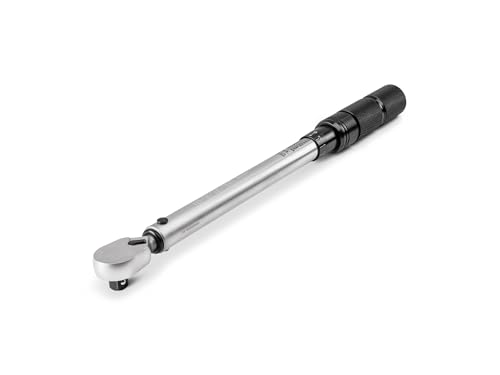
TEKTON 24335 3/8-Inch Drive Click Torque Wrench
Reliable click-type wrench with clear dual-range scale and durable construction.
| Product | Best For | Key Spec | Rating | Price |
|---|---|---|---|---|
| TEKTON 24335 | Overall reliability | 3/8 in, 5-80 ft-lb | 4.7/5 | Mid |
| CDI 1503MRPH | Precision & calibration | 3/8 in, 5-75 ft-lb | 4.8/5 | High |
| Precision Instruments PREC3F250H | Heavy-duty automotive | 1/2 in, 50-250 ft-lb | 4.6/5 | High |
| Neiko 03709B | Budget-friendly | 1/2 in, 10-150 ft-lb | 4.5/5 | Low |
| Capri Tools 31200 | Bike & small engine | 1/4 in, 20-200 in-lb | 4.6/5 | Mid |
Top Torque Wrench Picks for Safe Operation
TEKTON 24335 3/8-Inch Drive Click Torque Wrench
Best OverallPros
- Clear dual-range scale (ft-lb and Nm)
- Comfortable knurled handle
- Includes storage case
Cons
- Not reversible for left-hand threads
- Higher price than budget options
The TEKTON 24335 is widely praised in owner reviews for its accurate click mechanism and easy-to-read scale. The dual-range scale shows both foot-pounds and Newton-meters, which is helpful for working on imported vehicles. The knurled handle provides a secure grip even with oily hands, reducing the risk of slipping during use.
This wrench covers the most common torque range for automotive work, from spark plugs to suspension bolts. Its build quality is solid, with a smooth adjustment collar that locks securely. Many users report that it holds calibration well over years of use, making it a reliable choice for both beginners and experienced mechanics.
CDI 1503MRPH 3/8-Inch Drive Torque Wrench
Best for PrecisionPros
- Split-beam design reduces calibration drift
- Made in the USA
- Includes calibration certificate
Cons
- More expensive than comparable models
- Heavier than standard click wrenches
CDI is a subsidiary of Snap-on, and the 1503MRPH is known for its exceptional build quality and accuracy. The split-beam design means the internal spring is not under tension when stored, which helps maintain calibration over time. Owner reviews frequently mention that this wrench feels more precise than cheaper alternatives.
The handle is ergonomic and the adjustment mechanism is smooth. It comes with a certification of calibration traceable to NIST, which is important for professional use. The only downside is the premium price, but for those who need consistent accuracy for critical fasteners, it is a worthwhile investment.
Precision Instruments PREC3F250H 1/2-Inch Drive Torque Wrench
Best for Heavy-DutyPros
- High torque range for large fasteners
- Split-beam design for calibration stability
- Comfortable grip at high torque levels
Cons
- Not suitable for low-torque applications
- Large and heavy for storage
The Precision Instruments PREC3F250H is built for heavy-duty automotive work, such as axle nuts, suspension bolts, and wheel lugs on trucks. Its 50-250 ft-lb range covers the high end of most DIY needs. The split-beam mechanism ensures that the wrench can be stored without tension, preserving accuracy.
Owner reviews highlight its solid feel and consistent click at high torque values. The handle is long enough to provide good leverage without being unwieldy. Some users note that the scale markings are less detailed than on smaller wrenches, but the overall reliability makes it a favorite for serious mechanics.
Neiko 03709B 1/2-Inch Drive Click Torque Wrench
Best BudgetPros
- Very affordable price point
- Includes storage case
- Wide torque range for most DIY jobs
Cons
- Less precise feel than premium models
- Some users report calibration drift over time
The Neiko 03709B is a popular budget option that offers good value for occasional use. It covers the 10-150 ft-lb range, which is suitable for wheel lugs, suspension bolts, and general automotive work. The click mechanism is audible and the scale is easy to read.
Owner reviews are generally positive, with many users noting that it performs well for the price. However, some reviews mention that the wrench may lose calibration after heavy use or a drop. It is best suited for DIYers who need a torque wrench for occasional projects rather than daily professional use.
Capri Tools 31200 1/4-Inch Drive Torque Wrench
Best for Small FastenersPros
- Low torque range for delicate work
- Clear inch-pound scale
- Compact and easy to store
Cons
- Not suitable for automotive wheel lugs
- Small handle can be less comfortable
The Capri Tools 31200 is designed for low-torque applications, such as bicycle components, small engine work, and electronics. It measures torque in inch-pounds, which is essential for fasteners that require less than 20 ft-lb. The click mechanism is precise and the scale is easy to read.
Owner reviews praise its accuracy and build quality for the price. It is a favorite among cyclists and small engine mechanics. The 1/4-inch drive is perfect for small sockets and tight spaces. The only limitation is its narrow torque range, but for its intended use, it performs excellently.
How to Maintain Your Torque Wrench
Proper maintenance extends the life and accuracy of your torque wrench. After each use, wipe it clean with a dry cloth to remove grease and dirt. Store it in its case or a padded drawer to prevent impacts. Always return the adjustment to the lowest setting before storage. For click-type wrenches, this relieves tension on the internal spring. For beam-style wrenches, ensure the pointer is at zero. If you drop the wrench, have it recalibrated by a professional before using it again. Most manufacturers recommend recalibration every 12 months or after 5,000 cycles.
Torque Wrench Safety Tips
- Always wear safety glasses: A fastener can snap under high torque, sending debris flying.
- Use the correct drive size: Using an adapter can reduce accuracy and increase the risk of socket failure.
- Never use a cheater bar: Extending the handle with a pipe can over-torque the fastener and damage the wrench.
- Check for calibration: If the wrench feels loose or the click is inconsistent, have it calibrated before use.
- Follow the manufacturer's torque specs: Always refer to the vehicle or equipment manual for the correct torque value.
FAQs
What is the difference between a click-type and a beam-type torque wrench?
A click-type wrench emits an audible click when the preset torque is reached, while a beam-type uses a pointer and scale that you must watch during use. Click-type is more popular for automotive work because it allows you to focus on the fastener.
Can I use a torque wrench to loosen bolts?
No, torque wrenches are designed only for tightening. Using them to loosen fasteners can
Best Portable Air Compressor for Heavy Duty Use
Another buying guide from this category, picked for you.
Check Price →As an Amazon Associate we earn from qualifying purchases. We recommend on merit — see our disclosure.