LANYU SYNERGY Electric Creasing Machine Review: 3-in-1 Creaser, Perforator and Cutter
Creasing is the step that separates a card that folds cleanly from one that cracks along the spine. Thick card needs its fibres compressed before it is folded, and a scoring wheel does that far better than a bone folder or a flatbed scorer once you have fifty invitations to get through. The CZH102 from LANYU SYNERGY puts that job on a motor: feed the sheet in and the drive shaft pulls it through the dies for you.
This is a review of one machine, not a comparison. It covers what the manufacturer documents, how a roller creaser of this type works, what the listing leaves out, and which kind of workshop it actually suits. The product is sold on Amazon UK, so the link on this page goes to the UK listing.
Quick answer
The LANYU SYNERGY CZH102 is a motorised, 460 mm (18 inch) wide creasing machine that also perforates and cuts, using swappable steel dies on a driven shaft. It suits small print rooms, wedding stationers and card sellers who crease or perforate in batches. Setup is manual (screws and a hex wrench), so it rewards people who dial it in once per stock and then run volume. If you fold a handful of cards a month, a hand creaser is the better buy.
Why trust ToolBuyerHub
- Built from the manufacturer listing and published specifications, cross-checked against how rotary creasing machines work
- No lab test of this unit and no owner feedback yet: the UK listing had no customer ratings at the time of writing, and we say so
- Where the listing is silent (motor power, weight, maximum card weight) we flag the gap instead of guessing
- Warranty and included parts checked against the listing
- No fake hands on claims, no invented statistics
Research updated October 2026.

LANYU SYNERGY CZH102 3-in-1 Electric Creasing Machine (460 mm)
Motor-driven rotary creaser with interchangeable perforating and cutting dies, 460 mm working width, screw-set die positions.
What each die does
Three outcomes come from one mechanism. The table shows which die produces which result and where you would use it.
| Die | Result | Typical job | Included |
|---|---|---|---|
| Creasing die (x2) | Compressed fold channel, single or double line | Greeting cards, invitations, gatefolds | Yes |
| Sawtooth perforating die | Dashed tear line | Tickets, coupons, reply slips | Yes |
| Cutting die | Full cut through the sheet | Trimming a run to size | Yes |
| Rubber pressure rollers (x2) | Grip and feed without marking | Every pass | Yes |
LANYU SYNERGY CZH102 3-in-1 Electric Creasing Machine (460 mm)
Batch creasing and perforatingPros
- Three jobs in one frame: crease, perforate and cut on the same shaft, so batch work does not mean three tools
- Motor-driven feed keeps crease depth consistent across a run instead of varying with hand pressure
- Rotary (circular) creasing compresses fibres progressively, the right method for thick and coated card
- Full 460 mm width takes A3 landscape and SRA3 sheets, not just A4
- Blade order, spacing and height are all adjustable, so double creases and custom perforation lines are possible
- Two year manufacturer warranty stated on the listing
Cons
- Every change is a screw adjustment with a hex wrench; switching from crease to perforation takes minutes, not seconds
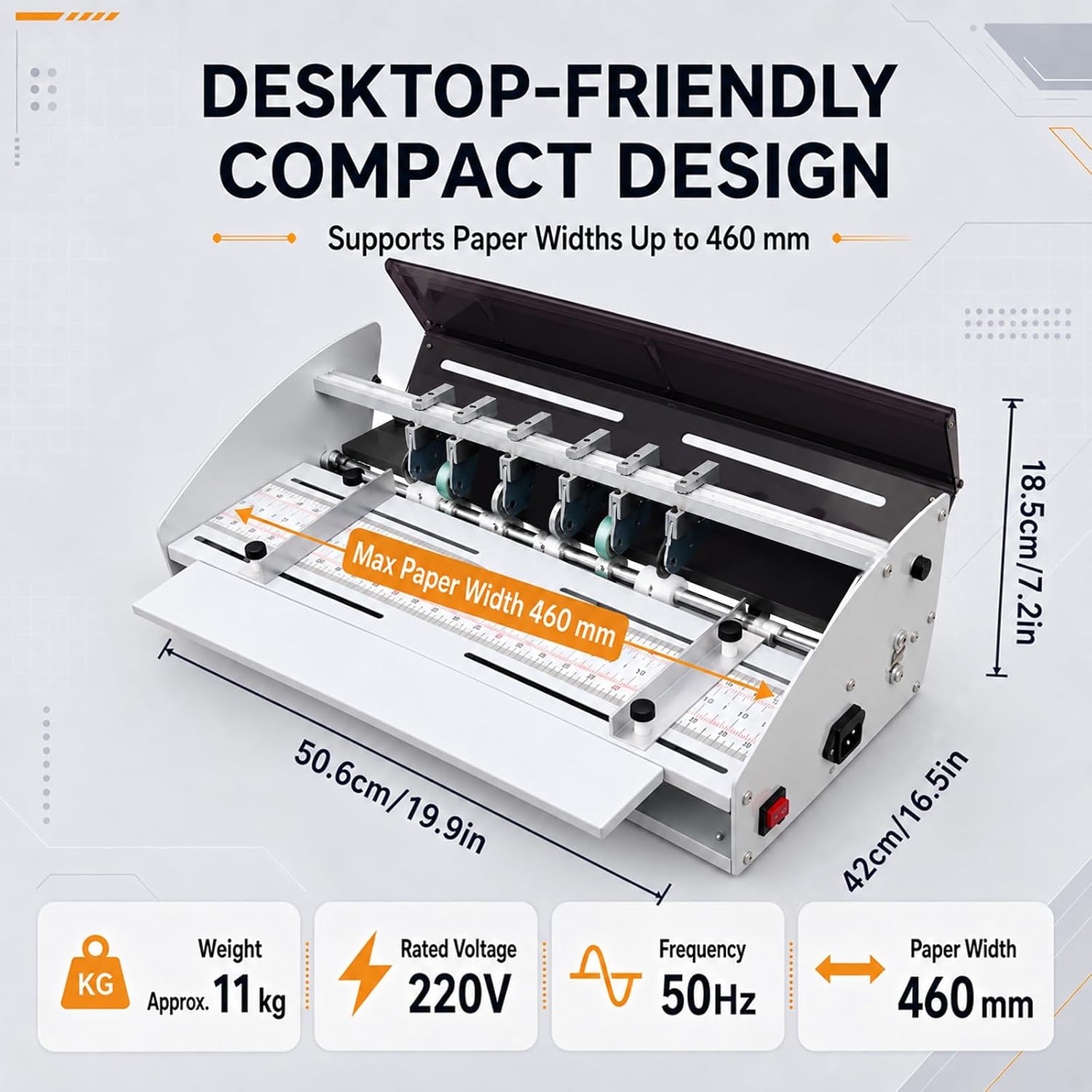
- The listing does not state motor power, machine weight, feed speed or maximum card weight in gsm
- No Amazon UK customer ratings yet, so no track record on durability or seller support
- A bench machine with a 460 mm shaft: it needs a permanent spot, not a shelf
A steel-framed roller creaser with a motor on the shaft and four die types in the box. The score reflects a well specified mechanism for the job, held back by a thin spec sheet and a brand with no UK review history yet.
What it is and who it is for
The CZH102 is an electric creasing machine in the classic roller format: a steel frame, a motor-driven shaft, and a row of dies that press down onto a supporting wheel as the sheet passes between them. The 460 mm working width is the important number. A landscape A3 sheet or an SRA3 printer sheet goes through in one pass, which matters for anyone imposing several cards on one sheet before cutting.
The people it suits are small print shops, wedding and event stationers, church and school offices that produce booklets and tickets, and crafters who sell cards in volume. The common thread is repetition. If your work is one unique card at a time, the setup cost outweighs the speed.
How the 3-in-1 system works
All the dies mount on the same shaft. You slide the die you need into position, set its height relative to the supporting wheel underneath, and lock it with a screw. When you feed a sheet, the rotating shaft grabs it and advances it automatically, so the die rolls a continuous line along the full length of the sheet. Because the dies sit side by side, a crease and a perforation can run in the same pass once they are spaced correctly.
The manufacturer describes the creasing as circular technology with a custom paper bearing that keeps wheel wobble low. In plain terms, a rotary crease applies pressure progressively along the line rather than all at once, which is why rotary machines are kinder to coated and laminated card than a flatbed scorer. Low wobble is what keeps that line straight across 460 mm.
Setting it up
This is where the machine asks something of you. Blade position, height and order are set with screws using the supplied hex wrench, and the listing is clear that you should adjust before bulk use to match the thickness of the paper you are running. Expect a first session with offcuts, moving the die up or down until the crease is deep enough to fold cleanly but not so deep that it cracks the surface. Once set for a stock, you leave it alone and run the batch.
Two practical notes. Mark your settings for each stock you use regularly, because switching between 250 gsm and 350 gsm card means resetting the height. When you add a second creasing die for a gatefold, measure the spacing from the sheet edge rather than from the first die, as that is how you will register the fold against the printed design.
Paper and card it handles
The listing names card stock, envelopes and labels as supported media, and the title calls out cards, invitations and tickets. That covers the bulk of stationery work: greeting cards, wedding suites, event tickets with a tear-off stub, menu cards and table numbers.
What the listing does not give is a maximum paper weight. Most roller creasers in this class handle up to roughly 300 to 400 gsm, but that is a figure for the category, not a specification for this unit. If heavy board is a regular part of your work, confirm the limit with the seller before ordering. Very thin paper can also wander on any rotary feed if the rollers are not set snugly.
Build and performance claims
The frame and dies are steel and the pressure rollers are rubber, the standard pairing for this type of machine: steel so the die edge stays true, rubber so the sheet is gripped without marking. The manufacturer claims a clear, full indentation that does not break the paper. That is the whole point of rotary creasing and is credible for a machine built this way, provided the height is set correctly for the stock.
What cannot be verified from the listing is the motor rating, the feed speed in sheets per minute, or the machine weight. Those three numbers decide how it behaves over a long run and how easy it is to move. The absence is not unusual at this brand tier, but it is a gap to know about.
Where it falls short
Manual screw adjustment is the trade-off for the price point. Machines with quick-release die holders change over faster, and if your day involves constant switching between crease and perforation you will feel the difference. The sparse spec sheet is the other issue. A two year manufacturer warranty is reassuring, but with no UK ratings yet there is no evidence either way on how the seller handles a claim.
Who should buy it, and who should not
Buy it if you crease or perforate card in batches, you print on sheets up to SRA3, and you are comfortable spending twenty minutes with a hex wrench setting it up for each stock you use.
Skip it if you fold a handful of cards a month, you need to switch functions constantly, or you run very heavy board and cannot get a gsm limit confirmed. A manual scoring board or a hand-cranked creaser serves light users better, and a machine with quick-change dies serves high-mix shops better.
FAQs
Does the LANYU SYNERGY CZH102 crease, perforate and cut?
Yes. It ships with two creasing dies, one sawtooth perforating die and one cutting die that all mount on the same drive shaft. You choose and position the dies for each job.
How wide a sheet can it take?
The working width is 460 mm, which is 18 inches. That covers A3 in landscape and SRA3 sheets.
Is the feed automatic?
Yes. Once a sheet is inserted the rotating shaft pulls it through on its own. Die selection, spacing and height are set by hand with screws and a hex wrench.
Can it make a double crease for a gatefold?
Yes. Two creasing dies are included and the spacing between them is adjustable, so a double line in one pass is possible once the dies are set.
What paper weight does it handle?
The listing names card stock, envelopes and labels but does not state a maximum gsm. Confirm with the seller if you regularly run heavy board.
Does it come with a warranty?
The listing states a two year manufacturer warranty.
Is it suitable for wedding invitations and tickets?
That is its main use case: clean folds on invitation card, and perforated tear-off stubs on tickets and reply slips.
Does rotary creasing crack coated card?
Rotary creasing applies pressure progressively along the line, which is the gentler method for coated and laminated stock. Correct die height for the card thickness is what prevents cracking.
How long does setup take?
Expect a first session with test sheets to dial in die height and spacing. A stock you have set before takes a few minutes to return to.
Our verdict
The LANYU SYNERGY CZH102 offers a genuinely useful mechanism: a motor-fed, 460 mm rotary creaser that doubles as a perforator and cutter. For stationers and small print rooms that work in batches it removes the slowest manual step in card production. The caveats are real but specific: screw-based adjustment, a thin spec sheet, and no UK owner history yet. Go in knowing that, confirm the card weight limit with the seller if it matters to you, and it is a sensible buy for volume creasing work.
See it on Amazon UK →