Best Caulking Guns for Fences: Cordless and Manual Picks
Sealing fence panels, gates, and posts means pushing stiff exterior-grade sealant out of a cartridge, over and over, often overhead. That is where cheap guns cramp your hand and lay an uneven bead. Below are the caulking guns worth considering for fence work, compared on published manufacturer specs rather than invented hands-on claims.
Quick answer
For fence work the Milwaukee 2441-20 M12 Caulk and Adhesive Gun is the best cordless pick: it takes standard 10 oz cartridges, has a variable-speed trigger with a speed dial, and retracts the plunger rod automatically when you let go so the bead stops instead of drooling down the boards. If you only need one gun for one fence and do not want a battery platform, the Newborn Model 250 drip-free caulking gun is a genuine manual workhorse with a 26:1 thrust ratio.
Why trust ToolBuyerHub
- Compared on published specs (capacity, thrust, speed control)
- Battery & ecosystem compared
- Model numbers verified against manufacturer listings
- Build quality & warranty checked
- Brand reliability
- No fake hands-on claims
Research updated August 2026.
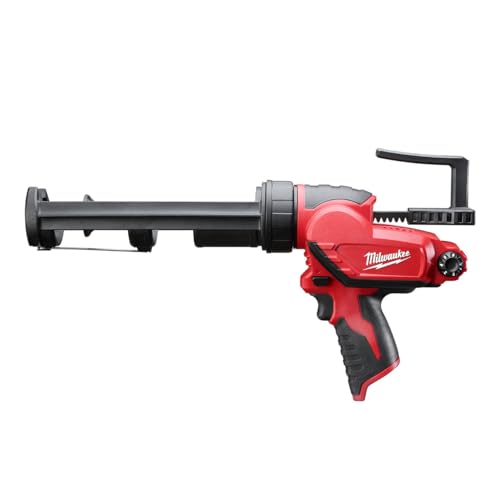
Milwaukee 2441-20 M12 Caulk and Adhesive Gun
Automatic rod retraction stops the drip the moment you release the trigger, which matters on vertical fence boards.
| Product | Best for | Key Spec | Our score | Price |
|---|---|---|---|---|
| Milwaukee 2441-20 M12 | Overall performance | Auto rod retraction, 10 oz | 4.8/5 | $$$ |
| DEWALT DCE560B 20V MAX | DeWalt battery owners | Variable speed, 10 oz | 4.6/5 | $$$ |
| Makita XGC01ZK 18V LXT | Makita battery owners | Speed dial, 10 oz | 4.5/5 | $$$ |
| Newborn Model 250 | Value / manual | 26:1 thrust ratio | 4.4/5 | $ |
| Bosch GCG12V-20N | Compact & precise | 12V Max platform, 10 oz | 4.3/5 | $$ |
Milwaukee 2441-20 M12 Caulk and Adhesive Gun
Best Overall for FencesPros
- Automatic rod retraction stops drips
- Variable speed trigger plus a speed dial for a repeatable bead
- Compact enough to work between fence rails
Cons
- Higher price point
- Sold as a bare tool, so battery and charger cost extra
The Milwaukee 2441-20 is a bare-tool M12 caulk and adhesive gun built for standard 10 oz cartridges, which is the size almost every exterior fence and siding sealant is sold in. Its headline feature for fence work is the anti-drip system: release the trigger and the plunger rod pulls back instead of continuing to push sealant out onto the boards below.
The variable speed trigger, combined with the speed dial on the body, lets you set a maximum flow rate that suits the sealant and then just modulate within it. That is genuinely useful on vertical fence boards, where a bead that runs is a bead you have to tool out. Note that this is a brushed M12 tool, not a Milwaukee FUEL model, so do not buy it expecting FUEL-tier runtime figures. It uses the same M12 REDLITHIUM packs as the rest of the M12 line.
DEWALT DCE560B 20V MAX Cordless Caulking Gun
Best for DeWalt Battery OwnersPros
- Runs on the widely owned 20V MAX battery platform
- Variable speed trigger for different sealant viscosities
- Anti-drip rod release for cleaner pauses
Cons
- Bare tool, so battery and charger are extra
- Larger and heavier in the hand than a 12V gun
The DCE560B is DEWALT's 10 oz cordless caulking gun and the obvious answer if your other cordless tools are already yellow. It takes the same standard cartridges as the Milwaukee, and the variable speed trigger gives you enough range to move between a thin acrylic latex caulk and a stiffer exterior polyurethane sealant without changing tools.
Where it earns its place for fences is battery availability. If you already own 20V MAX packs, the running cost of adding this tool is just the tool. It is a bare-tool listing, so check what you are buying before you order, and be aware the larger 20V body is a bit more awkward than a 12V gun when you are working close in around posts.
Makita XGC01ZK 18V LXT Cordless Caulk and Adhesive Gun
Best for Makita Battery OwnersPros
- Adjustable speed control for a consistent bead
- Runs on the large Makita 18V LXT battery range
- Includes a tool case in the K version
Cons
- Not a lightweight tool once a battery is fitted
- Battery and charger sold separately
The Makita XGC01ZK is the 18V LXT answer to the same job: a 10 oz cartridge gun with an adjustable speed setting so you can dial in a flow rate and reproduce the same bead down a whole run of fence boards. The Z suffix means bare tool and the K means it ships in a case.
Be realistic about weight. Cordless caulk guns are motor, gearbox and battery wrapped around a cartridge, so none of them are light, and this one is no exception once an 18V pack is on the back. If arm fatigue is your main concern on a tall fence, a compact 12V gun or a good manual gun will serve you better than any 18V model. Buy this one because you are already in the LXT system.
Newborn Model 250 Drip-Free Caulking Gun
Best Value / Best ManualPros
- No battery, no charger, no platform lock-in
- 26:1 thrust ratio handles stiff exterior sealants
- Drip-free smooth rod releases pressure the moment you stop
Cons
- Still a hand-powered gun, so long runs tire your grip
- Bead consistency depends entirely on your technique
Before you assume a fence job needs a cordless gun, look at the Newborn 250. It is a professional-grade manual gun with a 26:1 thrust ratio, which is the number that actually matters when the sealant is stiff. A typical hardware-store ratchet gun sits around 10:1 and that difference is exactly why cheap guns feel like they are fighting you on exterior sealant.
The smooth hex rod with a drip-free mechanism releases pressure as soon as you let go of the trigger, so you get much of the anti-drip behaviour of the cordless models at a fraction of the price. For a single fence, a gate, or occasional exterior sealing, this is the honest value pick.
Bosch GCG12V-20N 12V Max Cordless Caulking Gun
Best Compact & PrecisePros
- Compact 12V body for tight spaces around posts
- Variable speed control for precise beads
- Solid Bosch build quality
Cons
- 12V packs need charging more often than 18V or 20V
- Smaller battery platform than the big three
The Bosch GCG12V-20N is the compact option here. Note the model prefix: it is GCG, Bosch's caulking gun line. GTC is Bosch's thermal camera range, so if a listing says GTC you are looking at the wrong tool entirely. This one takes standard 10 oz cartridges and runs on Bosch's 12V Max packs.
The compact body is the real selling point for fence work, where you are often reaching into the gap between a post and a panel or working a bead along a rail with limited swing room. The trade-off is runtime: a 12V pack will not carry you as far as an 18V or 20V one, so plan on a spare if you are sealing a long run in one session.
What to check before buying a caulking gun for fences
Cartridge size first. In the US, the standard caulk and sealant cartridge is 10 oz, and that is what almost every exterior fence, siding and window sealant comes in. Larger 20 oz and 29 oz sausage packs exist, but they need a sausage-style gun and are aimed at contractors doing whole houses. For a fence, a 10 oz gun is the right tool. Buy the sealant first and match the gun to it, not the other way round.
Then look at force. On a manual gun that number is the thrust ratio, and higher is better: a 26:1 gun will push stiff polyurethane sealant that a 10:1 hardware-store gun turns into a wrist workout. On a cordless gun, the equivalent is the maximum dispensing force the manufacturer publishes, along with variable speed control so you can match flow to viscosity. Finally, battery platform compatibility matters more than brand loyalty, since a bare tool on a platform you already own is far cheaper than a kit on a new one.
Mistakes to avoid when using a caulking gun on fences
The most common mistake is using a low-thrust ratchet gun with a stiff exterior sealant, which gives you a stuttering, uneven bead and a cramped hand. The second is nozzle prep: cut at roughly 45 degrees, start with a smaller opening than you think you need, and puncture the inner seal properly rather than just jabbing at it.
Failing to release rod pressure when you pause causes drips down the face of the boards. Cordless models with automatic rod retraction handle that for you; on a ratchet gun you must flip the release or twist the rod every time you stop. Finally, do not apply sealant in direct sun or in near-freezing conditions, and check the label temperature range, because both adhesion and cure time suffer outside it.
FAQs
Can I use a standard caulk gun for fence sealant?
Yes, but a high thrust ratio manual gun or a cordless gun is recommended, because exterior fence sealants are stiffer than interior decorator's caulk and need more force to dispense smoothly.
What size caulking gun do I need for fences?
A standard 10 oz cartridge gun. That is the size nearly all exterior fence and siding sealants are sold in. Only step up to a 20 oz or 29 oz sausage gun if you are buying sealant in sausage packs.
Is a cordless caulk gun better than a manual one for fences?
For long runs, yes, because it removes the hand fatigue and gives you a more even bead. For a single fence or gate, a good manual gun with a high thrust ratio does the job for far less money.
Do I need a drip-free caulk gun for fences?
It helps a lot. Fence boards are vertical, so any sealant that keeps oozing after you stop runs down the face of the wood. Automatic rod retraction on cordless guns, or a drip-free smooth rod on a manual gun, prevents this.
What is a good thrust ratio for a caulking gun?
Look for 18:1 or higher for exterior sealants, and 26:1 if you want comfortable operation with stiff polyurethane products. Basic ratchet guns are often around 10:1, which is where most complaints about hand strain come from.
How long does a cordless caulk gun battery last?
It varies by tool, battery capacity and sealant stiffness, so treat manufacturer figures as best case. In practice, expect several 10 oz cartridges from a charged pack, and carry a spare if you are sealing a long fence in one go.
Can I use a caulk gun for wood filler on fences?
Yes, if the filler comes in a standard cartridge. Exterior wood fillers are thicker than caulk, so a higher thrust ratio or a cordless gun makes a noticeable difference.
What is the best brand for a fence caulking gun?
Milwaukee, DEWALT, Makita and Bosch all make solid cordless models, and the right choice usually comes down to which battery platform you already own. For manual guns, Newborn is the long-standing professional standard.
Do I need a variable speed caulk gun for fences?
Variable speed is genuinely useful, because it lets you slow down for corners and post details, then open up along a straight rail without changing your walking pace.
How do I clean a caulk gun after fence work?
Wipe off excess sealant immediately while it is still wet. For cured sealant, use the solvent the sealant manufacturer recommends on the rod, plunger plate and nozzle area, and keep solvent away from a cordless tool's motor housing.
Our verdict
For most fence projects, the Milwaukee 2441-20 M12 Caulk and Adhesive Gun is the best overall choice thanks to its automatic rod retraction and dialled-in speed control on standard 10 oz cartridges. If you already own DeWalt or Makita batteries, the DEWALT DCE560B and Makita XGC01ZK do the same job on your existing platform. And if this is a one-fence job, the Newborn Model 250 at 26:1 gives you most of the control for a small fraction of the cost.