Best Paint Sprayer
Spray type decides everything, and it is a straight split. Airless sprayers push unthinned paint at high pressure, which makes them fast on walls, fences and exteriors and heavy on overspray. HVLP sprayers move paint on a high volume of low pressure air, which gives a fine controlled finish on cabinets and furniture and is slow on a wall.
The honest warning about spraying is masking. A sprayer that coats a room in ten minutes will also coat the floor, windows and your car if they are not covered, and the masking takes longer than the spraying. Factor that in before assuming a sprayer saves time on a small job.
Quick answer
For walls, fences and exteriors the Graco Magnum X5 is the best all round airless sprayer. For cabinets, doors and furniture use an HVLP instead, with the Wagner FLEXiO 595 for occasional work and the Fuji Semi-PRO 2 if the finish really matters. The Wagner Control Pro 130 is the pick if overspray is your main concern.
Why trust ToolBuyerHub
- Every sprayer here is a named brand sold on Amazon US, checked against the live listing
- Specifications come from manufacturer and listing data, not from guesswork
- Owner-feedback themes are summarized as feedback, never as our own hands-on testing
- No invented star ratings; the Research Score criteria are visible on each pick
- Airless and HVLP are compared as different tools for different jobs, not ranked on one scale
- Overspray, masking time and cleaning time are stated, since those decide whether spraying is worth it
Research updated October 2026.
What Matters Most When Buying a Paint Sprayer
Decide between airless and HVLP first, because they are not substitutes. Airless pumps unthinned paint through a small tip at high pressure, which atomises it into a fast, heavy pattern suited to walls, ceilings, fences and siding. HVLP uses a large volume of low pressure air to carry a finer, more controlled spray, which is what you want on cabinet doors, furniture and trim where the finish is inspected closely. Overspray follows directly from that: airless produces a lot, HVLP much less, and high efficiency airless sits in between. Then consider thinning, since HVLP units generally need latex paint thinned while airless sprayers handle it as supplied. Finally, weigh cleaning time honestly. Every sprayer takes 15 to 30 minutes to flush properly, and skipping it is how sprayers die, so for a job smaller than a full room a brush and roller is often genuinely faster overall.
| Model | Best for | Key specs | Research Score |
|---|---|---|---|
| Graco Magnum X5 Airless Paint Sprayer, Interior and Exterior | Walls, ceilings, fences and exteriors | Airless, Draws from the paint can | 93/100 |
| Wagner Spraytech FLEXiO 595 Handheld HVLP Paint and Stain Sprayer | Occasional furniture and trim work | HVLP, handheld, Cup fed | 89/100 |
| Wagner Spraytech Control Pro 130 HEA Sprayer Kit, 515 and 311 Tips | Airless speed with less overspray | High efficiency airless, Draws from the can | 91/100 |
| HomeRight Super Finish Max HVLP Paint and Stain Sprayer with 3 Brass Tips | Cheap entry to fine finish spraying | HVLP, handheld, Three brass tips | 86/100 |
| Titan ControlMax 1700 High Efficiency Airless Paint Sprayer, 0580009 | Whole house exteriors and big jobs | High efficiency airless, Bucket feed | 92/100 |
| Graco TrueCoat 360 Variable Speed Handheld Airless Paint Sprayer, 26D283 | Small airless jobs and touch-ups | Handheld airless, Variable | 87/100 |
| Fuji Spray 2203G Semi-PRO 2 Gravity HVLP Spray System | Cabinet and furniture finishing | Turbine HVLP, Gravity feed, non-bleed | 94/100 |

Graco Magnum X5 Airless Paint Sprayer, Interior and Exterior
Best OverallPros
- Draws straight from a 1 or 5 gallon bucket, so you are not refilling a small cup every few minutes
- Handles unthinned latex, which removes the guesswork and mess of thinning
- Adjustable pressure lets you dial back for trim and up for exterior siding
Cons
- Heavy overspray, so masking is extensive and non-negotiable
- Cleaning takes a proper flush cycle every time, around 20 to 30 minutes
The standard answer for anyone spraying walls or a house exterior. Drawing from the bucket is the feature that matters most in practice: cup fed sprayers stop every few minutes on a large job, which destroys the speed advantage that made you buy a sprayer. Unthinned latex is the second. Go in expecting serious masking and a real cleaning routine, because both are the price of the speed.

Wagner Spraytech FLEXiO 595 Handheld HVLP Paint and Stain Sprayer
Best Handheld HVLPPros
- Far less overspray than airless, so masking is quicker and indoor work is more practical
- Adjustable pattern and flow make it genuinely usable on both trim and small wall sections
- No compressor or hose, so setup is a couple of minutes
Cons
- Cup fed, so you refill often and it is slow on a whole room
- Latex usually needs thinning, which takes trial and error to get right
The sensible first sprayer for most homeowners, because the jobs most people actually spray are furniture, doors, cabinets and trim rather than whole houses. Less overspray means you can work inside with a reasonable amount of masking instead of sealing the room. Accept the refills and plan to thin latex; the manual gives a starting point and a test board will tell you the rest.

Wagner Spraytech Control Pro 130 HEA Sprayer Kit, 515 and 311 Tips
Best Low OversprayPros
- High efficiency airless runs at lower pressure, which cuts overspray substantially against conventional airless
- Still bucket fed and still handles unthinned latex, so it keeps the airless speed advantage
- Two tip sizes included covers both wide wall patterns and narrower trim work
Cons
- Lower pressure means it is a little slower than a full pressure airless on big exterior work
- Still produces more overspray than any HVLP, so interior masking remains significant
The best compromise in this list. High efficiency airless was developed specifically because conventional airless overspray is the main complaint about the technology, and running at lower pressure genuinely reduces it while keeping bucket feed and unthinned paint. If you want to spray interior walls without turning the whole room into a paint booth, this is the category to look at.
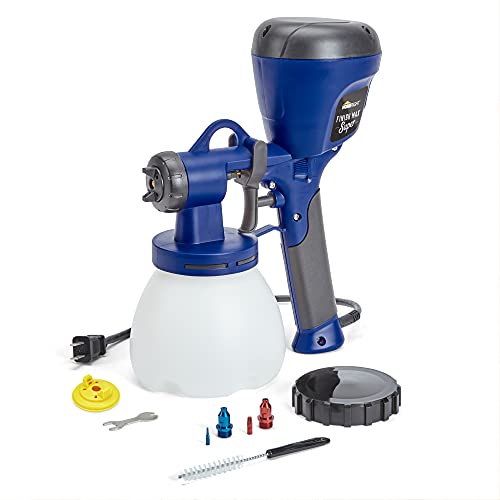
HomeRight Super Finish Max HVLP Paint and Stain Sprayer with 3 Brass Tips
Best BudgetPros
- Three brass tip sizes cover thin stains through to thicker latex, which is unusual at this price
- Cheap enough to justify for a single furniture project
- Light and simple, with a short learning curve on a test board
Cons
- Build quality is consumer grade, so heavy repeated use will wear it
- Needs careful thinning and more frequent cleaning than better HVLP units
A reasonable way to find out whether spraying suits you without much outlay. The included tip range is the genuinely useful part, since matching tip size to material viscosity is most of getting a good HVLP result and many budget units ship with one compromise tip. Treat it as consumer grade: clean it thoroughly every time, and if you end up spraying regularly, step up to a Fuji.

Titan ControlMax 1700 High Efficiency Airless Paint Sprayer, 0580009
Best for Large JobsPros
- Built for sustained use, so it keeps up on a whole house rather than overheating or stalling
- High efficiency design cuts overspray while keeping real airless throughput
- Long hose means the pump stays put while you move around the building
Cons
- More sprayer, and more cost, than a single room project justifies
- Still needs full masking on anything you do not want painted
The pick when the job is big enough that pump capacity matters. Consumer airless units slow down, heat up and stall under continuous demand, and a house exterior is continuous demand. Titan builds for that duty cycle. The long hose is a practical point people underrate, because moving a pump repeatedly around a building is both slow and how pumps get knocked over into the shrubbery.

Graco TrueCoat 360 Variable Speed Handheld Airless Paint Sprayer, 26D283
Best Handheld AirlessPros
- Airless atomisation of unthinned latex without a pump, hose and bucket to set up
- Sprays in any orientation, including upside down for undersides and ceilings
- Variable speed gives some control over flow for smaller work
Cons
- Cup fed, so it is unsuited to anything larger than a small room or a few pieces
- Still produces airless-level overspray despite the small size
Useful for the jobs that fall between a brush and a full airless setup: a fence panel, a shed, a set of railings, a single accent wall. The appeal is that there is nothing to set up, so the overhead of spraying drops to almost nothing. Do not expect it to replace a bucket fed airless on a real job, and do not expect the small size to mean less overspray, because it does not.

Fuji Spray 2203G Semi-PRO 2 Gravity HVLP Spray System
Best Finish QualityPros
- A dedicated turbine delivers consistent air, which is what produces a genuinely furniture grade finish
- Gravity feed gun with a quality needle and nozzle gives fine control over the pattern
- Serviceable with available spares rather than disposable, so it lasts years
Cons
- Expensive, and only justified if finish quality is the point of the purchase
- Slow on walls, so it is not a general purpose sprayer
If you are refinishing kitchen cabinets and the result has to look sprayed rather than painted, this is the right class of tool. Handheld HVLP units compromise on air supply, and inconsistent air is what produces orange peel and dry spray. A turbine system removes that variable, and the gun is a serviceable piece of equipment rather than a sealed consumer unit. It is the wrong tool for a wall.
Airless or HVLP, and why it is not a close call
Airless forces unthinned paint through a small tip at high pressure. That makes it fast and well suited to large areas: walls, ceilings, fences, siding. It produces a lot of overspray and a slightly heavier film. HVLP carries paint on a high volume of low pressure air, producing a finer, more controlled pattern with far less overspray, which is what cabinet doors, furniture and trim need. Choosing by job rather than by price is the whole decision. Buying an airless to spray kitchen cabinets, or an HVLP to spray a house, both end badly. High efficiency airless is a genuine middle ground for interior walls.
Masking is the real cost of spraying
A sprayer coats everything in the direction it is pointed, plus a surprising amount that drifts. Indoors that means floors, ceilings if you are doing walls, windows, outlets, door hardware and anything left in the room. Outdoors it means windows, roofing, plants, paths, the neighbour's car and your own. Proper masking on a room takes longer than the spraying does, which is why spraying only pays off from about a full room upward, or on a surface such as a picket fence or a slatted door that is slow to brush. For a single wall, a roller is usually faster door to door.
Thinning, tips and getting a clean pattern
Airless sprayers generally handle latex as supplied, and the tip size controls the pattern width and flow: a 515 tip, for example, sprays a 10 inch fan with a 15 thousandths orifice. HVLP units usually need latex thinned, and the correct amount depends on the paint, so test on cardboard and adjust rather than guessing. Common faults have standard causes: tails or fingers at the edge of the pattern mean pressure is too low or the tip is worn, spitting means air in the system or a loose fitting, and heavy orange peel means the material is too thick or the gun is too far from the surface.
Cleaning, and why it decides whether you keep the sprayer
Every sprayer needs a full flush immediately after use, typically 15 to 30 minutes including dismantling the gun, cleaning the tip and filters and running solvent or water through the system. Dried latex in a pump, a hose or a tip is the main way sprayers die, and tips and needles are precision parts that do not survive being scraped. Budget the cleaning time into every job from the start. If a job is small enough that 20 minutes of cleaning dominates it, that is a sign to use a brush.
FAQs
What is the best paint sprayer for home use?
For walls, ceilings and exteriors, the Graco Magnum X5 airless sprayer, because it draws from the paint bucket and handles unthinned latex. For cabinets, furniture and trim, an HVLP sprayer is the right tool instead, with the Wagner FLEXiO 595 covering occasional work well.
What is the difference between airless and HVLP sprayers?
Airless pushes unthinned paint through a small tip at high pressure, which is fast on large areas and produces heavy overspray. HVLP carries paint on high volume low pressure air, giving a finer, more controlled finish with much less overspray but far slower coverage. Airless is for walls and exteriors; HVLP is for cabinets, furniture and trim.
Do I need to thin paint for a sprayer?
Usually not for an airless sprayer, which is designed to handle latex as supplied. Usually yes for HVLP, especially handheld units, where latex is too thick to atomise properly. The right amount varies by paint, so test on cardboard and adjust rather than following a fixed ratio.
Is spraying faster than rolling?
Only above a certain size. Spraying itself is several times faster, but masking a room properly takes longer than spraying it, and cleaning the sprayer takes another 15 to 30 minutes. From about a full room upward, or on slow-to-brush surfaces such as picket fences, louvre doors and railings, spraying wins clearly. For a single wall, a roller is usually faster overall.
How much overspray does a paint sprayer produce?
Conventional airless produces the most, high efficiency airless noticeably less, and HVLP the least. All of them produce enough that everything you do not want painted must be covered, including items well away from the surface. Working outdoors on a breezy day significantly increases drift, so check conditions before spraying an exterior.
What tip size should I use?
Tip numbers encode two things: the first digit relates to fan width and the last two to the orifice size in thousandths of an inch. A 515 tip sprays a 10 inch fan through a 15 thousandths orifice, which suits walls, while a 311 gives a 6 inch fan through 11 thousandths for trim and narrower work. Thicker materials need a larger orifice, and a worn tip produces tails at the edge of the pattern.
How do I clean a paint sprayer?
Flush immediately after use, before anything dries. Run water for latex or the appropriate solvent for oil-based products through the whole system, then dismantle the gun, clean the tip, filters and needle, and reassemble. Dried paint in a pump, hose or tip is the main cause of sprayer failure, and tips and needles are precision parts that cannot be scraped clean.
Can I spray kitchen cabinets with an airless sprayer?
You can, but an HVLP will give a visibly better finish, which is the point of spraying cabinets in the first place. Airless lays down a heavier film with more overspray and less control at edges and detail. For cabinet work, a turbine HVLP such as the Fuji Semi-PRO 2 is the right tool, with a handheld HVLP as the budget option.
Why is my sprayer leaving an orange peel texture?
Usually the material is too thick for the sprayer, the gun is too far from the surface so the paint is partly dry on arrival, or on HVLP the air supply is inconsistent. Thin the paint to the recommended viscosity, work around 6 to 10 inches from the surface depending on the unit, and keep the gun moving parallel to the surface rather than arcing.
Our verdict
Choose by job, not by price. The Graco Magnum X5 is the right airless sprayer for walls, fences and exteriors, with the Titan ControlMax 1700 taking over when the job is a whole house. Pick the Wagner Control Pro 130 if you want airless speed indoors without coating the room in overspray. For cabinets and furniture, use HVLP: the Wagner FLEXiO 595 for occasional work, the HomeRight Super Finish Max to try it cheaply, and the Fuji Semi-PRO 2 when the finish is the whole point.