Best Basin Wrenches of 2026 for Under-Sink Faucet Nuts
Changing a faucet means reaching mounting nuts that sit six to ten inches back behind the bowl, in a cabinet you cannot get your head into. A basin wrench is the tool built for exactly that job: a long shaft with a spring-loaded jaw on a pivot, turned blind from below. Below are the models we can actually stand behind, with real capacities rather than made-up numbers.
Quick answer
The RIDGID 1017 telescoping basin wrench is the safest all-round buy: a classic spring-jaw head, a shaft that extends from about 10 to 17 inches, and a 3/8 to 1-1/4 inch capacity that covers most US faucet mounting nuts. If your nuts are the common standard sizes and you want speed over versatility, the RIDGID 57003 EZ Change is a socket-style tool that grabs them faster, though it is not a true basin wrench.
Why trust ToolBuyerHub
- Specs checked against manufacturer catalog data (reach, jaw capacity, material)
- Model numbers verified before we publish them
- Tool type matched to the actual job, not to a category label
- Build quality & warranty checked
- Brand reliability
- No fake hands-on claims and no invented review counts or star averages
Research updated August 2026.
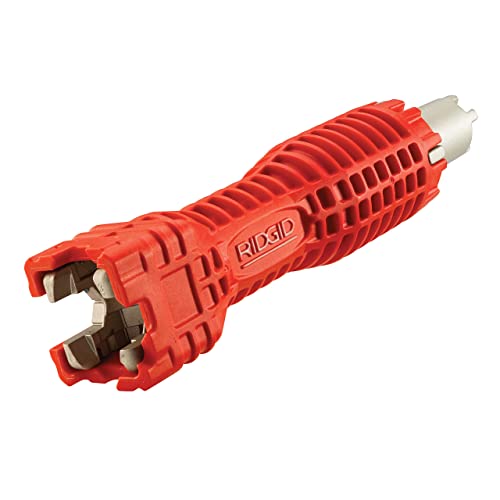
RIDGID 57003 EZ Change Plumbing Wrench
A socket-style faucet tool, not a pivoting-jaw basin wrench. The head drops straight over common faucet and supply nuts, so there is no jaw to set.
| Product | Best For | Type | Capacity | Price |
|---|---|---|---|---|
| RIDGID 1017 | Overall / most faucets | Telescoping spring-jaw | 3/8 to 1-1/4 in | Check Amazon |
| RIDGID 57003 EZ Change | Fast faucet swaps | Socket-style head | Common faucet nuts | Check Amazon |
| Superior Tool Faucet & Sink Installer | Tight cabinets / budget | Multi-slot installer | Common faucet & supply nuts | Check Amazon |
| Danco telescoping basin wrench | Occasional DIY | Telescoping spring-jaw | Standard faucet nuts | Check Amazon |
| RIDGID 1019 | Oversized nuts | Large-capacity spring-jaw | Roughly 1 to 2-1/2 in | Check Amazon |
What is a Basin Wrench and Why Do You Need One?
A basin wrench is a specialized plumbing tool designed to tighten or loosen the nuts that hold faucets and supply lines to a sink. Those nuts sit in a dead zone at the back of the cabinet where a standard wrench simply will not fit. The long shaft and pivoting spring-loaded jaw let you reach up from below, bite the nut by feel, and turn it without ever seeing it.
The jaw flips to either side of the shaft, which is what lets one tool both loosen and tighten. For any faucet replacement or supply-line repair, this is the tool that turns a two-hour fight with pliers into a ten-minute job.
What to Check Before Buying a Basin Wrench
Start with reach. Fixed-shaft basin wrenches are usually around 10 to 11 inches; telescoping models such as the RIDGID 1017 extend to roughly 17 inches, which matters on deep vanity or farmhouse sinks. Longer is not automatically better, since a long shaft is harder to swing inside a cramped cabinet.
Then check jaw capacity, and check it against your actual nut. A standard basin wrench covers roughly 3/8 inch to 1-1/4 inch, which handles most US faucet mounting nuts and supply-line nuts. Oversized nuts, including many wide plastic mounting nuts on modern pull-down kitchen faucets, need a large-capacity tool such as the RIDGID 1019 that opens to about 2-1/2 inches. Buying the standard size and discovering mid-job that the jaw will not open is the single most common mistake here.
Material matters less than people assume, but a steel shaft with a hardened jaw will outlast a stamped one. A T-bar handle, which on most basin wrenches is a sliding rod through the bottom of the shaft, gives you leverage and can be shifted off-center to clear an obstruction.
Mistakes to Avoid When Using a Basin Wrench
The most common mistake is applying too much force on plastic nuts, which crack rather than strip. Turn slowly and stop when it snugs. Another error is not fully seating the jaw on the flats of the nut, which causes it to slip and round the corners off.
Check the jaw direction before you climb under the sink. The jaw pivots, and set the wrong way it will simply ratchet off the nut instead of biting. On rusted or seized nuts, apply penetrating oil and give it time before forcing anything; a seized steel nut can bend the shaft. And never use the wrench as a hammer or pry bar.
RIDGID 1017 Telescoping Basin Wrench
Best OverallPros
- Telescoping shaft covers shallow and deep sinks
- Capacity matches most US faucet mounting nuts
- Long-running RIDGID catalog item with warranty support
Cons
- Costs more than a generic fixed-shaft wrench
- Jaw will not open wide enough for oversized plastic nuts
The 1017 is the basin wrench most plumbers reach for, and it earns that by being the least fussy option. The shaft telescopes so one tool serves a shallow bathroom basin and a deep kitchen sink, and the spring-loaded jaw flips to either side so the same wrench loosens and tightens without re-rigging anything.
The important number is the 3/8 to 1-1/4 inch capacity. That range covers standard brass and plastic faucet mounting nuts and supply-line nuts, which is the large majority of residential work. If you already know you are dealing with one of the wide plastic mounting nuts used on some modern pull-down kitchen faucets, size up to the 1019 instead rather than assuming this one will stretch.
RIDGID 57003 EZ Change Plumbing Wrench
Fastest for Faucet NutsPros
- No jaw to set, the head simply drops over the nut
- Much faster on standard nut sizes
- Telescoping shaft for deep sinks
Cons
- Only fits the nut sizes its head is cut for
- Not a substitute for a real basin wrench on odd or damaged nuts
This is the tool most often mislabeled online as a basin wrench, and the distinction matters. The EZ Change does not use a pivoting spring jaw. It uses a socket-style head sized for common faucet mounting and supply nuts, which you push up over the nut and turn. On the sizes it fits, that is genuinely faster than fishing a jaw into position by feel.
The trade-off is range. A spring jaw will grab almost anything inside its capacity, including a nut that has already been chewed up. A fixed socket profile either fits or it does not. Treat this as a faucet installation and removal tool that complements a basin wrench rather than replacing one, and it is excellent value.
Superior Tool Faucet & Sink Installer
Best BudgetPros
- Costs a fraction of a steel basin wrench
- Several nut sizes in one tool
- Light and short, easy to work in a cramped cabinet
Cons
- Polymer body can flex or break under heavy torque
- Short body offers no reach on deep sinks
The familiar molded multi-slot installer covers several standard faucet and supply nut sizes in one cheap tool, and for a homeowner replacing one faucet on an accessible sink it is often all that is needed. Slip the correct opening over the nut, then turn by hand or with a bar through the tool.
Know its limit. It is polymer, not steel, so a genuinely seized nut will flex or break it before the nut moves. It also has no shaft to speak of, so a deep sink where the nut sits far back is out of its range. Within those bounds it is the best value here.
Danco Telescoping Basin Wrench
Best for Occasional UsePros
- Conventional pivoting jaw, so it handles odd nuts
- Widely stocked alongside Danco faucet repair parts
- Cheaper than pro-catalog wrenches
Cons
- Finish and jaw hardness are a step below RIDGID
- Capacity varies by model, so check the listing before buying
Danco is a repair-parts brand rather than a professional tool brand, and its basin wrench reflects that: a conventional telescoping shaft and pivoting spring jaw at a homeowner price. Mechanically it does the same thing as the 1017, and for a faucet you will change once a decade that is enough.
Because Danco revises its plumbing tool line periodically, confirm the stated jaw capacity and extended length on the specific listing you are buying rather than assuming. That single check avoids the most common complaint on tools in this price band, which is a jaw that will not open far enough for the nut in question.
RIDGID 1019 Large-Capacity Basin Wrench
Best for Oversized NutsPros
- Opens far wider than a standard basin wrench
- Handles wide plastic mounting nuts on modern kitchen faucets
- Same proven RIDGID jaw mechanism
Cons
- Too large for small supply-line nuts
- Bulkier head needs more room to swing
The 1019 exists for one reason: the nut is too big for a normal basin wrench. Many contemporary pull-down kitchen faucets and some vessel-sink installations use wide plastic mounting nuts that a 1-1/4 inch jaw cannot get around, and no amount of forcing changes that.
This is not a first purchase. It is the tool you add when you have measured the nut and found it out of range, or when you work on enough kitchen faucets that you will hit one eventually. Because the jaw starts around 1 inch, it is a poor choice for small supply-line nuts, so it complements the 1017 rather than replacing it.
FAQs
Can I use a basin wrench on plastic nuts?
Yes, and it is usually the right tool for them, but use gentle force. Plastic mounting nuts crack rather than strip. Seat the jaw fully on the flats and stop as soon as it snugs.
What size basin wrench do I need?
Check the nut, not the sink. A standard wrench such as the RIDGID 1017 covers 3/8 to 1-1/4 inch, which fits most faucet mounting and supply nuts. Wide plastic mounting nuts over 1-1/4 inch need a large-capacity model like the 1019.
Are basin wrenches universal?
No. They are limited by jaw capacity at both ends. A standard jaw will not close small enough for tiny fittings or open wide enough for oversized nuts, so always check the stated capacity range against your nut.
What is the difference between a basin wrench and the RIDGID EZ Change tool?
A basin wrench uses a pivoting spring-loaded jaw that grips a range of nut sizes. The EZ Change uses a socket-style head cut for specific common nut sizes. The socket is faster on the sizes it fits; the jaw is more versatile.
Do I need a telescoping shaft?
On a standard bathroom basin, no. On a deep kitchen or farmhouse sink where the nut sits well back, a telescoping shaft that extends to around 17 inches is the difference between reaching the nut and not.
Can I use a basin wrench for other plumbing tasks?
It is built for nuts under sinks in confined space. For exposed pipe work, an adjustable wrench or pipe wrench gives far better control and will not damage the basin wrench jaw.
How do I maintain my basin wrench?
Wipe it dry after use, since under-sink work means moisture. Put a drop of light oil on the jaw pivot and the telescoping detent occasionally so the jaw keeps springing back cleanly.
What is the best basin wrench for tight cabinets?
A shorter fixed-shaft wrench, or the Superior Tool installer, since both need less room to swing. A long telescoping wrench collapsed down to its minimum length also works.
Do basin wrenches come with a warranty?
RIDGID hand tools carry a lifetime warranty against defects in materials and workmanship. Coverage on budget and homeowner-brand tools is more limited, so check the specific product listing.
Is a basin wrench worth it for a single faucet replacement?
Yes. It costs a fraction of a plumber's call-out and removes most of the risk of rounding off a nut you cannot see. If it really is one job on a standard sink, the budget installer tool is enough.
Our verdict
For most people the RIDGID 1017 telescoping basin wrench is the right buy: the 3/8 to 1-1/4 inch jaw and roughly 10 to 17 inch reach cover the large majority of US faucet installations. Add the RIDGID 57003 EZ Change if you want speed on standard nuts, or step up to the 1019 if you have measured an oversized plastic mounting nut. For one straightforward faucet swap, the Superior Tool installer will do the job for a few dollars.