Best Caulking Guns for Bathrooms and Kitchens in Hard Water Areas
Let us clear up the myth first: hard water does not attack a caulking gun. The gun never carries water, and calcium and magnesium deposits form on fixtures, tile and showerheads, not on a tool that sits in a drawer between jobs. What hard water really does is shorten the life of the caulk line around tubs, showers and sinks, because mineral scale, mildew and the harsh cleaners used to remove them break down the bead. In a hard water home you simply re-caulk more often, so the gun worth buying is the one that lays a clean bead, stops on demand instead of oozing, and pushes stiff silicone without wrecking your hand.
Quick answer
The Newborn 930-GTD is the caulking gun most people should buy: a 10:1 thrust ratio, a smooth pressure rod and a genuine drip-free release, which is what keeps a bathroom bead tidy. If you re-caulk often or want zero hand fatigue, the Milwaukee 2641-20 M18 cordless caulk gun gives you an adjustable speed dial and automatic anti-drip for a consistent bead every time.
Why trust ToolBuyerHub
- Specs checked against manufacturer listings (thrust ratio, cartridge size, battery platform)
- Battery & ecosystem compared
- Common owner-review themes summarized, not counted
- Build quality & warranty checked
- Brand reliability
- No fake hands-on claims and no invented performance numbers
Research updated August 2026.
Newborn 930-GTD
· Best OverallDrip-free smooth rod and 10:1 thrust: the cleanest bead for the money.
| Product | Best For | Key Spec | Rating | Price |
|---|---|---|---|---|
| Newborn 930-GTD | Overall bathroom and kitchen work | 10:1 thrust, drip-free smooth rod | 4.8 / 5 | $ |
| Milwaukee 2641-20 (M18) | Frequent re-caulking, cordless | 10 oz cartridge, speed dial, anti-drip | 4.7 / 5 | $$$ |
| DeWalt DCE560B (20V MAX) | DeWalt battery owners | 10 oz cartridge, variable-speed trigger | 4.6 / 5 | $$$ |
| Makita XGC01Z (18V LXT) | Fine control on long beads | 10 oz cartridge, speed dial | 4.5 / 5 | $$$ |
| Newborn 250 | Stiff sealants on a budget | 26:1 thrust, ratchet rod | 4.3 / 5 | $ |
What Hard Water Actually Does (And Does Not Do)
Hard water is water carrying dissolved calcium and magnesium. It leaves scale on showerheads, glass, taps and tile, and that scale traps soap residue that mildew feeds on. Around a bath or shower tray, that combination sits directly on the silicone bead. The bead discolors, the surface gets scrubbed with acidic limescale removers or bleach-based cleaners, and the edge eventually lifts and lets water behind it.
None of that happens to the caulking gun. A caulking gun holds a cartridge and pushes a plunger; it is not plumbed into anything. There is no such thing as a hard-water-rated or corrosion-rated caulking gun, and any listing that claims a sealed trigger keeps minerals out is marketing rather than engineering. The only genuine moisture concern is storage: a bare steel rod left damp in a bathroom cupboard can develop surface rust, which a wipe-down and a drop of light oil prevents.
What to Check Before Buying a Caulking Gun
Thrust Ratio
Thrust ratio is the leverage the handle gives you. A basic 5:1 gun struggles with cold, stiff sanitary silicone. A 10:1 gun such as the Newborn 930-GTD is comfortable for standard bathroom and kitchen tubes. High-ratio guns of 18:1 to 26:1 exist for construction adhesives and cold-weather work, and they trade speed for easy squeezing, so they are overkill for a simple bath seal.
Drip-Free Release
This is the feature that actually improves your finish. A drip-free or smooth-rod gun releases pressure the instant you let go of the trigger, so the bead stops where you stop. Cheap ratchet-rod guns keep pushing for a second or two and dump sealant at the end of every run, which is exactly where a bathroom bead looks worst.
Cartridge Size
Almost all household bathroom and kitchen sealant comes in a 10 oz (1/10 gallon) cartridge, so a standard-size gun is what you want. The 20 oz and 29 oz cordless guns, including sausage-pack models, are aimed at construction adhesive and will not take a normal tube of tub-and-tile silicone.
Corded, Cordless or Manual
Manual guns are cheaper, lighter and perfectly capable. A cordless gun earns its price when you re-caulk often or run long continuous beads, because a set speed dial produces a more even flow than a hand can hold. Cordless caulk guns are usually sold as bare tools, so factor in a battery and charger unless you already own the platform.
Nozzle and Cutting
The bead width is set by where you cut the nozzle, not by the gun. Cut small, at roughly 45 degrees, and enlarge only if the bead is too thin. A cut-and-cap nozzle or a screw-on tip lets you save a part-used tube.
Mistakes to Avoid When Re-Caulking in a Hard Water Home
Sealing Over Scale and Old Silicone
New silicone will not bond to limescale, soap film or an old bead. Cut the old bead out completely, scrape the residue, clean the joint with a limescale remover, then finish with isopropyl alcohol or methylated spirit and let it dry fully. This single step decides whether the new seal lasts one year or five.
Using the Wrong Sealant
Use a 100 percent silicone sanitary sealant with a mildewcide for baths, showers and sinks. Acrylic or painters caulk absorbs water, and in a hard water bathroom it stains and fails quickly.
Leaving a Loaded Cartridge in the Gun
Release the plunger and take the tube out after use. Left under pressure, a cartridge keeps oozing and the nozzle sets solid, which wastes the rest of the tube.
Filling a Gap the Sealant Cannot Bridge
Silicone is a seal, not a filler. If the gap between the bath and the tile is wider than about 1/4 inch, pack it with backer rod or fit a trim strip first, otherwise the bead sags and splits.
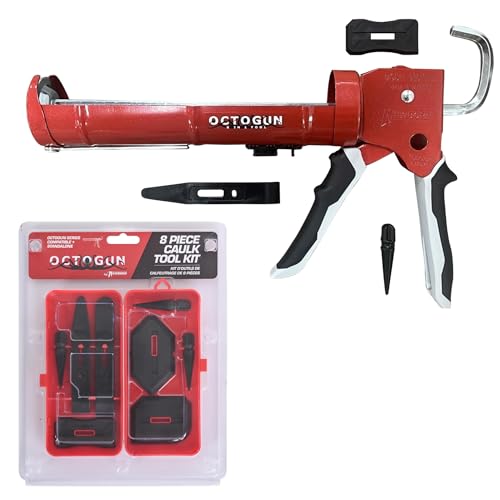
Newborn 930-GTD
Best OverallPros
- True drip-free release for clean bead ends
- Comfortable 10:1 leverage on sanitary silicone
- Ladder hook, seal punch and nozzle cutter built in
- Costs a fraction of a cordless gun
Cons
- Steel body can surface-rust if stored damp
- No speed control, so pace is down to your hand
The 930-GTD is the gun professional decorators and plumbers keep buying, and it is the one to get for bathroom and kitchen work. The smooth pressure rod combined with the drip-free release means pressure drops the moment you release the trigger, so the bead ends where you want it instead of blobbing at the corner.
The 10:1 thrust ratio is the sweet spot for a standard 10 oz tube of tub-and-tile silicone. Owner feedback consistently comes back to the same two points: it does not drip, and it lasts far longer than a hardware store gun. Wipe the rod and barrel dry before you put it away and it will not rust.

Milwaukee 2641-20 M18 Caulk Gun
Best CordlessPros
- Set the dial and the bead width stays constant
- Automatic anti-drip retracts the plunger at release
- No hand fatigue over a whole bathroom
- Runs on the widely available M18 platform
Cons
- Bare tool, so battery and charger add real cost
- Bulkier than a manual gun in a tight shower corner
Milwaukee builds this as a straightforward M18 caulk and adhesive gun for standard 10 oz cartridges. There is no Fuel or brushless version of the 10 oz caulk gun, and it is not rated in PSI: the useful specs are the cartridge size, the speed dial and the anti-drip mechanism.
The dial is what justifies the price. Once you find the setting for the sealant you are using, every bead comes out the same width, which is difficult to achieve by hand across a long bath run. Anti-drip pulls the plunger back at the end of each pull so the tube stops flowing. If you own M18 batteries already and re-caulk more than once or twice a year, this is the upgrade worth making. Milwaukee also sells 20 oz and M12 versions if you need a different size or a lighter body.

DeWalt DCE560B 20V MAX
Best for DeWalt OwnersPros
- Fits the 20V MAX batteries you probably own
- Anti-drip and reverse plunger release
- Rotating barrel helps in awkward corners
Cons
- Bare tool only
- Nose-heavy with a large battery fitted
The DCE560B is DeWalt's 10 oz cordless caulk gun, which is the size that matches ordinary bathroom and kitchen sealant cartridges. Note the model numbers carefully: the DCE580B is the larger 20 oz adhesive gun and the DCE570B takes 29 oz tubes, and neither will accept a standard silicone tube.
In use it behaves much like the Milwaukee: pick a speed, pull the trigger and the flow stays steady, with the plunger retracting when you let go. If your batteries are yellow, this is the sensible cordless pick rather than buying into a second platform.

Makita XGC01Z 18V LXT
Best for Fine ControlPros
- Stepped speed dial makes slow, neat beads easy
- Comfortable balance for long runs
- Fits the LXT batteries used across Makita tools
Cons
- Bare tool only
- Slowest of the three cordless picks at the low settings
The XGC01Z is Makita's 18V LXT caulk and adhesive gun for 10 oz cartridges. Its stepped speed dial is the reason to choose it: the lower settings are genuinely slow and controllable, which suits detail work such as a shower tray perimeter or a worktop-to-splashback joint.
Power is not the deciding factor between these cordless guns, and the PSI figures you see quoted for caulk guns are not a manufacturer specification. Pick on battery platform, cartridge size and how fine you need the speed control to be.
Newborn 250
Best High-Thrust Budget GunPros
- Very easy squeeze on cold or stiff sealant
- Cheap and close to indestructible
- Handles construction adhesive as well as silicone
Cons
- Ratchet rod is not drip-free, so beads need a manual release
- Slower flow than a 10:1 gun for the same effort
If your problem is hand strength rather than bead neatness, the 250 solves it. The 26:1 thrust ratio means very little squeeze pressure is needed, which helps with cold cartridges, stiff hybrid polymer sealants and adhesive work.
The trade-off is the ratchet rod. It does not release pressure automatically, so you have to flip the plunger release yourself at the end of a run or the tube keeps oozing. For a tidy bathroom bead the 930-GTD is the better tool; for grunt, this one wins.
FAQs
Does hard water damage a caulking gun?
No. A caulking gun never carries water, so calcium and magnesium have nothing to build up on. What hard water affects is the caulk line itself around baths, showers and sinks. Ignore any listing that sells a gun as hard-water or corrosion rated.
Why does my bathroom sealant fail faster in a hard water area?
Limescale and soap residue collect on the bead and feed mildew, and the acidic descalers used to remove them attack the silicone surface. The bead discolors, then the edge lifts and lets water behind it.
What sealant should I use in a hard water bathroom?
A 100 percent silicone sanitary sealant with a mildewcide. Avoid acrylic or painters caulk in wet areas because it absorbs water and stains quickly.
What thrust ratio do I need for bathroom silicone?
A 10:1 gun handles standard 10 oz sanitary silicone comfortably. Ratios of 18:1 to 26:1 are for construction adhesive, stiff hybrid sealants or cold conditions.
What is the difference between a drip-free gun and a ratchet gun?
A drip-free or smooth-rod gun releases plunger pressure the moment you let go of the trigger. A ratchet rod holds pressure until you release it by hand, so it keeps pushing sealant out at the end of every bead.
Are cordless caulking guns worth it?
They are if you re-caulk regularly or run long beads. A speed dial gives a more even bead than a hand can hold. For one bathroom every few years, a good manual gun is enough.
What size cartridge do the cordless guns take?
The models listed here take standard 10 oz cartridges. Larger 20 oz and 29 oz guns such as the DeWalt DCE580B and DCE570B are for adhesive and will not accept a normal silicone tube.
How do I stop my caulking gun rusting in a damp bathroom?
Wipe the barrel and rod dry after use, keep the gun out of the shower room, and put a drop of light machine oil on the rod occasionally. That is all a steel gun needs.
Can I reuse a part-used cartridge?
Yes. Release the plunger, cap the nozzle or push a screw in the tip, and store it upright. If the nozzle sets, cut back to fresh sealant before the next job.
How wide should the bead be?
Match it to the gap, usually 1/4 inch or less. Cut the nozzle small at about 45 degrees and open it up only if the bead is too thin. Gaps wider than roughly 1/4 inch need backer rod or a trim strip first.
Our verdict
Hard water is a caulk problem, not a caulking gun problem, so buy the gun that gives you the neatest bead on the joints you will be resealing more often. The Newborn 930-GTD does that for very little money thanks to its 10:1 thrust and drip-free smooth rod. If you re-caulk regularly, step up to the Milwaukee 2641-20 M18 cordless for its speed dial and anti-drip, or the DeWalt DCE560B if you already run 20V MAX batteries. Then spend the time you saved on prep, because a properly cleaned and dried joint outlasts any tool choice.