Best Drain Inspection Cameras for Homeowners
A drain inspection camera lets you see inside a clogged or suspicious drain line before you call a plumber or rent a machine, which can save real money on a job you might handle yourself. The market ranges from budget USB borescopes that pair with your phone to self-contained reels with their own monitor, and the right pick depends on how far you need to reach and how often you plan to use it.
Quick answer
For most homeowners, the DEPSTECH Wireless Endoscope is the best overall pick because it balances a low price, a flexible waterproof probe, and simple phone-based viewing.
Why trust ToolBuyerHub
- Cross-checked manufacturer-published specifications before writing any recommendation
- Verified US market availability and configuration for every model discussed
- Owner-feedback themes are summarized as feedback, never presented as our own hands-on testing
- No invented star ratings; see the visible Research Score criteria on this page
- Flagged water-isolation and pressure-safety steps wherever a tool touches pressurized lines
- We compare manufacturer specifications, owner-feedback themes, and real US retail availability rather than relying on sponsored placements or copied retailer ratings.
Research updated September 2026.
What Matters Most for This Category
The single biggest factor is cable length and diameter. A short, thin probe works for sink traps and short runs, while a longer semi-rigid cable is needed to reach deeper into a main line. Also consider whether you want a self-contained monitor or are happy to use your phone, since phone-based models are cheaper but depend on your device and a stable app. Waterproofing and LED lighting matter for dark, wet pipes, and a reel makes longer cables far easier to manage.
| Model | Best for | Key specs | Research Score |
|---|---|---|---|
| DEPSTECH Wireless Endoscope | Best Overall | About 16.5 ft, 2 MP, 1080p-class | 92/100 |
| DEPSTECH Dual-Lens Endoscope | Best Value | About 16.5 ft, Dual lens, front and side | 89/100 |
| DEPSTECH DS300 Sewer Camera | Best for Main Lines | About 100 ft, 720p-class | 87/100 |
| DEPSTECH DS520 Sewer Camera | Best Mid-Range Reel | About 50 ft, 1080p-class | 85/100 |
| Teslong USB Borescope | Best Budget | Varies by model, often around 10 ft, 720p to 1080p depending on model | 83/100 |
| Teslong Articulating Borescope | Best for Tight Turns | Varies by model, 1080p-class on many models | 81/100 |
| Anysun Sewer Camera | Best for Occasional Heavy Use | Varies by kit, often 50 to 100 ft, Varies by model | 79/100 |

DEPSTECH Wireless Endoscope
Top PickPros
- Very affordable for the reach it offers
- Flexible probe fits around bends in traps
- Works with both Android and iOS via app
Cons
- Wi-Fi connection can lag on some phones
- No built-in monitor, so you supply the screen
This is the model most homeowners land on because it covers sink traps, short branch lines, and toilet drains without a big spend. The flexible cable snakes through common residential bends, and the LED ring lights up dark pipe interiors. Based on manufacturer specifications, it is a phone-first tool rather than a pro-grade reel.
DEPSTECH Dual-Lens Endoscope
Great ValuePros
- Side lens helps inspect pipe walls, not just ahead
- Good price for a two-camera probe
- Adjustable LED brightness
Cons
- Still phone-dependent
- App quality varies by device
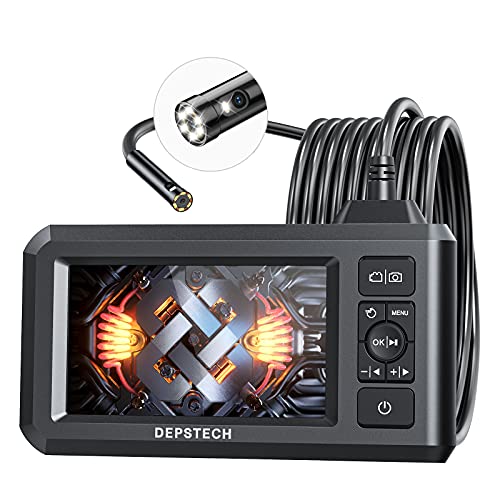
The dual-lens design is genuinely useful in drains because a forward-only camera can miss buildup clinging to the pipe wall. Switching to the side view lets you spot grease and scale that a straight-ahead lens would glide past. It keeps the same budget-friendly, phone-based approach as the standard model.
DEPSTECH DS300 Sewer Camera
Long ReachPros
- Long cable reaches into main sewer runs
- Self-contained monitor, no phone needed
- DVR recording for later review
Cons
- Higher price than phone-based models
- Bulkier to store
When the problem is past the trap and into the main line, a short borescope will not cut it. This reel-based unit offers a much longer cable and its own screen, so you are not juggling a phone in a wet crawlspace. Based on manufacturer specifications, it is aimed at homeowners who want a more serious inspection tool.
DEPSTECH DS520 Sewer Camera
BalancedPros
- Good middle ground on cable length
- Sharper image than entry reels
- Self-contained with recording
Cons
- Costs more than phone-based options
- Cable stiffness takes practice to feed
A 50-foot reel hits a sweet spot for many homes, long enough for most branch and short main runs without the bulk of a 100-foot unit. The higher-resolution sensor helps you distinguish roots from grease. It keeps the convenience of a built-in screen and recording.

Teslong USB Borescope
Budget PickPros
- Very low entry price
- Simple plug-in connection
- Compact and easy to store
Cons
- USB models need an adapter for some phones
- Shorter reach than reel units
Teslong makes some of the most affordable inspection cameras, and the USB versions are popular for quick looks inside traps and short pipes. They are simple devices with few moving parts. Based on manufacturer specifications, expect basic image quality rather than pro-grade clarity.

Teslong Articulating Borescope
ArticulatingPros
- Steerable tip helps navigate offsets
- Useful for inspecting pipe joints
- Better control than fixed probes
Cons
- Pricier than fixed-camera models
- Articulation mechanism needs care
An articulating tip lets you aim the camera left or right once inside the pipe, which helps when a fixed lens would only stare at a wall. That control is handy around joints and offsets. It costs more than a basic borescope but adds real maneuverability.

Anysun Sewer Camera
Reel SystemPros
- Reel design manages long cable well
- Self-contained kit with monitor
- Recording for documentation
Cons
- Image quality varies across models
- Bulkier and heavier than borescopes
Anysun offers reel-style inspection kits that bundle a monitor, cable, and recording in one package. These suit homeowners who expect to inspect longer runs more than once. Based on manufacturer specifications, quality varies by model, so check the specific listing.
Who Should Avoid the Top Pick
Skip a drain camera if your line is fully blocked and backing up, since you will likely need a drain machine or a plumber regardless. Also avoid buying a long reel system if you only ever deal with sink traps, because a cheap borescope does that job for far less.
Before You Buy
Measure or estimate how far you need to reach, since cable length is the main cost driver. Confirm the probe is waterproof and check whether the model needs your phone or includes its own screen. Read the specific listing carefully, because many brands sell several models under similar names with different specs.
FAQs
Do I need a plumber to use a drain camera?
No. Homeowner-grade borescopes and reel cameras are designed for DIY use, though a pro camera offers better optics and reach for serious main-line work.
What cable length do I need?
For sink and toilet traps, a short borescope of around 10 to 16 feet is usually enough. For main lines, look at 50 to 100 feet.
Are these cameras waterproof?
Most drain inspection probes are rated waterproof, often IP67 or IP68, but check the specific model before submerging it.
Can I record what I see?
Many reel systems include recording, and phone-based models can often capture video through their app.
Will a camera clear my clog?
No. A camera only lets you see the problem. You still need a snake, auger, or plumber to remove the blockage.
Is a phone-based or monitor-based camera better?
Phone-based models are cheaper and lighter, while monitor-based reels are more self-contained and easier to use in wet or awkward spaces.
Our verdict
For most homeowners, a budget phone-based borescope like the DEPSTECH Wireless Endoscope handles everyday trap and short-run inspections at a low price. Step up to a reel system only if you need to inspect main lines or want a self-contained monitor and recording. Match the cable length to your actual drains before spending more.