Best Infrared Thermometers for Plumbing
Infrared thermometers have become a genuinely useful tool for plumbing work, letting you check supply line temperatures, radiator output, water heater flue readings, and hidden pipe runs without touching a hot surface. The catch is that not every IR gun is built for the dusty, damp, and sometimes tight conditions a plumber works in, so the distance-to-spot ratio, emissivity adjustment, and build quality matter more than the headline temperature range.
Quick answer
The Fluke 62 MAX+ is the top overall pick for plumbing work thanks to its rugged build, dual laser targeting, and reliable accuracy in the field.
Why trust ToolBuyerHub
- Cross-checked manufacturer-published specifications before writing any recommendation
- Verified US market availability and configuration for every model discussed
- Owner-feedback themes are summarized as feedback, never presented as our own hands-on testing
- No invented star ratings; see the visible Research Score criteria on this page
- Flagged water-isolation and pressure-safety steps wherever a tool touches pressurized lines
- Plumbing-specific criteria like distance-to-spot ratio at pipe diameters, minimum spot size, and emissivity adjustment for copper, PEX, and painted surfaces were weighted heavily in scoring.
Research updated September 2026.
What Matters Most for This Category
The single most important spec for plumbing is distance-to-spot ratio, because pipes are narrow targets and a low ratio means the gun averages a large area and reads the wall behind the pipe instead of the pipe itself. Look for at least a 10:1 ratio, adjustable emissivity so you can match bare copper or shiny fittings, and a minimum spot size small enough to hit a half-inch line from a few feet away. Ruggedness and a backlit display matter too, since crawlspaces and mechanical rooms are rarely well lit or gentle on tools.
| Model | Best for | Key specs | Research Score |
|---|---|---|---|
| Fluke 62 MAX+ | Best Overall | 12:1, -22F to 1202F | 94/100 |
| Klein Tools IR5 | Best Value | 12:1, -22F to 752F | 91/100 |
| Etekcity Lasergrip 1080 | Best Budget | 12:1, -58F to 1022F | 84/100 |
| Milwaukee 2267-20 | Best for Job Site Durability | 12:1, -22F to 1022F | 90/100 |
| Bosch GTC400C | Best for Fast Scanning | 12:1, -22F to 752F | 88/100 |
| Fluke 59 MAX+ | Best for Tight Spaces | 8:1, -22F to 752F | 87/100 |
| ThermoPro TP-450 | Best for Homeowners | 12:1, -58F to 1022F | 82/100 |

Fluke 62 MAX+
Field-Ready AccuracyPros
- Dual laser shows the actual measurement spot size on the pipe
- IP54 rated against dust and water splash
- Adjustable emissivity handles copper, PEX, and painted surfaces
Cons
- Premium price compared to budget IR guns
- No thermocouple input for contact readings
Fluke's 62 MAX+ is the model most often recommended for trade work because the dual laser actually brackets the spot being measured, which is a real advantage when you are aiming at a narrow pipe. It carries an IP54 rating and a drop-tested housing that suits mechanical rooms and crawlspaces. Adjustable emissivity lets you dial in readings on bare copper or shiny fittings where a fixed-emissivity gun would read low.
Klein Tools IR5
Dual Laser ValuePros
- Dual laser targeting at a much lower price than Fluke
- Adjustable emissivity for different pipe materials
- Backlit display and rugged over-mold grip
Cons
- Lower maximum temperature than some competitors
- Not IP rated like the Fluke
Klein's IR5 brings dual laser targeting and adjustable emissivity into a mid-range price bracket, which makes it a strong pick for plumbers who want accurate pipe readings without paying Fluke money. The 12:1 ratio is the same as the Fluke 62 MAX+, so spot size behavior on narrow pipes is comparable. The 752F ceiling is plenty for supply lines, radiators, and most water heater surfaces.
Etekcity Lasergrip 1080
Cheap and CapablePros
- Very low cost for a 12:1 ratio gun
- Adjustable emissivity is unusual at this price
- Wide temperature range covers most plumbing checks
Cons
- Single laser does not show spot size
- Plastic body feels less durable for job site use
The Etekcity Lasergrip 1080 is the budget option that still gets the important specs right, with a 12:1 distance-to-spot ratio and adjustable emissivity that many cheap guns omit. It will not survive the abuse a Fluke or Klein will, but for a homeowner or occasional user checking radiator temps and supply lines it covers the basics. The single laser is a pointer only, so you have to estimate the spot size yourself.
Milwaukee 2267-20
Tough BuildPros
- Built to survive drops and job site abuse
- Backlit display readable in dim mechanical rooms
- Adjustable emissivity for pipe materials
Cons
- Single laser rather than dual
- Priced above budget guns
Milwaukee's 2267-20 is aimed at tradespeople who need a gun that survives being dropped off a ladder. The housing and grip are built for daily job site use, and the 12:1 ratio plus adjustable emissivity keep the readings useful on pipe work. It is a natural pick if you already run Milwaukee tools and want one battery platform mindset across your kit.
Bosch GTC400C
Fast RefreshPros
- Fast response time helps when scanning multiple radiators
- Adjustable emissivity for different surfaces
- Compact body fits in a tool pouch
Cons
- Single laser aiming only
- No IP rating listed
The Bosch GTC400C is a compact IR gun that responds quickly, which is handy when you are walking a house checking radiator after radiator or tracing a heating loop. The 12:1 ratio and adjustable emissivity keep it competent on pipe surfaces. It is a good middle-ground option for plumbers who want Bosch build quality without the Fluke price.
Fluke 59 MAX+
Compact BodyPros
- Small body reaches into tight mechanical spaces
- Fluke build quality and reliability
- Simple one-hand operation
Cons
- 8:1 ratio is lower than the 62 MAX+
- Fixed emissivity limits accuracy on shiny metals
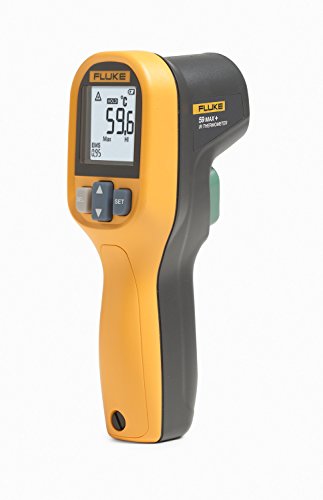
The Fluke 59 MAX+ trades some optical performance for a smaller body that fits into cramped mechanical rooms and under-sink cabinets. The 8:1 ratio means you need to get closer to a pipe for an accurate reading, and the fixed 0.95 emissivity is best suited to painted or oxidized surfaces rather than bare shiny copper. For quick checks in tight spots it remains a solid, well-built choice.
ThermoPro TP-450
Simple and CheapPros
- Low price with a 12:1 ratio
- Adjustable emissivity for basic pipe checks
- Simple controls for occasional use
Cons
- Not built for daily job site abuse
- Single laser aiming only
The ThermoPro TP-450 is aimed at homeowners and light users who want to check supply line temperatures, radiator output, or drafty spots without spending much. It still offers a 12:1 ratio and adjustable emissivity, which are the specs that matter for pipe readings. Build quality is consumer-grade, so it is best kept for occasional diagnostic use rather than daily trade work.
Who Should Avoid the Top Pick
Skip infrared thermometers if you need to measure the temperature of a fluid inside a pipe rather than the pipe surface, since IR guns only read surface temperature and will be thrown off by insulation, reflective metal, or a dirty exterior. Also avoid fixed-emissivity budget guns if your work involves bare shiny copper or stainless, because those surfaces need emissivity adjustment to read accurately.
Before You Buy
Confirm the distance-to-spot ratio is at least 10:1 so you can read a narrow pipe from a working distance, and check whether emissivity is adjustable for the materials you encounter most. Consider the environment too, since a dusty crawlspace or wet mechanical room favors an IP-rated, drop-tested body over a lightweight consumer gun. Finally, decide whether dual laser targeting is worth the extra cost for your typical aiming conditions.
FAQs
Can an infrared thermometer measure water temperature inside a pipe?
No, an IR thermometer reads the surface temperature of the pipe, not the water inside it. You can infer water temperature from the pipe surface if the pipe is uninsulated and you account for emissivity, but a contact thermometer or thermocouple gives a direct reading.
What distance-to-spot ratio do I need for plumbing?
Aim for at least 10:1, and 12:1 is better. Pipes are narrow targets, so a higher ratio keeps the measurement spot small enough that you are reading the pipe rather than the wall or air behind it.
Why does emissivity matter on copper pipes?
Bare shiny copper has a low emissivity, so a fixed 0.95 emissivity gun will read it inaccurately low. Adjustable emissivity lets you match the surface and get a more realistic reading, or you can tape a matte patch on the pipe and read that instead.
Are cheap infrared thermometers accurate enough for plumbing diagnostics?
For rough checks like confirming a radiator is heating or a supply line is hot, a budget gun with a 12:1 ratio and adjustable emissivity is often adequate. For precise diagnostics or trade work, a rugged model from Fluke, Klein, or Milwaukee is worth the extra cost.
Can I use an IR thermometer to find a pipe leak behind a wall?
An IR thermometer can sometimes reveal temperature anomalies behind a wall that hint at a leak, but it is not a dedicated leak detector and results depend on wall material and conditions. It is best used as a supporting tool alongside moisture meters and visual inspection.
Do I need a dual laser infrared thermometer?
Dual laser targeting shows the approximate size of the measurement spot, which helps you aim accurately at a narrow pipe. It is a genuine convenience for plumbing work, but a single laser gun with a known distance-to-spot ratio can still work if you calculate the spot size yourself.
Our verdict
For most plumbing work the Fluke 62 MAX+ is the safest bet, combining dual laser targeting, adjustable emissivity, and a body that survives job site conditions. If budget is tighter, the Klein Tools IR5 delivers the same 12:1 ratio and adjustable emissivity for noticeably less money, while the Etekcity Lasergrip 1080 covers basic homeowner checks at the lowest cost.