Best Leak Detector for Emergency Use: Water Alarms and Moisture Meters
A burst pipe or hidden drip can cause thousands of dollars in damage within hours. Emergency leak detection is really two jobs: a water alarm that screams the moment water appears, and a moisture meter that tells you where the water actually went so you stop guessing and cutting drywall.
Quick answer
For instant warning, the Govee Water Leak Detector pairs a 100 dB siren with phone alerts, so you hear about a leak even when you are not home. To trace where the water spread, the Klein Tools ET140 is a pinless moisture meter that scans walls and floors without putting a single hole in them.
Why trust ToolBuyerHub
- Specs checked against manufacturer documentation
- Detection method matched to the actual job
- Alarm, alert and power type compared
- Build quality & warranty checked
- Brand reliability
- No fake hands-on claims
Research updated August 2026.
Govee Water Leak Detector
Loud local siren plus phone notifications, sold in multi-packs so you can cover every risk point at once.
| Product | Best For | Type | Rating | Price |
|---|---|---|---|---|
| Govee Water Leak Detector | Instant alerts anywhere | Wi-Fi water alarm / 100 dB | 4.7 / 5 | Check online |
| Resideo RWD41 | No app, no Wi-Fi | Standalone alarm / 4 ft cable | 4.4 / 5 | Check online |
| Klein Tools ET140 | Scanning walls and floors | Pinless moisture meter | 4.5 / 5 | Check online |
| General Tools MMD4E | Confirming a wet spot | Pin-type moisture meter | 4.4 / 5 | Check online |
| Moen Flo Smart Water Shutoff | Whole-home protection | Inline monitor + auto shutoff | 4.3 / 5 | Check online |

Govee Water Leak Detector
Best OverallPros
- Sends a phone notification when nobody is home
- Sold in multi-packs to cover several rooms cheaply
- Sits flat under a water heater, sink or washer
Cons
- Needs 2.4 GHz Wi-Fi, and some kits require a small hub
- Only alerts where you place a sensor
An emergency leak is cheapest to fix in the first ten minutes, and that is exactly what this sensor buys you. The Govee detector sits on the floor at the most likely failure points, and the moment water bridges its contacts it sounds a 100 dB alarm and pushes a notification to your phone. If the water heater lets go while you are at work, you find out immediately rather than when the ceiling below stains.
Because these sell in multi-packs, the sensible approach is coverage rather than a single unit. Put one behind the toilet, one under the kitchen sink, one under the washing machine and one at the water heater pan. Check the listing carefully before you buy: some Govee kits connect straight to Wi-Fi while others include a small gateway hub that the sensors talk to.
Resideo RWD41 Water Leak Alarm
Best Without Wi-FiPros
- No app, account or network setup
- Extension cable snakes into tight spots
- Works during an internet or router outage
Cons
- Local alarm only, no remote notification
- Useless if nobody is in the building to hear it
Not everyone wants another device on their Wi-Fi. The Resideo RWD41 is the honest low-tech answer: a battery alarm you drop on the floor that howls when it gets wet. The unit senses water at its own base, and a four-foot sensing cable lets you run detection behind a washing machine or along the back edge of a water heater pan where you cannot easily place the body of the alarm.
This is the right pick for an occupied home, a rental you do not want to put on a network, or a basement utility corner. It keeps working when the router is down, which is worth remembering, because storm outages and water damage often arrive on the same night.

Klein Tools ET140 Pinless Moisture Meter
Best For ScanningPros
- Leaves no pin holes in paint, tile or laminate
- Covers a large area quickly to map the wet zone
- Reads drywall, wood and masonry
Cons
- Gives a relative reading, not an exact percentage
- Metal behind the surface can skew a reading
When you can see a ceiling stain but have no idea where the water entered, a pinless meter is the fastest way to work backwards. The Klein ET140 presses flat against the surface and reads moisture underneath electronically, with no pins and no damage. You take a reading on known-dry drywall for a baseline, then sweep outward until the numbers climb and mark the edges of the wet area with a pencil.
That mapping step is what stops unnecessary demolition. Instead of cutting a two-foot inspection hole and hoping, you open the wall at the highest, wettest point the meter found. Keep in mind that a pinless meter reports relative moisture rather than a laboratory percentage, so what matters is the difference between dry and wet readings on the same material.
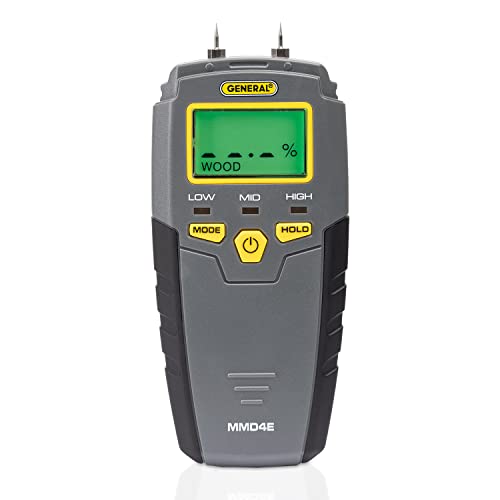
General Tools MMD4E Moisture Meter
Best For ConfirmationPros
- Color-coded LED bar plus audible tone
- Actual moisture content percentage, not a relative index
- Inexpensive enough to keep in an emergency kit
Cons
- Pins leave two small holes in the surface
- Only reads where the pins touch
The MMD4E is the classic budget pin meter, and it does one thing very well: it tells you whether a specific piece of material is genuinely wet. Two pins push into wood, subfloor, baseboard or drywall and the meter reports moisture content directly, with a green, yellow and red LED bar and a tone so you are not staring at the screen while working under a sink.
Use it as the second step after a pinless scan, or on its own when you already have access to the suspect material. It is also the right tool for the drying phase: once the repair is done, the same readings tell you when the framing has come back down to a normal level and it is safe to close the wall up.

Moen Flo Smart Water Monitor and Shutoff
Best Whole-HomePros
- Shuts the water off instead of only warning you
- Catches slow drips anywhere downstream, not just where a sensor sits
- Runs a daily self-test on system pressure
Cons
- Cuts into the main line, so most people need a plumber
- Highest cost here, and some features sit behind a subscription
Floor sensors only find water that reaches them. The Moen Flo takes the opposite approach: it installs on the main supply line and watches flow rate, pressure and temperature for patterns that do not belong, such as water running continuously at three in the morning. When it sees a failure signature it closes its own valve and stops the supply.
That distinction matters most for a house that sits empty for stretches, a vacation property, or anyone who has already paid for one flood. It is the only pick here that can end an emergency without a person present. Budget for a plumber unless you are genuinely comfortable cutting and rejoining your main line, and check the app tier before you rely on any specific alert feature.
What to Check Before Buying a Leak Detector for Emergency Use
When water is actively damaging your home, you need the right category of tool, not just the loudest one. Consider these factors before purchasing.
Alarm versus meter: A water alarm tells you that a leak has started. A moisture meter tells you where the water traveled. They are different tools and most homes benefit from both. Pinless versus pin-type: Pinless meters scan through finished surfaces without damage and are faster for mapping a wet area, while pin meters read an exact moisture content at one spot. Alert type: A local siren is only useful if somebody is home. If the property is regularly empty, you need phone notifications or an automatic shutoff valve. Power: Standard 9V and AAA cells are ideal for emergency kits because you can source replacements anywhere, and a connected sensor is worthless if its battery died six months ago.
Mistakes to Avoid
Buying a wall scanner and expecting it to find water. This is the most common mix-up. Multi-scanners such as the Bosch GMS 120 detect wood studs, metal and live electrical wiring behind drywall. They do not have a moisture mode and will not find a leak. You need a moisture meter for that. Relying on a single sensor. A leak alarm only protects the exact spot it sits on. Cover the water heater, washer, dishwasher and every under-sink cabinet. Trusting one meter reading. Always take a baseline on material you know is dry, then compare. Forgetting to test the unit. Many owners report their detector sat in a drawer for months and the battery was dead when it mattered. Test it quarterly.
FAQs
Can a moisture meter find water behind tile?
A pinless meter such as the Klein ET140 can read moisture through ceramic tile and grout, but dense tile and any metal backing reduce sensitivity. Compare readings against a dry section of the same tile rather than trusting a single number.
What is the difference between a pin-type and pinless moisture meter?
A pin-type meter uses two small probes that penetrate the material to measure resistance, giving a moisture content percentage at that exact point. A pinless meter uses an electromagnetic sensor to scan below the surface without contact or damage, which is better for mapping how far water has spread.
How do I test a leak detector before an emergency?
For a water alarm, touch a damp sponge or wet paper towel across the sensor contacts and confirm it sounds. For a meter, take a reading on dry material and then on a damp sponge and check that the value moves. Repeat every three months.
Can I use a stud finder as a leak detector?
No. Stud finders and multi-scanners detect density changes from wood, metal and live wiring, not moisture. The Bosch GMS 120 is often confused for a leak detector for this reason, but it has no moisture function. Buy a dedicated moisture meter.
Do moisture meters work on concrete floors?
Some do. Concrete is dense and holds moisture differently from wood, so look for a meter with a masonry or building-materials mode and treat the reading as relative. For a slab, a taped plastic sheet test over 24 hours is a useful cross-check.
How often should I replace the battery in my leak detector?
Check the battery every three months, and treat a low-battery app warning as urgent rather than optional. Remove the battery if you are storing a meter for more than six months to prevent corrosion.
Can a leak detector find a pinhole leak in a pipe?
It detects the moisture around the leak, not the pinhole itself. Once the meter shows you the wettest area, open the wall at the highest wet point and confirm visually or with a pressure test.
Is an automatic shutoff valve worth the extra cost?
It is if your home sits empty regularly or you have already had a flood. A device like the Moen Flo stops the water without anyone present, which alarms and meters cannot do. For an occupied home, an alarm plus a meter covers most situations for far less.
What is the best leak detector for an emergency kit?
Pair a compact water alarm with a 9V pin meter such as the General Tools MMD4E. Between them you get early warning and the ability to confirm whether a surface is genuinely wet.
Do I need a separate tool to locate the pipe itself?
Yes. Once the moisture meter narrows down the area, a wall scanner or stud finder is what tells you where the studs, pipes and electrical cables run so you can cut safely. They are complementary tools, not alternatives.
Our verdict
For most homeowners facing a plumbing emergency, the right answer is a pair of tools rather than one. The Govee Water Leak Detector gives you the alarm and the phone alert that turn a flood into a puddle, and the Klein Tools ET140 pinless meter lets you trace where the water went without cutting a single inspection hole. Add the General Tools MMD4E if you want an exact moisture reading on exposed wood, and step up to the Moen Flo only if your property is regularly unoccupied.