Best Silicone Sealant Tool Under $50
Applying silicone sealant straight from the tube is slow and messy. A decent caulk gun is the tool that actually decides whether the bead comes out even, and you do not need to spend more than $50 to get one that works. Note that "sealant tool" here means a caulking gun, not a powered sprayer.
Quick answer
For most DIYers, the Dripless ETS2000 Ergo is the best all-rounder under $50: a 12:1 thrust ratio, a proper drip-free release and a light composite body. If you want cordless power and already own Ryobi batteries, the Ryobi ONE+ 18V Power Caulk and Adhesive Gun (P310G) is the one to get, tool only.
Why trust ToolBuyerHub
- Compared on published specs (thrust ratio, cartridge size)
- Battery & ecosystem compared
- Aggregated owner reviews
- Build quality & warranty checked
- Brand reliability
- No fake hands-on claims
Research updated August 2026.
Dripless ETS2000 Ergo
Smooth 12:1 thrust with a drip-free release that stops the ooze.
| Product | Best For | Key Spec | Rating | Price |
|---|---|---|---|---|
| Dripless ETS2000 Ergo | Overall Performance | Manual, 12:1 thrust, drip-free | 4.7 / 5 | Under $25 |
| Ryobi ONE+ P310G | Cordless Convenience | 18V, variable speed dial | 4.3 / 5 | Under $50 (tool only) |
| Newborn 250 | Budget Basics | Manual, 10:1 thrust, smooth rod | 4.4 / 5 | Under $20 |
| Newborn 250-HTD | Heavy Duty / Viscous Sealants | Manual, 26:1 high thrust | 4.5 / 5 | Under $40 |
| Tajima Convoi CNV-100 | Precision & Clean Finish | Manual, thumb-release, ultralight | 4.4 / 5 | Under $50 |
Dripless ETS2000 Ergo
Best OverallPros
- 12:1 thrust pushes cold silicone without a fight
- Drip-free release stops the bead oozing after you let go
- Built-in spout cutter, seal puncture rod and ladder hook
Cons
- Composite body feels less solid than an all-steel gun
- Not enough thrust for stiff construction adhesive in the cold
The Dripless ETS2000 is the gun most DIYers should buy. The 12:1 thrust ratio is the sweet spot for standard silicone and acrylic latex caulk: enough leverage that you are squeezing gently rather than clamping down, which is exactly what gives you an even bead. The drip-free mechanism releases pressure the moment you let go of the trigger, so you are not chasing a runaway line of sealant down the tub.
The extras are genuinely useful rather than marketing filler. There is a spout cutter in the handle, a puncture rod folded into the frame for the foil seal, and a hook so it can hang off a ladder rung or a bucket rim. The composite barrel keeps it around a pound, which matters on a long day of window trim. Owner reviews are consistently strong on the anti-drip action, which is the feature people miss most on cheap guns.
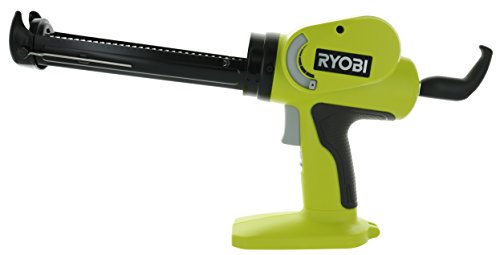
Ryobi ONE+ 18V Power Caulk and Adhesive Gun (P310G)
Best CordlessPros
- Constant flow rate, so the bead does not thin out as your hand tires
- Speed dial lets you set the flow and just walk the joint
- Runs on any Ryobi ONE+ 18V battery
Cons
- Sold as a bare tool, battery and charger extra
- Much heavier and bulkier than a manual gun
The Ryobi P310G is the sensible cordless pick if you are already in the ONE+ ecosystem. Its real advantage is not speed, it is consistency: a motor pushing the plunger at a fixed rate produces a more uniform bead over a long run than a hand can, which is why it earns its place on big jobs like a whole bathroom or a run of exterior trim. Set the dial, match your walking pace to it, and the line stays the same width end to end.
The trade-offs are the usual cordless ones. With a battery on board it is noticeably heavier and more awkward overhead or behind a toilet than a one-pound manual gun, and the under-$50 price is tool only. If you do not already own ONE+ batteries, a battery and charger will push the real cost well past this guide's budget and a manual gun is the better buy.

Newborn 250 Drip-Free Smooth Rod Caulking Gun
Best BudgetPros
- Steel frame that survives being thrown in a truck bed
- Smooth rod, so no ratchet clicking or jerking the bead
- Usually around $20
Cons
- 10:1 thrust means more hand effort on cold or stiff tubes
- No spout cutter or puncture tool built in
The Newborn 250 is the plain steel gun that has been on contractor vans for decades, and it is still the right answer if you want the basics done properly for the least money. The smooth rod is the key detail: instead of a ratchet stepping the plunger forward in clicks, the rod slides continuously, which keeps the sealant flowing evenly rather than pulsing. The drip-free release lets go of pressure the moment you release the trigger.
What you give up is leverage and convenience. At 10:1 thrust you will feel it in your hand on a cold tube of silicone, and there is no built-in cutter or puncture rod, so keep a utility knife and a long nail nearby. For occasional jobs around a bathroom or a few windows, none of that matters much.
Newborn 250-HTD
Best for Heavy Duty / Viscous SealantsPros
- 26:1 thrust handles construction adhesive and stiff polyurethane
- Comfort trigger takes the bite out of high-effort tubes
- Same drip-free release as the standard 250
Cons
- High thrust makes it easy to overshoot on thin silicone beads
- Heavier and bulkier than the basic 250
The 250-HTD is the high-thrust version of the same gun, and the difference is entirely in the leverage. At 26:1 the trigger moves the plunger further per squeeze relative to the effort you put in, which is what you need for polyurethane sealants, subfloor and construction adhesives, and any tube that has been sitting in a cold garage. Those are the materials that make a 10:1 gun feel broken.
The flip side is control. High thrust and thin silicone are an awkward pairing, because a small trigger movement dumps a lot of material and you end up with a fat bead you have to tool back. If most of your work is bathroom silicone, the standard 250 or the Dripless is the better fit; buy the HTD if adhesive tubes are a regular part of your work.

Tajima Convoi CNV-100
Best for Precision & Clean FinishPros
- Instant thumb release gives the cleanest stops and starts
- Very light, which helps on long overhead or vertical runs
- Smooth rod with no ratchet pulse in the bead
Cons
- Closest to $50 of the manual guns here
- Not built for heavy construction adhesive
Tajima's Convoi is the gun for people who care about how the finished joint looks. The thumb-operated release sits where your hand already is, so you can cut the flow the instant you reach the end of a run rather than a half-second later. That is the difference between a bead that stops square at the corner and one that blobs into it.
It is also the lightest gun in this group, which sounds trivial until you are caulking a ceiling line or the top of a shower surround with your arm extended. The trade-off is that it is tuned for finesse rather than force, so it is not the tool for stiff adhesives, and it costs roughly twice what the basic Newborn does.
What to Check Before Buying a Silicone Sealant Tool
Thrust ratio is the spec that matters most and the one budget guns hide. It describes the leverage between your trigger squeeze and the plunger, so a 10:1 gun needs roughly twice the hand effort of a 20:1 gun to push the same sealant. For ordinary silicone and acrylic latex caulk, 10:1 to 12:1 is plenty. For polyurethane, subfloor adhesive, or anything used in cold weather, look for 18:1 or higher.
After that, check the release mechanism and the rod. A drip-free or instant release drops the pressure the moment you stop, which is what prevents the trailing ooze that ruins the end of a bead. A smooth rod feeds the plunger continuously, while a ratchet rod steps it forward in clicks that can show up as a slightly pulsing line. Finally, match the gun to your cartridge: standard US tubes are 1/10 gallon, and quart-size or sausage-pack guns are a different tool entirely.
Mistakes to Avoid When Using a Caulk Gun
The most common mistake is using a low-thrust gun on high-viscosity material. Forcing stiff adhesive through a 10:1 gun bends the plunger rod, splits cartridges, and produces a bead that surges and stops. Check what the sealant manufacturer recommends and step up the thrust ratio rather than squeezing harder.
The second is the cut. Cut the nozzle at 45 degrees and start smaller than you think you need, because you can always widen it, and a bead that is too fat has to be tooled off and wiped away. Beyond that, surface prep decides adhesion: silicone will not stick to a dusty, damp, or soap-filmed joint, so scrape out the old sealant, clean with alcohol, and let it dry before you start.
FAQs
Can I use a caulk gun for construction adhesive?
Yes, but you need the thrust for it. A high-thrust gun such as the Newborn 250-HTD at 26:1 handles adhesive and polyurethane comfortably; a basic 10:1 gun will struggle and can bend its rod.
Is a manual or cordless caulk gun better?
For most homeowners, manual. It is lighter, cheaper, and gives you direct feel for the flow. A cordless gun is worth it when you have long runs to do and want a bead that stays perfectly uniform without hand fatigue.
What does thrust ratio actually mean?
It is the mechanical advantage between your squeeze and the plunger. Higher thrust means less hand effort for the same flow, which translates directly into finer control over the bead.
Do I need a special tool for silicone sealant?
You need some kind of caulk gun. Squeeze tubes exist for tiny repairs, but for anything longer than a few inches a gun gives you far better control and gets through a cartridge without wrecking your hand.
How do I stop a caulk gun from dripping?
Buy one with a drip-free or instant release, and release the trigger a moment before you reach the end of the run. On a gun without that feature, pull the plunger rod back manually as soon as you stop.
What is the best caulk gun for a beginner?
The Dripless ETS2000 Ergo. The drip-free release forgives the timing mistakes beginners make, and the built-in spout cutter and puncture rod mean one less thing to hunt for.
Is caulk the same thing as silicone sealant?
Not quite, though guns fit both. Caulk is the broad term and usually means paintable acrylic latex; silicone sealant is more flexible and waterproof but cannot be painted. Both come in the same 1/10 gallon cartridges.
How many tubes will a cordless caulk gun do per charge?
Ryobi does not publish a fixed figure, and the honest answer is that it depends heavily on the material. Thin silicone draws far less current than stiff construction adhesive, so treat any single number you see as a guess.
Smooth rod or ratchet rod?
Smooth rod for a cleaner, more continuous bead, which is what you want on visible joints. Ratchet rods are cheaper and perfectly fine for rough work where the joint will be hidden.
What warranty do caulk guns come with?
Manual guns are simple enough that coverage varies and is rarely the deciding factor, so check the listing for the specific model. The Ryobi P310G is covered by Ryobi's standard 3-year ONE+ tool warranty.
Our verdict
For the best all-around performance and value under $50, the Dripless ETS2000 Ergo is our top pick: 12:1 thrust, a real drip-free release, and the small extras that save trips to the toolbox. If you want to spend as little as possible, the Newborn 250 at around $20 is a steel gun that will outlast most of what else is on the shelf.