Best Belt Sander Under $100
A capable belt sander is one of the few tools where the sub-$100 shelf is genuinely worth shopping. We looked at the corded 3 x 18 and 3 x 21 inch models widely sold in the US and compared motor amperage, belt size, dust collection and belt tracking to find the ones that hold up to real DIY work.
Quick answer
For most users, the WEN 6321 is the best belt sander under $100. Its 7-amp motor and 3 x 21 inch belt give you enough reach and stock removal for flattening panels and stripping paint at a price well under budget. If you want better dust control and a sander that helps you avoid pressing too hard, the SKIL 7510-01 is the smarter pick.
Why trust ToolBuyerHub
- Compared on published specs (amps, belt size, dust collection)
- Belt size checked for easy replacement availability
- Tracking and tensioning systems compared
- Build quality & warranty checked
- Brand reliability and parts support
- No fake hands-on claims and no invented review scores
Research updated August 2026.
WEN 6321
7-amp motor with a full-size 3 x 21 inch belt, for less than most 3 x 18 models cost.
| Product | Best For | Motor | Belt Size | Price |
|---|---|---|---|---|
| WEN 6321 | Overall value | 7 amp | 3 x 21 in | Check Amazon |
| SKIL 7510-01 | Dust control & tracking | 6 amp | 3 x 18 in | Check Amazon |
| BLACK+DECKER DS321 | Sanding into tight spots | 7 amp | 3 x 21 in | Check Amazon |
| CRAFTSMAN CMEW213 | Lighter, easier handling | 7 amp | 3 x 18 in | Check Amazon |
WEN 6321
Best OverallPros
- Longer 3 x 21 in belt covers more surface per pass
- 7-amp motor handles paint stripping and rough stock
- One of the cheapest full-size belt sanders on the US market
Cons
- Single speed, so no dial for heat-sensitive materials
- Belt tracking needs checking before each session
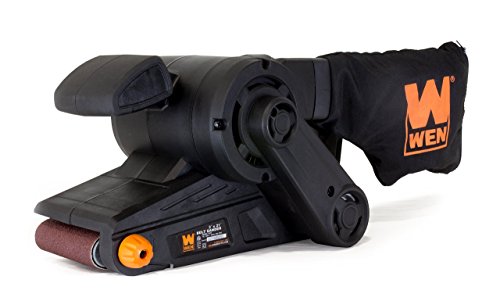
The WEN 6321 is the default recommendation in this price bracket because it does not cut the belt short to hit the price. The 3 x 21 inch belt is the size most people want for flattening tabletops, doors and deck boards, and the 7-amp motor has enough grunt to strip old finish without stalling the moment you lean on it.
It is a no-frills tool. There is no variable speed dial and no electronic speed control, so the belt will slow slightly under heavy pressure. The dust bag catches the bulk of the debris but fills quickly on a long session, and the port accepts a shop vac hose if you want to run extraction instead. Belt tracking is adjusted with a knob and is worth setting before every job.

SKIL 7510-01
Best Dust ControlPros
- Micro-filter dust canister traps finer particles than a cloth bag
- Auto belt tracking keeps the belt centered without fiddling
- Pressure Control indicator warns when you are pushing too hard
Cons
- 6-amp motor is the least powerful here
- Shorter 3 x 18 in belt covers less area per pass
The SKIL 7510-01 is the sander to buy if you sand indoors or if you are new to belt sanders. Its two signature features are genuinely useful: auto belt tracking keeps the belt running centered so you are not stopping to adjust a knob, and the Pressure Control indicator tells you when you are leaning on the tool hard enough to bog the motor and burn the workpiece.
The micro-filter dust canister is a real step up from a plain cloth bag for fine dust, which matters when you are sanding inside a house rather than a garage. The trade-off is power: at 6 amps with a 3 x 18 inch belt, it removes material more slowly than the 7-amp 3 x 21 machines. For finishing work and moderate stock removal that is a fair trade.

BLACK+DECKER DS321 Dragster
Best for Tight SpacesPros
- Slim front roller reaches into corners and against edges
- Retractable handle lowers the profile for tight clearance
- Standard 3 x 21 in belts are cheap and easy to find
Cons
- Dust bag is small and needs emptying often
- Plastic housing feels less solid than pro-grade tools
The Dragster name refers to the narrowed front roller, which is the whole point of this sander. Most belt sanders leave an unsanded margin wherever the housing bumps into a wall, a face frame or an adjoining board. The DS321 gets far closer to that edge, which saves you switching to a detail sander to finish the last inch.
Elsewhere it is a conventional 7-amp, 3 x 21 inch machine, and the retractable top handle helps when clearance overhead is limited. Dust collection is a standard bag rather than a filtered canister, so run a shop vac on the port if you care about fine dust. Build quality is fine for homeowner use rather than daily job-site work.

CRAFTSMAN CMEW213
Easiest to HandlePros
- 7 amps in the lighter 3 x 18 in format
- Shorter footprint is easier to control on narrow stock
- Widely stocked brand with easy parts and warranty support
Cons
- Shorter belt means more passes on wide panels
- Dust bag attachment is basic
The CRAFTSMAN CMEW213 pairs a 7-amp motor with the smaller 3 x 18 inch belt, which is an unusual combination at this price. The result is a sander that still removes material quickly but is easier to steer on narrow work such as door edges, stair treads and shelving, where a 21-inch belt wants to rock.
Belt changes use a tool-free tension lever, and 3 x 18 belts are stocked everywhere, so consumables are never a problem. Dust collection is a plain bag. If most of your sanding is on wide flat panels, the longer-belt WEN or BLACK+DECKER will finish faster; if it is trim and furniture parts, this is the more controllable tool.
What to Check Before Buying a Belt Sander Under $100
Motor amperage: Corded sanders in the US are rated in amps, not watts. Expect 6 to 8 amps at this price. More amps means the sander is less likely to slow down when you press into the workpiece, which is what actually determines how fast material comes off.
Belt size: The two common sizes are 3 x 18 inch and 3 x 21 inch. The longer 3 x 21 belt covers more surface per pass and stays flatter on wide panels; the 3 x 18 is lighter and easier to control on narrow stock. Both sizes are cheap and available everywhere, so pick by the work, not by belt cost.
Dust collection: A cloth bag is the norm at this price. A micro-filter canister catches finer dust, and any of these sanders will accept a shop vac hose on the dust port, which is by far the most effective option indoors.
Belt tracking: Belts drift sideways as they wear. Most budget sanders use a manual tracking knob you set by eye; a few offer automatic tracking. If you have never used a belt sander, automatic tracking removes a real source of frustration.
Mistakes to Avoid When Buying a Cheap Belt Sander
Ignoring dust management: A sander with a small bag and no vacuum port will coat your workspace in fine dust. Check that the dust port accepts a standard shop vac hose before you buy.
Buying on amps alone: A high-amp motor with poor tracking or a wobbly platen still produces a bad finish. Control matters more than raw power for most DIY sanding.
Pressing down on the tool: A belt sander should be guided, not forced. Its own weight supplies the pressure. Leaning on it slows the belt, burns the wood and shortens motor life.
Buying a UK or EU model listing: Sanders sold in Europe are rated in watts and run on 230V. If a listing quotes a wattage rating and a millimetre belt size, check the voltage before ordering, because it will not run on a US outlet without a transformer.
FAQs
What is the best belt sander under $100 for heavy stock removal?
The WEN 6321 is the pick. Its 7-amp motor and full-size 3 x 21 inch belt remove material faster than the shorter 3 x 18 models in this price range.
Is a 3 x 18 or 3 x 21 inch belt better?
A 3 x 21 inch belt covers more area per pass and stays flatter on wide panels. A 3 x 18 is lighter and easier to control on narrow stock like trim, door edges and furniture parts.
Which belt sander under $100 has the best dust collection?
The SKIL 7510-01, because it uses a micro-filter canister rather than a plain cloth bag. For any of these sanders, connecting a shop vac to the dust port works better than the included bag.
Are belt sanders under $100 suitable for woodworking?
Yes, for flattening boards, stripping paint and shaping. They are aggressive tools though, so you will still want a random orbital sander to finish the surface before applying a finish.
Can I use a belt sander on metal?
Yes, with an abrasive belt rated for metal, for tasks like deburring or rust removal. Expect sparks, keep the dust bag off to avoid a fire risk, and do not use the same belts you use on wood.
Do I need variable speed on a belt sander?
Not for wood. Variable speed helps on heat-sensitive materials like plastics and on fine finishing passes, but most sanders under $100 are single speed and that is fine for general DIY.
How do I change the sanding belt?
Release the tension lever on the side of the sander, slide the old belt off, and fit the new one so the arrow printed inside the belt matches the direction of rotation. Re-tension, then run the sander briefly and adjust the tracking knob until the belt sits centered.
Why does my belt keep drifting off the rollers?
That is tracking, and it needs adjusting as belts wear. Turn the tracking knob in small increments while the sander is running until the belt stays centered on the platen. Models with automatic tracking, like the SKIL 7510-01, handle this for you.
Is the SKIL 7510-01 powerful enough at 6 amps?
For finishing work and moderate stock removal, yes. For stripping thick paint or flattening rough lumber, a 7-amp model with a longer belt will get there noticeably faster.
What warranty do these sanders come with?
Warranty terms vary by brand and change over time, so check the current terms on the listing or manufacturer page before buying rather than relying on a figure quoted in a review.
Our verdict
The WEN 6321 is our top pick for the best belt sander under $100. It is the only tool here that gives you a full-size 3 x 21 inch belt and a 7-amp motor at genuine budget money. If you sand indoors, or you have never set belt tracking before, spend the same money on the SKIL 7510-01 instead for its filtered dust canister and automatic tracking.