Best Belt Sander of 2026
A belt sander is a stock-removal tool, not a finishing tool, so the specs that matter are motor amps, belt speed in surface feet per minute (SFPM), and belt size. We compared the corded belt sanders that are actually sold in the US on published manufacturer specs, owner feedback, and brand support.
Quick answer
The Makita 9903 is our top pick: an 8.8-amp 3 x 21 in belt sander with variable speed from 690 to 1,440 SFPM and an auto-tracking belt system. For a cheaper starter tool, the Skil 7510-01 Sandcat covers light DIY sanding at a fraction of the price.
Why trust ToolBuyerHub
- Compared on published specs (amps, SFPM, belt size)
- Belt tracking and dust collection checked
- Owner feedback read across retailers
- Build quality & warranty checked
- US-available models only
- No fake hands-on claims
Research updated August 2026.
Makita 9903
Variable-speed 3 x 21 belt sander with auto-tracking and quiet operation.
| Product | Best for | Motor | Belt & speed | Price |
|---|---|---|---|---|
| Makita 9903 | Overall | 8.8 Amp | 3 x 21 in, 690–1,440 SFPM | $$ |
| DeWalt DWP352VS | Stock removal | 8.0 Amp | 3 x 21 in, 850–1,570 SFPM | $$$ |
| Makita 9403 | Heavy duty | 11 Amp | 4 x 24 in, 1,640 SFPM | $$$ |
| Skil 7510-01 | Budget | 6.0 Amp | 3 x 18 in, single speed | $ |
| WEN 6321 | Value 3 x 21 | 7.0 Amp | 3 x 21 in, single speed | $ |

Makita 9903
Best OverallPros
- Variable speed dial for different materials
- Auto-tracking belt system stays centred
- Quiet for the class, rated around 84 dB
Cons
- Cloth dust bag is small; a vacuum works better
- Only a one-year warranty
The Makita 9903 is the reference 3 x 21 belt sander. Its 8.8-amp motor drives the belt at a variable 690 to 1,440 SFPM, so you can slow it down for veneer or paint and open it up for hardwood stock removal. The auto-tracking belt system is the standout feature: it keeps the belt centred without constant knob fiddling, which is where cheaper sanders lose people.
At 9.5 lbs it is not light, but that mass helps it sit flat and cut evenly instead of digging in. Owner feedback repeatedly mentions how quiet it is compared with rivals, and the front grip and flat top make it usable inverted in a bench clamp. The cloth dust bag catches the coarse stuff; hook it to a shop vac for fine dust. Makita covers it with a one-year limited warranty.
DeWalt DWP352VS
Best for Stock RemovalPros
- Top speed of 1,570 SFPM removes material fast
- Three-year limited warranty
- Lock-on button and long cord for shop use
Cons
- Heaviest 3 x 21 model in this roundup
- Bulky next to the Makita for vertical work
The DWP352VS is DeWalt's corded 3 x 21 belt sander, and the one people mistake for the DWE6423, which is a 5-inch random orbit sander and a completely different tool. The 8.0-amp motor runs a variable 850 to 1,570 SFPM, the fastest top speed of any 3 x 21 here, so it clears mill marks and old finish quickly.
The trade-off is weight. At roughly 11 lbs it is a two-hand tool and tiring on vertical or overhead surfaces, though the extra mass keeps it planted on flat panels. The dust bag swivels out of the way and the port takes a vacuum hose. DeWalt's three-year limited warranty and wide service network are a genuine advantage over the one-year cover most rivals offer.

Makita 9403
Best for Heavy DutyPros
- 11-amp motor barely slows under load
- Wide 4 x 24 belt levels big surfaces fast
- Rated around 84 dB, unusually quiet for its size
Cons
- 13 lbs and awkward in tight spaces
- 4 x 24 belts cost more and are stocked less widely
When the job is flooring, doors, workbench tops, or glued-up panels, a 4 x 24 sander finishes in a fraction of the time a 3 x 21 takes. The Makita 9403 runs an 11-amp motor at a single 1,640 SFPM and holds that speed under real pressure, which is what separates it from underpowered wide-belt machines that bog down and burnish the wood.
It is a specialist. At 13 lbs it is not the tool for cabinet edges or anything vertical, and consumables are pricier. What you get is a wide, flat platen that removes high spots without leaving the dish marks a narrow belt can create. Noise is notably low for a machine this size, which matters over a full day.

Skil 7510-01 Sandcat
Best BudgetPros
- Automatic belt tracking at a budget price
- Pressure Control indicator warns when you push too hard
- Micro-filtration dust box instead of a loose bag
Cons
- 6 amps stalls on aggressive hardwood removal
- Shorter 3 x 18 belt covers less area per pass
The Sandcat is the sensible entry point. The 3 x 18 belt is shorter than the 3 x 21 standard, which makes the tool lighter and easier to control in one hand, at the cost of covering less surface per pass. Automatic belt tracking at this price is unusual and removes the most common beginner frustration.
The Pressure Control feature is more useful than it sounds: leaning on a belt sander slows the belt, burnishes the wood, and shortens belt life, and the indicator tells you when you are doing it. The enclosed micro-filtration box keeps more fine dust out of the air than a cloth bag. Push it into thick hardwood removal, though, and the 6-amp motor will let you know it is out of its depth.
WEN 6321
Best Value 3 x 21Pros
- Full-size 3 x 21 belt for well under the big brands
- Two-year warranty beats most one-year cover
- Uses the cheapest, most widely stocked belt size
Cons
- No variable speed
- Manual tracking needs checking as belts wear
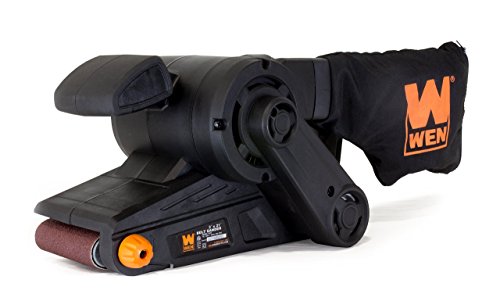
The WEN 6321 gets you the standard 3 x 21 belt size, and therefore the cheapest and most available consumables, for far less than the Makita or DeWalt. The 7-amp motor runs at a single fixed speed, which is fine for the job a belt sander is actually for: fast removal on framing lumber, decking, and rough boards.
What you give up is refinement. Tracking is a manual knob, so you check and nudge it as a belt stretches, and there is no speed dial for delicate work such as veneer or softwood finishing. Build quality is lighter than the Japanese and US brands, but WEN backs it with a two-year warranty, which is longer than most of this list.
What to check before buying a belt sander
Motor amps come first. Anything under about 7 amps will stall or slow noticeably on hardwood, which burnishes the surface instead of cutting it. Belt speed is quoted in surface feet per minute; most portable models sit between roughly 850 and 1,650 SFPM, and variable speed matters if you sand veneer, softwood, or painted surfaces where full speed removes too much too fast.
Belt size decides both coverage and running cost. The 3 x 21 in belt is the most common and the cheapest to replace; 3 x 18 in is lighter and easier one-handed; 4 x 24 in is for flooring and large panels only. Then check tracking. Automatic tracking keeps the belt centred on its own, while manual tracking means a knob you adjust as the belt runs. Finally, look at dust handling: a vacuum port beats a cloth bag every time for fine dust.
Mistakes to avoid
The most common mistake is buying the wrong tool entirely. A belt sander is for aggressive stock removal; if you want a smooth finish ready for stain, you want a random orbit sander. Model numbers make this easy to get wrong, and several DeWalt orbital sanders sit right next to the belt sanders in search results.
After that: do not buy on price alone, because an underpowered motor stalls under load; do not lean on the tool, since pressure slows the belt and shortens its life rather than cutting faster; and do not leave the sander sitting in one place while it is running, which dishes the surface within seconds. Check the tracking adjustment before your first real workpiece, because a drifting belt will chew the roller housing and the wood.
FAQs
What size belt sander should I buy?
A 3 x 21 in belt is the standard and the cheapest to feed. Go 3 x 18 in if you want something lighter for one-handed work, or 4 x 24 in if you are levelling floors and large panels.
Is variable speed important on a belt sander?
It matters if you sand veneer, softwood, or paint, where full speed removes material too fast. For rough lumber and general stock removal, a single-speed model is fine.
How do I maintain a belt sander?
Clear the dust port after each session, check belt tracking regularly, and replace worn or glazed belts promptly. A worn belt generates heat and burnishes the wood instead of cutting it.
Can I use a belt sander on metal?
Yes, with an abrasive belt rated for metal, such as zirconia or ceramic. Use a machine with enough amps to avoid stalling, and be aware that sparks and metal dust should not be collected in the same bag as wood dust.
What is the difference between a belt sander and a random orbital sander?
A belt sander drags a continuous loop of abrasive in one direction for fast stock removal and leaves scratch lines. A random orbital sander vibrates a round pad in an irregular pattern for a swirl-free finish. Most workshops need both, and the belt sander always comes first in the sequence.
How do I change the belt on a belt sander?
Release the tension lever to collapse the front roller, slide the old belt off, then fit the new one with the directional arrow inside the belt matching the arrow on the housing. Restore tension and run the tool briefly to check tracking.
What safety gear do I need for belt sanding?
Safety glasses and a dust mask rated at least N95 are the minimum, since fine wood dust is a respiratory hazard. Hearing protection is sensible for longer sessions, and keep loose sleeves and gloves away from the belt.
Can I use a belt sander for sharpening tools?
Yes, with a fine-grit belt and a light touch, belt sanders are used to shape chisels and plane blades. Keep the steel cool by dipping it frequently, as overheating ruins the temper of the edge.
How do I stop the belt drifting off?
Turn the tracking knob in small increments while the sander runs unloaded until the belt sits centred on the platen. If it will not hold, the belt is worn unevenly or the rollers need cleaning. Models with automatic tracking handle this themselves.
What is the best belt sander for beginners?
The Skil 7510-01 Sandcat is a sensible first belt sander: low cost, lighter 3 x 18 in belt, automatic tracking, and a pressure indicator that teaches you not to lean on the tool.
Our verdict
The Makita 9903 is the best belt sander for most people, combining variable speed from 690 to 1,440 SFPM with auto-tracking and low noise. Choose the DeWalt DWP352VS if you want the fastest removal on flat panels and a three-year warranty, the Makita 9403 if you are levelling floors or large surfaces, and the Skil 7510-01 or WEN 6321 if you need a capable sander on a tight budget.