Best Borescopes
Probe diameter decides whether a borescope is any use to you, and it is the spec most listings bury under resolution claims. A 9 mm probe will not go down a spark plug hole. A 5.5 mm one will. No amount of megapixels fixes a probe that does not fit.
The second real decision is whether you want a screen or your phone. Phone-based scopes are cheap and the image is big, and they are useless when you are lying under a car with no free hands. Standalone units with a built-in screen cost more and work where phones do not. Each pick below lists its probe diameter first.
Quick answer
For general trade use the Klein ET20 is the best borescope, with a 9 mm armored probe and Wi-Fi to a phone. Go to the Klein ET19 at 5.5 mm if you need to get into tighter holes. For hands-free work under a vehicle, a standalone screen unit like the Ridgid Micro CA-25 is the right answer, and the Foxwell Y400 is the one for genuinely tiny openings.
Why trust ToolBuyerHub
- Every scope here is a named brand sold on Amazon US, checked against the live listing
- Specifications come from manufacturer and listing data, not from guesswork
- Owner-feedback themes are summarized as feedback, never as our own hands-on testing
- No invented star ratings; the Research Score criteria are visible on each pick
- Probe diameter and length are stated for every pick, since those decide whether it physically fits
- Resolution claims are treated as secondary, because lighting and probe size limit image quality first
Research updated October 2026.
What Matters Most When Buying a Borescope
Probe diameter comes first and rules out most of the market for any given job. Around 8 to 9 mm is the general purpose size, fine for walls, drains and engine bays. Around 5.5 mm reaches into spark plug holes and tight cavities. Below 4 mm is specialist, for keyways, fuel systems and small bores. Probe length matters next, and more is not automatically better, because a long thin probe is harder to steer and buckles when pushed. Articulation is the feature that changes what you can actually see: a fixed camera looks only where the probe points, while an articulating tip bends to look sideways at the wall of a bore. Then decide between a phone app and a built-in screen, and choose a screen if your hands will be busy or you work where a phone is awkward. Finally check whether the probe is waterproof and whether the gooseneck holds a shape, since a semi-rigid gooseneck you can bend and have stay bent is far more useful than a floppy cable.
| Model | Best for | Key specs | Research Score |
|---|---|---|---|
| Klein Tools ET20 Wi-Fi Borescope, 9 mm Probe, 6 ft Armored Waterproof Gooseneck | General trade and household inspection | 9 mm, 6 ft | 92/100 |
| Klein Tools ET19 Wi-Fi Pro Borescope, 5.5 mm Probe, 9.8 ft Armored Snake | Tight bores and long runs | 5.5 mm, 9.8 ft | 93/100 |
| Teslong Articulating Borescope with Dual Lens and 8 Plus 1 LED Lights | Looking sideways inside a bore | Articulating tip, Dual, front and side | 91/100 |
| Ridgid Micro CA-25 Hand-Held Inspection Camera with 4 ft Cable | Hands-free work with no phone | Built-in, 4 ft | 89/100 |
| Milwaukee M12 M-Spector 360 Inspection Camera, 4 ft | Trades already on M12 batteries | Milwaukee M12, 4 ft | 90/100 |
| Foxwell Y400 220 Degree 2-Way Articulating Borescope, 0.24 in Ultra-Slim Probe | Very small openings | 0.24 in, about 6 mm, 220 degrees, 2-way | 88/100 |
| Depstech Dual Lens Inspection Borescope Endoscope Camera with Light | Trying a borescope cheaply | Dual, front and side, Phone | 85/100 |
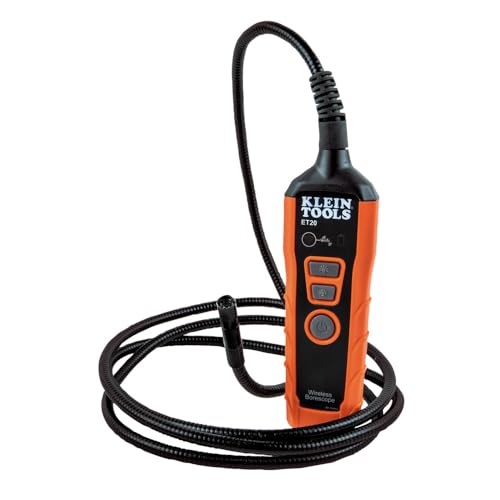
Klein Tools ET20 Wi-Fi Borescope, 9 mm Probe, 6 ft Armored Waterproof Gooseneck
Best OverallPros
- Armored gooseneck holds the shape you bend it into, which is what lets you steer around a bend
- A 9 mm probe is the general purpose size, fine for walls, drains, vents and engine bays
- Klein build standards and waterproof probe make it usable in wet and dirty inspections
Cons
- A 9 mm probe is too thick for spark plug holes and other tight bores
- Wi-Fi to a phone means you need a free hand and a charged phone
The sensible default, and the gooseneck is why. Cheap scopes use a floppy cable that goes wherever gravity takes it, so you cannot aim the camera once it is inside a wall. A semi-rigid armored gooseneck keeps the bend you put in it, which turns the tool from a novelty into something you can actually steer. Wi-Fi to a phone gives you a big bright image, with the usual caveat about needing a hand free.

Klein Tools ET19 Wi-Fi Pro Borescope, 5.5 mm Probe, 9.8 ft Armored Snake
Best for Tight SpacesPros
- A 5.5 mm probe fits spark plug holes, tight wall cavities and small bores a 9 mm cannot
- Nearly ten feet of reach covers long wall runs and duct inspection
- Same armored construction and Wi-Fi approach as the ET20, so it steers properly
Cons
- A longer, thinner probe is harder to push without buckling
- Thinner probes gather less light, so the image is dimmer than a 9 mm scope
The one to buy if you have ever found the probe simply would not fit. Dropping from 9 mm to 5.5 mm opens up spark plug holes, narrow stud cavities and small bores, and the extra length covers long duct and wall runs. Understand the trade honestly: a thin long probe buckles when pushed hard and its smaller lights give a dimmer picture. That is physics, not a product flaw.

Teslong Articulating Borescope with Dual Lens and 8 Plus 1 LED Lights
Best ArticulatingPros
- Articulating tip bends to inspect the wall of a bore rather than only looking straight ahead
- Dual lens gives a side view without having to turn the whole probe
- Generous LED array, which matters because light is the real limit on image quality
Cons
- Articulating mechanisms add bulk at the tip, so the usable diameter is larger than the probe looks
- More moving parts at the tip means more that can eventually fail
Worth it when the thing you need to see is beside the probe rather than in front of it, which in practice is most cylinder, duct and cavity inspections. A fixed camera forces you to twist the whole cable and hope. An articulating tip plus a side lens means you look where you want. The LED count is not marketing fluff here, because inside a dark bore the lighting limits the image long before the sensor does.

Ridgid Micro CA-25 Hand-Held Inspection Camera with 4 ft Cable
Best Standalone ScreenPros
- Built-in screen means no phone, no app and no pairing, which is faster and more reliable on site
- Works where a phone is impractical, under a vehicle or in a wet crawl space
- Ridgid is a plumbing trade standard, so it is built for site abuse
Cons
- Smaller screen than a phone, and the image quality is lower than modern phone-based scopes
- Four feet of cable is short for duct or long wall runs
The pick if your objection to borescopes is fiddling with a phone app while holding a probe in one hand and a torch in the other. A standalone unit turns on and shows a picture. The trade is a smaller, lower resolution screen than your phone would give, and a short cable. For plumbing and automotive work where the inspection point is close and your hands are dirty, that trade is usually right.

Milwaukee M12 M-Spector 360 Inspection Camera, 4 ft
Best for TradesPros
- Rotating image means you can orient the picture upright without twisting the cable
- Runs on M12 batteries, which most trades already carry, so no separate charger
- Built for daily site use rather than occasional DIY
Cons
- Only worth it if you already own M12 batteries, which are a significant separate cost
- Four feet of cable limits it to close inspections
A strong choice for anyone already on the Milwaukee M12 platform, where the battery is already in the van. The rotating image is a genuinely useful detail that sounds trivial: without it, pushing a probe into a cavity often leaves the picture sideways or upside down, and the only fix is twisting the cable, which moves the camera. Being able to rotate the image instead solves it properly.

Foxwell Y400 220 Degree 2-Way Articulating Borescope, 0.24 in Ultra-Slim Probe
Best Slim ProbePros
- A roughly 6 mm probe combined with articulation is an unusual pairing, since articulation usually adds bulk
- A 220 degree two-way bend lets you look back along the bore you came down
- Aimed at automotive diagnostics, where small access holes are the norm
Cons
- Slim articulating tips are delicate and will not survive being forced
- Less light than a thicker probe, so dark cavities look dim
A specialist pick for automotive and small-bore inspection. The useful combination is slimness with articulation, because most articulating scopes get fat at the tip and lose the diameter advantage. A 220 degree bend means you can look back at the wall you just passed, which is how you inspect a cylinder wall or a valve properly. Treat the tip gently, since this is a precision mechanism on a thin probe.
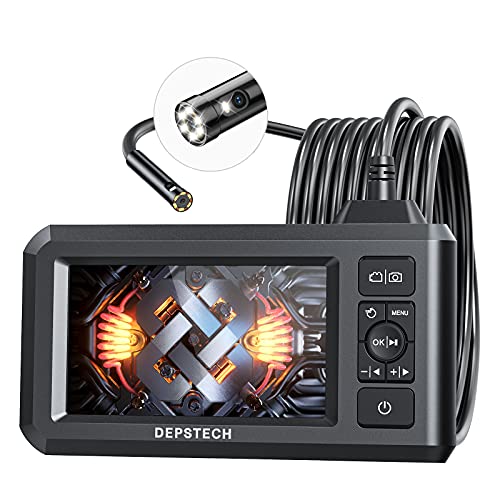
Depstech Dual Lens Inspection Borescope Endoscope Camera with Light
Best ValuePros
- Cheapest honest way to find out whether you will use a borescope at all
- Dual lens gives a side view, which many budget scopes omit entirely
- Uses your phone, so the screen is bigger and brighter than any budget standalone unit
Cons
- Plain cable rather than a shape-holding gooseneck, so it is hard to aim once inside
- Depstech is a consumer brand rather than a trade one, so build life is shorter
A reasonable entry point if you have one job in mind and are not sure you will use a scope again. The dual lens is a genuine inclusion rather than a spec-sheet trick, since a side view is what you usually want. Be clear on the main limitation: without a gooseneck that holds its bend, steering inside a wall or a bore is largely guesswork, and that is the thing you pay more for on the Klein units.
Probe diameter is the constraint that matters
Work out the smallest hole you need to get through before looking at anything else. Around 8 to 9 mm is the general purpose size and handles wall cavities, drains, vents and engine bays. Around 5.5 mm reaches spark plug holes, tight stud cavities and small bores. Below about 4 mm is specialist territory for keyways and fuel systems. The trade-off is real and unavoidable: thinner probes gather less light, produce a dimmer image and buckle more easily when pushed. So buy the thinnest probe your jobs actually require, not the thinnest available.
Articulation, dual lenses and why straight-ahead views disappoint
A fixed camera on the end of a probe sees only what is directly in front of it, which is usually the far end of the cavity rather than the wall you want to inspect. There are two fixes. A dual lens scope adds a side-facing camera, which is cheap and effective for seeing what you are passing. An articulating tip bends under your control, which lets you aim at a specific point and look back along a bore. Articulation is better and costs more, and it adds bulk at the tip, so check the real working diameter rather than the cable diameter.
Phone app or built-in screen
Phone-based scopes give you a large, bright, high resolution screen for very little money, and they are genuinely better for inspections where you can set the phone down and look at it. They fail when your hands are full, when you are lying under a vehicle, when the phone would get wet or filthy, or when pairing decides to be difficult on a job. Standalone units with a built-in screen cost more and show a smaller, lower quality picture, and they just work. Trades generally end up preferring a screen; occasional users are usually better served by a phone scope.
Lighting, waterproofing and the specs that are oversold
Resolution is the most advertised and least limiting specification, because inside a dark cavity the lighting determines what you can see long before the sensor does. Look for multiple LEDs with adjustable brightness, since too much light at close range washes out the image just as badly as too little. Waterproofing matters for drains, sumps and any wet inspection, and it should cover the probe at minimum. Finally, check the gooseneck: a semi-rigid probe that holds a bend you put into it is far more useful than a floppy cable, regardless of what the camera at the end can resolve.
FAQs
What is the best borescope to buy?
For general trade and household inspection, the Klein Tools ET20, because its 9 mm armored gooseneck holds the shape you bend into it, which is what makes a borescope steerable. If you need to get into spark plug holes or tight cavities, step down to the 5.5 mm Klein ET19 instead.
What size borescope probe do I need?
Around 8 to 9 mm for general use in walls, drains, vents and engine bays. Around 5.5 mm for spark plug holes and tight cavities. Below about 4 mm only for specialist small-bore work. Buy the thinnest probe your jobs genuinely need, since thinner probes give a dimmer image and buckle more easily when pushed.
Is an articulating borescope worth it?
If you need to inspect the wall of a bore rather than the far end of it, yes. A fixed camera only sees straight ahead, so you end up twisting the whole cable and guessing. An articulating tip aims where you want and can look back along the bore. The cost is price and extra bulk at the tip, which reduces the effective probe diameter.
Phone borescope or one with a screen?
A phone scope gives a bigger, brighter, higher resolution image for less money and suits inspections where you can put the phone down. A built-in screen is better when your hands are full, when you are under a vehicle, in the wet, or when you cannot rely on pairing. Trades usually prefer a screen; occasional users usually prefer a phone.
Can a borescope go down a drain?
Yes, if the probe is waterproof, which most are, and long enough. A 9 mm probe on a six foot gooseneck handles sink and shower traps well. Full sewer line inspection needs a dedicated drain camera with a much longer, stiffer push cable, since a borescope gooseneck will not travel far along a pipe.
Does borescope resolution matter?
Less than the marketing suggests. Inside a dark cavity, lighting limits what you can see long before the sensor does, so LED count and adjustable brightness matter more than megapixels. Probe diameter, whether the gooseneck holds a bend, and articulation all affect the usefulness of a scope far more than its stated resolution.
Will a borescope fit in a spark plug hole?
Only a slim one. A 9 mm probe will not, while a 5.5 mm probe such as the Klein ET19 generally will, as will the roughly 6 mm Foxwell Y400 with the advantage of articulation for looking at the cylinder wall and valves. Always check the specific hole size, since it varies by engine.
What does a dual lens borescope do?
It has a second camera facing sideways as well as the one facing forward, so you can see the wall of a cavity or pipe as you pass it without rotating the cable. It is a cheaper way to get a side view than full articulation, though it is fixed, so you cannot aim it at a particular point the way an articulating tip can.
Are cheap borescopes any good?
For a one-off look behind a wall or into a drain, yes, and a dual lens phone scope is a reasonable way to try the tool. The main thing you give up is a gooseneck that holds its shape, which means you cannot steer the camera once it is inside. If you find yourself using it repeatedly, that is the upgrade worth paying for.
Our verdict
Buy the Klein ET20 for general work, since its armored gooseneck is what makes a borescope genuinely steerable, and step down to the 5.5 mm ET19 if spark plug holes and tight cavities are your reason for buying. Choose the Ridgid Micro CA-25 or the Milwaukee M12 M-Spector if you want a screen rather than a phone, and the Foxwell Y400 if you need articulation in a very small opening. The Depstech dual lens scope is the sensible way to find out whether you will use one at all.