Best Circuit Breaker Finder Under $100
Finding the right breaker for a circuit shouldn't involve a second person yelling at a panel. We've rounded up the best circuit breaker finders under $100 to help you map your home's electrical system safely and efficiently.
Quick answer
The Klein Tools ET310 is our top pick for its reliable transmitter-receiver combo, its integrated GFCI outlet tester, and its durable build. For a cheaper alternative that still includes a GFCI outlet test, the Sperry Instruments CS61200 is a solid choice.
Why trust ToolBuyerHub
- Compared on published specs (circuit voltage, features)
- Transmitter and receiver design compared
- Owner feedback read, not counted
- Build quality & brand support checked
- Brand reliability
- No fake hands-on claims
Research updated August 2026.
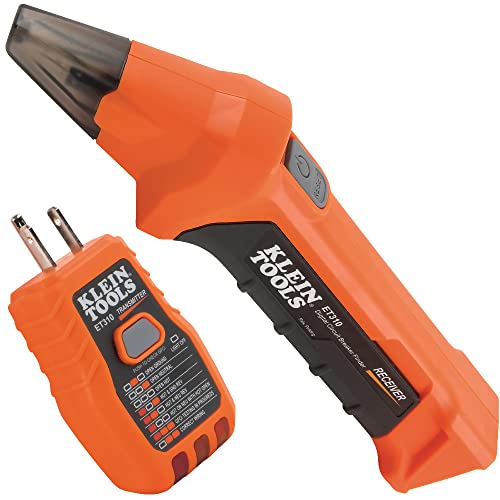
Klein Tools ET310
Accurate, fast, and includes a GFCI outlet test for well under $100.
| Product | Best for | Key Spec | Rating | Price |
|---|---|---|---|---|
| Klein Tools ET310 | Overall accuracy | 90-120V AC, GFCI outlet test | 4.7 / 5 | Check |
| Sperry CS61200 | Budget value | 120V AC, GFCI outlet test | 4.4 / 5 | Check |
| Southwire 41210S | Simplicity | 120V AC, one-button receiver | 4.3 / 5 | Check |
| Extech CB10 | No-frills kit | 120V AC transmitter + receiver | 4.1 / 5 | Check |
| IDEAL 61-534 | Durability | 120V AC, rugged casing | 4.2 / 5 | Check |
Klein Tools ET310
Best OverallPros
- Very accurate identification
- Built-in GFCI outlet tester
- Durable Klein Tools build
Cons
- Priciest pick here
- Receiver can beep loudly
The Klein Tools ET310 is the standard for a reason. It uses a digital transmitter that plugs into an outlet and a receiver that sweeps across the breaker panel. Owner feedback repeatedly points to its ability to lock onto the correct breaker without false positives, even in crowded panels. The GFCI test function is a genuine bonus, letting you verify outlet protection without a separate tool.
Build quality is typical Klein, with a rubberized grip on the receiver and a transmitter that feels solid. Klein rates it for 90 to 120V AC circuits, which covers standard US residential branch circuits. While it sits at the top end of this group on price, the reliability and time saved make it a worthwhile buy for any homeowner or electrician.
Sperry Instruments CS61200
Best BudgetPros
- Great value for the price
- Adjustable receiver sensitivity
- GFCI outlet test on the transmitter
Cons
- Plastic feels less premium than Klein
- Indicator lights are small
The Sperry CS61200 is a strong entry-level option for homeowners, and it is often confused with cheaper finders that skip the outlet test. Sperry sells it as a breaker finder with a GFCI outlet tester built into the transmitter, so it covers the same two jobs as the Klein for less money. The receiver has a sensitivity control to help you zero in on the correct breaker.
Owner feedback is generally positive for the price, with people noting it works reliably on standard residential panels. The build is mostly plastic, which keeps the weight down, but it feels sturdy enough for regular DIY use. If you want the GFCI test without the Klein price, the Sperry is the obvious pick.
Southwire 41210S
Easiest to UsePros
- Simple one-button operation
- Compact and lightweight
- Good sensitivity adjustment
Cons
- Plastic housing feels basic
- Feature set varies by kit version
The Southwire 41210S is designed for simplicity. It has a single button on the receiver to adjust sensitivity, making it very straightforward to use. The transmitter plugs into the outlet, and you scan the panel until the receiver beeps and flashes. It is built for standard 120V AC residential circuits.
Its compact size is a plus for storing in a toolbox. The build is all plastic, which keeps costs down, but it is not as rugged as the Klein. Southwire has sold this finder in a few kit variations, so check the specific listing if you also want an outlet test function. For a DIYer who just wants a no-fuss tool to label the panel, it is an excellent low-cost choice.
Extech CB10
Simple Two-Piece KitPros
- Straightforward two-piece kit
- Slim receiver fits a pouch
- Familiar Extech test-gear brand
Cons
- Fewer extras than the Klein
- Availability comes and goes
The Extech CB10 is a conventional breaker finder kit, not a pen-style voltage detector. You plug the transmitter into the outlet on the circuit you want to trace, then sweep the slim receiver down the face of the panel until it signals on the matching breaker. Extech is a long-standing test-instrument brand, and the CB10 is its basic entry in this category.
It does not add much beyond the core job, and it does not undercut the Sperry on price often enough to be the automatic budget choice. Availability also comes and goes compared with the Klein and Southwire. Buy it if you already trust Extech gear or you find it discounted; otherwise the top two picks cover the same ground.
IDEAL 61-534
Most DurablePros
- Rugged casing built for trade use
- Good sensitivity control
- Trusted electrical-trade brand
Cons
- Bulkier than competitors
- Costs more than the budget picks
IDEAL is an electrical trade brand, and the 61-534 is built accordingly. It is a traditional transmitter-receiver kit: the transmitter plugs into a standard 120V AC outlet, and the receiver has a sensitivity control to help filter out noise from adjacent circuits when the panel is crowded.
Owner feedback highlights durability and consistent performance. It is a bit bulkier than the Klein or Sperry, but the trade-off is a tool that survives being tossed in a gang box. Note that like every outlet-plug finder here, it traces circuits fed from a standard receptacle; hard-wired 240V circuits such as ranges and dryers need a different approach, covered in the FAQs below.
What to Check Before Buying a Circuit Breaker Finder
Type: Almost every finder worth buying is a two-piece kit: a transmitter that plugs into an outlet and a receiver that scans the panel. Be careful not to buy a plain non-contact voltage pen by mistake, since those cannot tell you which breaker feeds a circuit.
GFCI testing: If you have GFCI outlets in kitchens, bathrooms, garages or outdoors, a finder whose transmitter also runs a GFCI trip test (like the Klein ET310 or Sperry CS61200) saves you buying a separate tester.
Circuit voltage: These tools are designed for standard US 120V AC branch circuits fed through a normal receptacle. Manufacturers rarely publish a useful "range in feet" figure, because what actually matters is that the transmitter and the panel are on the same circuit.
Sensitivity adjustment: This helps you tune the receiver to avoid false positives from adjacent breakers. Essential for crowded panels.
Mistakes to Avoid
Buying a non-contact voltage tester only: These can tell you a circuit is live but cannot identify which breaker controls it. You need a dedicated finder kit.
Ignoring the transmitter battery: A weak battery in the transmitter can cause weak signals and inaccurate readings. Always check or replace batteries before starting.
Not verifying the circuit is live: The finder needs a live circuit to work. If the breaker is already off, the transmitter cannot send a signal and the tool will be useless.
FAQs
How does a circuit breaker finder work?
A transmitter plugs into an outlet and sends a coded signal through the wiring. A receiver scans the breaker panel and beeps or lights up when it detects that signal on the correct breaker.
Can I use a circuit breaker finder on a dead circuit?
No. The transmitter needs power from the circuit to send its signal. The circuit must be live for the finder to work.
Are circuit breaker finders accurate?
Good quality models like the Klein ET310 are accurate enough to identify the correct breaker even in crowded panels. Adjusting the receiver sensitivity is usually what separates a clean result from a confusing one.
What is GFCI testing on a breaker finder?
It is a feature on the transmitter that simulates a ground fault to check whether a GFCI outlet actually trips. It verifies the outlet's safety function without a separate tester.
Will a breaker finder work on a 240V circuit?
Not directly. Every finder in this guide plugs into a standard 120V receptacle, and most 240V circuits (ranges, dryers, EV chargers, water heaters) are either hard-wired or use a different outlet. Tracing those safely is a job for an electrician or a clamp-on tracer, not a plug-in finder.
Do these finders quote a range in feet?
Not usefully. The signal travels along the branch circuit's own wiring, so what matters is that the outlet and the panel are on the same circuit, not the distance between them. Treat any big "300 ft" number on a listing as marketing, not a spec.
Why does my breaker finder give false positives?
This is usually the receiver being too sensitive, so it picks up the signal bleeding onto adjacent breakers. Lowering the sensitivity setting normally isolates the right one.
Can I use a breaker finder on a metal panel?
Yes. The receiver is designed to pick up the signal at the face of the breakers with the panel door open. Signal strength drops through a closed metal cover, so open the door and scan the breaker faces.
Is a pen-style voltage detector as good as a transmitter kit?
No, and they are not the same tool. A voltage pen only tells you whether something is live. Only a transmitter-and-receiver kit can tell you which breaker feeds a given outlet.
What batteries do circuit breaker finders use?
Most use a 9V battery in the transmitter and either a 9V or AAA cells in the receiver. Check the manual for your specific model.
Do I need a professional electrician to use a breaker finder?
No. These tools are designed for DIY use. They are safe and simple to operate as long as you follow the instructions and keep the panel cover in place.
What is the best circuit breaker finder under $100?
The Klein Tools ET310 is the best overall for accuracy, its GFCI outlet test and build quality. The Sperry CS61200 is the best budget alternative and still includes the GFCI test.
Our verdict
For most people, the Klein Tools ET310 is the best circuit breaker finder under $100. It combines accurate breaker identification, a genuinely useful GFCI outlet test and a build that holds up. If you are on a strict budget, the Sperry CS61200 does both of those same jobs for less money, which makes it a strong runner-up.