Best Measuring & Layout
Quick answer
For most people building core skills, Measuring & Layout for Beginners is the strongest starting point since it teaches the measurement and shop math fundamentals that make every tool in this guide more effective.
Why trust ToolBuyerHub
- Cross-checked manufacturer-published specifications before writing any recommendation
- Verified US market availability and configuration for every model discussed
- Owner-feedback themes are summarized as feedback, never presented as our own hands-on testing
- No invented star ratings; see the visible Research Score criteria on this page
- Checked accessory compatibility and guarding before ranking any cutting or grinding tool
Research updated September 2026.
What Matters Most for This Category
The right choice in this category depends on whether you need a physical instrument or foundational knowledge, and if it is a tool, whether the priority is repeatable marking, angle accuracy, reading convenience, or measuring range. Reverse-read tapes solve overhead and eye-level reading, self-locking tapes solve one-handed convenience, adjustable scribing rulers solve repeatable marks, and a digital angle gauge solves angle accuracy that a printed scale cannot match as directly.
| Model | Best for | Key specs | Research Score |
|---|---|---|---|
| Measuring & Layout for Beginners: A Complete Step-by-Step Guide to Measurement, Layout, Shop Math & Fabrication Accuracy (Welding Skills for Beginners) | Best for Beginners | n/a, Check current price | 90/100 |
| VICHSAMWY Precision Metal Slide Stop Scribing Ruler - 12, 8 & 6 Inch, Adjustable Measuring & Marking for Woodworking | Best for Woodworking Marking | n/a, Check current price | 87/100 |
| Measuring Marking & Layout: A Builder's Guide | Best for Builders and Contractors | n/a, Check current price | 84/100 |
| GemRed Digital Angle Gauge DAG-V1 for Measuring and Layout | Best for Angle Layout | n/a, Check current price | 81/100 |
| FastCap ProCarpenter Standard Reverse Measuring Tape, 16 Foot | Best for Overhead Marking | n/a, Check current price | 78/100 |
| Komelon SL2825 Self Lock 25-Foot Power Tape | Best Value | n/a, Check current price | 76/100 |
| FastCap ProCarpenter Standard Reverse Measuring Tape, 25-Foot | Best for Long-Reach Layout | n/a, Check current price | 75/100 |

Measuring & Layout for Beginners: A Complete Step-by-Step Guide to Measurement, Layout, Shop Math & Fabrication Accuracy (Welding Skills for Beginners)
Best for BeginnersPros
- Walks through measurement, layout, and shop math in a structured, step-by-step order
- Written specifically for welding and fabrication beginners rather than general DIY readers
- Builds a foundation in shop math that supports accurate cuts and joints before tool use
Cons
- A book format, so it does not replace an actual tape measure, square, or angle gauge
- Experienced fabricators who already know basic shop math may find the content too introductory
This guide walks new welders and fabricators through the fundamentals of measurement, layout, and shop math needed for fabrication accuracy. It is part of a beginner-focused welding skills series meant to build core technique before advanced project work.

VICHSAMWY Precision Metal Slide Stop Scribing Ruler - 12, 8 & 6 Inch, Adjustable Measuring & Marking for Woodworking
Best for Woodworking MarkingPros
- Slide stop mechanism locks a setting so the same mark can be repeated across multiple pieces
- Includes 12, 8, and 6 inch scales in one adjustable ruler for different marking tasks
- Metal construction is built to hold up to regular shop and workbench use
Cons
- More moving parts than a fixed ruler means the slide stop can loosen with heavy use over time
- Precision marking tools like this need careful handling so the scale stays accurate
This adjustable scribing ruler combines 12, 8, and 6 inch metal scales with a slide stop for marking repeatable measurements in woodworking. The slide stop lets a user lock a setting once and scribe consistent lines across several pieces.

Measuring Marking & Layout: A Builder's Guide
Best for Builders and ContractorsPros
- Organized around real building and job site tasks rather than abstract math theory
- Covers marking and layout together as connected practical skills
- Works as a reference that can be revisited for specific techniques on future jobs
Cons
- Requires reading and study time before it translates into faster on-site work
- Still needs to be paired with actual measuring tools since the guide itself is not one
This builder's guide focuses on the practical skills of measuring, marking, and laying out work on construction sites. It is organized around real building tasks rather than general math instruction.

GemRed Digital Angle Gauge DAG-V1 for Measuring and Layout
Best for Angle LayoutPros
- Digital readout removes the guesswork of reading lines on a printed protractor scale
- Purpose built for angle-specific layout tasks such as miters and bevels
- Compact size makes it practical to carry on a job site or in a tool bag
Cons
- Runs on battery power, which adds a charging or replacement step that mechanical gauges avoid
- A digital display and internal electronics can be less rugged than a solid metal square if dropped
The GemRed DAG-V1 is a digital angle gauge built to measure and lay out angles with a numeric display instead of a printed scale. It targets tasks like setting miter angles, checking bevels, and transferring angles between workpieces.
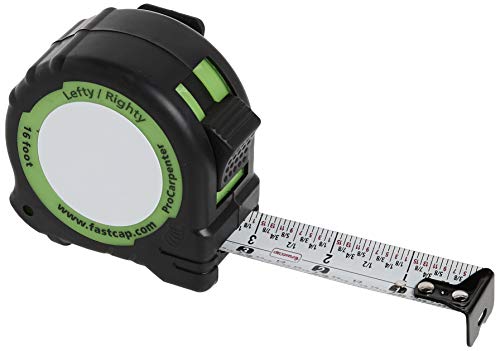
FastCap ProCarpenter Standard Reverse Measuring Tape, 16 Foot
Best for Overhead MarkingPros
- Reverse-printed blade reads correctly when held overhead or facing the user directly
- 16 foot length suits typical interior trim, cabinet, and finish carpentry tasks
- Part of a carpenter-focused tape line designed around job site ergonomics
Cons
- 16 feet is short for larger room layouts or exterior measuring tasks
- Reverse-read tapes take an adjustment period for users used to standard-orientation blades
The FastCap ProCarpenter Standard Reverse tape is a 16 foot measuring tape with a reverse-printed blade that reads correctly when held overhead or facing the user. It is built for carpenters marking cuts and layout lines without twisting to read the numbers.

Komelon SL2825 Self Lock 25-Foot Power Tape
Best ValuePros
- Self-locking blade holds an extended measurement without a manual lock button
- 25 foot length covers most interior room and general layout measuring tasks
- Standard power tape format that is familiar and easy to use one-handed
Cons
- The self-lock mechanism is an added moving part that can wear with heavy repeated use
- 25 feet is not enough reach for large exterior or full-site layout work
The Komelon SL2825 is a 25 foot power tape with a self-locking blade that holds its extended position automatically. It is built as a general-purpose tape for both interior and job site measuring.

FastCap ProCarpenter Standard Reverse Measuring Tape, 25-Foot
Best for Long-Reach LayoutPros
- Same reverse-read blade as the 16 foot version but with extended 25 foot reach
- Better suited to larger layout tasks like framing and full room dimensions
- Carpenter-oriented tape body built for regular job site handling
Cons
- A longer reverse-read blade tends to be bulkier to carry than a standard 25 foot tape
- Still requires the same adjustment period reverse-reading tapes generally demand
This is the 25 foot version of FastCap's ProCarpenter Standard Reverse tape, offering the same reverse-printed blade for overhead and eye-level reading with extended reach. It covers larger measuring tasks like framing layout where the 16 foot version falls short.
Who Should Avoid the Top Pick
Readers who already have solid shop math and layout experience may get little from the two guides beyond a refresher, and anyone who only occasionally needs a quick measurement probably does not need a specialized reverse-read or self-locking tape over a basic one. Buyers focused purely on metalworking may find the woodworking-specific scribing ruler less relevant to their material and tolerances.
Before You Buy
Before buying, consider the material you work with most since some of these tools are built with wood layout in mind while others suit metal fabrication or general job site use. Also think about the length or range needed for your typical tasks, since a 16 foot tape and a 25 foot tape are not interchangeable for larger framing or room layout work, and whether a reverse-read or self-locking feature actually fits how you hold and read a tape during real jobs.
FAQs
Which measuring & layout are best for how work?
It depends on your workflow: choose the beginner's guide if you are still learning shop math, a scribing ruler or angle gauge if you need repeatable marks or precise angles, and a reverse-read or self-locking tape if you do a lot of overhead or one-handed measuring on site.
Which measuring & layout are best for how to choose?
Choose based on task fit first, then features: match the tool to your material and typical measuring range, then weigh convenience features like reverse reading, self-locking, or digital angle readouts against how often you would actually use them.
Which measuring & layout are best for how to clean?
Wipe metal rulers, tapes, and angle gauges with a dry or lightly damp cloth after use, avoid submerging digital gauges, and keep tape blades retracted when not in use to reduce dirt buildup and blade wear.
Which measuring & layout are best for are worth it?
For the physical tools, the added convenience features are generally worth it if they solve a real friction point in your work, such as reading a tape overhead or locking a repeated measurement; for the guides, they are worth it mainly for readers still building foundational skills.
How do I choose measuring & layout?
Start by identifying the task, then the material, then the range or scale you need, and only after that compare convenience features like reverse reading, self-locking, or digital readouts across the options that already fit those first three criteria.
Our verdict
There is no single tool that covers every measuring and layout need, so the best approach is matching the tool to the task: a foundational guide for beginners, a scribing ruler for repeatable woodworking marks, a digital angle gauge for angle-critical cuts, and the right length reverse-read or self-locking tape depending on whether overhead reading or one-handed convenience matters more. Buyers doing framing or larger layout work should lean toward the 25 foot options, while trim and cabinet work is well served by the 16 foot reverse-read tape.