Best Milwaukee Miter Saw in 2026: M18 FUEL Size Guide
Milwaukee only builds three M18 FUEL miter saw sizes, but each one targets a different job. Picking the wrong one means dragging a 50-pound 12-inch saw up a ladder, or running out of crosscut capacity on wide baseboard.
Quick answer
For most DIYers, the Milwaukee 2734-21HD (M18 FUEL 10-inch dual-bevel) hits the sweet spot of capacity and portability. Trim carpenters cutting wide crown should size up to the Milwaukee 2733-21HD (12-inch), while anyone hauling a saw to jobsites daily benefits from the compact Milwaukee 2732-20 (7-1/4-inch).
Why trust ToolBuyerHub
- We compare published manufacturer specifications, not marketing copy.
- Pricing and availability are checked directly on current Amazon listings.
- We read verified owner reviews for real-world durability patterns.
- No saw on this list was provided free by Milwaukee or a retailer.
- We flag single-bevel versus dual-bevel differences that spec sheets often bury.
- This page is updated when Milwaukee changes a kit configuration or battery bundle.
Research updated August 2026.
Milwaukee 2734-21HD M18 FUEL 10" Dual Bevel Sliding Compound Miter Saw Kit
The 2734-21HD pairs Milwaukee's 10-inch dual-bevel sliding miter saw with two 12.
| Model | Best for | Key specs | Rating |
|---|---|---|---|
| Milwaukee 2734-21HD M18 FUEL 10" Dual Bevel Sliding Compound Miter Saw Kit | Best Overall | 10 inches, 0-48° left and right, dual bevel | 4.8/5 |
| Milwaukee 2734-20 M18 FUEL 10" Dual Bevel Sliding Compound Miter Saw (Bare Tool) | Best Value | 10 inches, 0-48° left and right, dual bevel | 4.7/5 |
| Milwaukee 2733-21HD M18 FUEL 12" Dual Bevel Sliding Compound Miter Saw Kit | Best for Wide Crown and Trim | 12 inches, 0-48° left and right, dual bevel | 4.7/5 |
| Milwaukee 2732-20 M18 FUEL 7-1/4" Compact Dual Bevel Sliding Miter Saw (Bare Tool) | Best Compact and Portable | 7-1/4 inches, Dual bevel, both directions | 4.6/5 |
| Milwaukee 2733-20 M18 FUEL 12" Dual Bevel Sliding Compound Miter Saw (Bare Tool) | Best for Pro Crews on an Existing Battery Fleet | 12 inches, 0-48° left and right, dual bevel | 4.5/5 |
| Milwaukee 2732-21HD M18 FUEL 7-1/4" Compact Dual Bevel Sliding Miter Saw Kit | Best Budget-Friendly Kit | 7-1/4 inches, Dual bevel, both directions | 4.4/5 |
| DeWalt DCS361B 12" Cordless Sliding Compound Miter Saw (Bare Tool) | Best Alternative for a Non-Milwaukee Shop | 12 inches, Single bevel, left only | 4.3/5 |
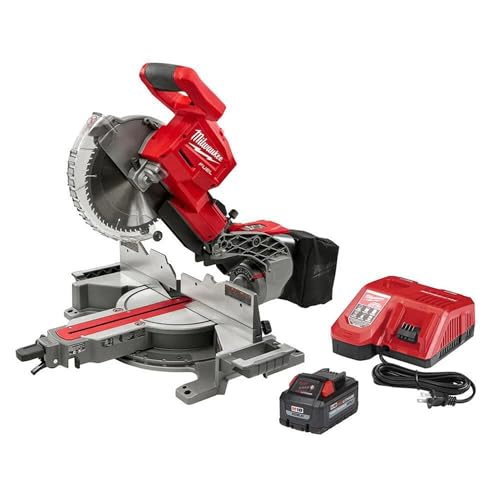
Milwaukee 2734-21HD M18 FUEL 10" Dual Bevel Sliding Compound Miter Saw Kit
Best OverallPros
- Dual bevel cuts compound angles without flipping material
- Ships with two high-capacity batteries and a charger
- Cordless mobility for jobsites without power
Cons
- Heavier than the 7-1/4-inch compact model
- Kit price reflects the included batteries
The 2734-21HD pairs Milwaukee's 10-inch dual-bevel sliding miter saw with two 12.0Ah High Demand batteries and a charger. It handles crown molding, baseboard, and framing crosscuts without a cord. Dual bevel means no flipping stock for compound cuts on both sides.
Milwaukee 2734-20 M18 FUEL 10" Dual Bevel Sliding Compound Miter Saw (Bare Tool)
Best ValuePros
- Same cutting capacity as the full kit
- Lower cost for existing M18 battery owners
- Works with any M18 battery in the lineup
Cons
- Needs a separately purchased battery and charger
- Not a fit for buyers new to the M18 platform
The 2734-20 is the bare-tool version of Milwaukee's 10-inch dual-bevel saw. It's the same cutting head and capacity as the 21HD kit, just without batteries or a charger. It's the practical pick for anyone who already owns M18 batteries.
Milwaukee 2733-21HD M18 FUEL 12" Dual Bevel Sliding Compound Miter Saw Kit
Best for Wide CrownPros
- Largest crosscut capacity in Milwaukee's M18 lineup
- Dual bevel handles compound crown cuts
- Kit includes batteries and charger
Cons
- Heaviest of the three sizes to carry daily
- Overkill for smaller baseboard and molding jobs
The 2733-21HD steps up to a 12-inch blade, adding crosscut and miter capacity for wide baseboard, crown, and dimensional lumber. It keeps the dual-bevel design of the smaller saws. The tradeoff is more weight and a bigger footprint on a jobsite cart.

Milwaukee 2732-20 M18 FUEL 7-1/4" Compact Dual Bevel Sliding Miter Saw (Bare Tool)
Best CompactPros
- Lightest Milwaukee M18 FUEL miter saw to carry
- Compact footprint for tight interior spaces
- Still offers dual-bevel cutting
Cons
- Smaller crosscut and miter capacity than the 10 or 12-inch saws
- Not suited to framing or thick dimensional lumber
The 2732-20 shrinks Milwaukee's miter saw down to a 7-1/4-inch blade aimed at trim carpenters who move from room to room. It's light enough to carry up a ladder or into a finished space without a cart. Cutting capacity is smaller, so it suits trim and molding rather than framing lumber.
Milwaukee 2733-20 M18 FUEL 12" Dual Bevel Sliding Compound Miter Saw (Bare Tool)
Best for Pro CrewsPros
- Full 12-inch cutting capacity without paying for batteries again
- Fits into an existing M18 battery fleet
- Same cutting head as the full kit version
Cons
- Requires separately purchased batteries and charger
- Heaviest bare-tool option to store and transport
The 2733-20 is the bare-tool version of Milwaukee's 12-inch saw, built for crews already running a fleet of M18 batteries. It delivers the same wide crosscut capacity as the 21HD kit. Buying bare avoids paying twice for batteries a crew already owns.
Milwaukee 2732-21HD M18 FUEL 7-1/4" Compact Dual Bevel Sliding Miter Saw Kit
Best Budget KitPros
- Lower total kit cost than the 10 or 12-inch kits
- Complete kit with batteries and charger included
- Lightest saw in the lineup to store and move
Cons
- Limited crosscut capacity compared to larger saws
- Not suited to framing or wide crown work
The 2732-21HD bundles the compact 7-1/4-inch saw with two batteries and a charger, giving new M18 buyers a complete, ready-to-cut kit at a lower entry cost than the 10 or 12-inch kits. It's aimed at DIYers starting from zero tools. Cutting capacity stays limited to trim-scale material.

DeWalt DCS361B 12" Cordless Sliding Compound Miter Saw (Bare Tool)
Best AlternativePros
- Fits directly into an existing DeWalt 20V MAX or FlexVolt fleet
- Wide 12-inch crosscut capacity
- Bare-tool pricing for owners with batteries already
Cons
- Single bevel requires flipping stock for opposite-angle cuts
- Requires buying into a different battery platform than Milwaukee
The DCS361B is DeWalt's cordless 12-inch sliding miter saw, sold as a bare tool for shops already using 20V MAX or FlexVolt batteries. It's single bevel, so compound cuts on the opposite side require flipping the stock. It's the sensible pick if switching battery platforms for one saw doesn't make sense.
How Miter Saw Size Affects What You Can Cut
Blade diameter sets the ceiling on crosscut and miter capacity. A larger blade reaches through wider stock at an angle before the arm runs out of travel. A 7-1/4-inch blade suits trim and molding, while a 12-inch blade clears wide baseboard, crown, and dimensional framing lumber in fewer passes.
Dual Bevel vs Single Bevel: Why It Matters
Dual bevel saws tilt the blade left and right, so compound angles on either side of a workpiece don't require flipping the material. Single bevel saws only tilt one direction, forcing a flip and a re-measure for the opposite cut. Milwaukee's entire M18 FUEL lineup is dual bevel, which is one reason it draws comparisons to single-bevel competitors.
Bare Tool vs Kit: Which Saves More Money
Kits like the 2734-21HD bundle two batteries and a charger with the saw, which suits someone starting from zero M18 tools. Bare tools like the 2734-20 skip that hardware entirely. Anyone who already owns M18 batteries from a drill, driver, or other tool typically saves money buying bare.
Matching Saw Size to Your Actual Projects
Interior trim, baseboard, and molding rarely need more than a 10-inch blade. Framing crews and anyone cutting wide crown against a fence benefit from the extra reach of a 12-inch saw. Finish carpenters who move between rooms or job sites often prefer the lighter 7-1/4-inch saw over the added capacity of a bigger blade.
FAQs
What size Milwaukee miter saw is best for trim work?
For interior trim and baseboard, most carpenters choose the 10-inch 2734-21HD. It balances capacity and weight better than the 12-inch model for daily carrying.
Is the Milwaukee 2734-21HD dual bevel?
Yes. The 2734-21HD uses a dual-bevel design, so it tilts left and right without flipping the workpiece for compound cuts.
Can I use any M18 battery with a Milwaukee miter saw?
Yes. All three M18 FUEL miter saws accept any battery in Milwaukee's M18 lineup, from compact packs to high-capacity HD12.0 batteries.
How much does the Milwaukee M18 FUEL 12-inch miter saw weigh?
Exact weight varies with the battery installed, but the 12-inch 2733 series is the heaviest of the three M18 FUEL saws.
Does Milwaukee make a corded miter saw?
No. Milwaukee's current miter saw lineup is cordless-only, built around the M18 FUEL platform rather than a corded design.
What is the difference between Milwaukee 2732-20 and 2734-20?
The main difference is blade size and capacity. The 2732-20 uses a 7-1/4-inch blade for lighter, more portable trim work, while the 2734-20 uses a 10-inch blade with greater crosscut capacity.
Is a bare tool miter saw worth buying over a kit?
It's worth it if you already own M18 batteries and a charger. Buying bare skips paying for batteries a second time.
Which Milwaukee miter saw is best for crown molding?
The 12-inch 2733-21HD offers the most capacity for wide crown molding cut against a fence, though the 10-inch 2734-21HD handles most standard crown sizes.
Can Milwaukee M18 batteries run out mid-cut on the miter saw?
Battery runtime depends on the pack size and how often you're cutting. Higher-capacity batteries like the HD12.0 packs included in the HD kits reduce the chance of running out mid-job.
Our verdict
Milwaukee's M18 FUEL lineup comes down to three real choices: 7-1/4 inches for portability, 10 inches for all-around trim and framing work, and 12 inches for maximum capacity. Match the saw to the material you cut most, not the biggest number on the spec sheet.