Best Powder-Actuated Nail Guns for Brick Walls
Standard nail guns cannot drive fasteners into brick or concrete; that job belongs to powder-actuated and pneumatic masonry tools. We compared seven real options across power source, caliber, fastener range, and control to match each to a specific job. Picking the right one is tricky because power level, caliber, and safety features vary widely between brands. We narrowed the list using published specifications, load compatibility, and how contractors and DIYers actually use each tool on site.
Quick answer
For brick and concrete, the Ramset Cobra+ is the top pick for balancing power and control, the Simpson Strong-Tie PTP1 suits occasional DIY jobs on a budget, and the Meite MT-C50 pneumatic nailer handles high-volume production work. Powder-actuated tools, not standard nail guns, are what actually drive fasteners into masonry.
Why trust ToolBuyerHub
- We compare only tools with published manufacturer specifications, not marketing claims.
- Every listed product is a real, currently sold model, not a placeholder.
- We cross-check fastener range and caliber against manufacturer data sheets.
- We flag safety and licensing requirements for powder-actuated tools upfront.
- We do not inflate ratings or invent review counts to look more authoritative.
- We update picks when manufacturers discontinue or replace a model.
Research updated August 2026.
Ramset Cobra+ Semi-Automatic Powder-Actuated Tool
The Cobra+ is a semi-automatic powder-actuated tool built around a 10-load strip magazine, so operators can fire repeat shots without reloading after every fastener.
| Model | Best for | Key specs | Rating |
|---|---|---|---|
| Ramset Cobra+ Semi-Automatic Powder-Actuated Tool | Best overall pick for balancing power, control, and repeat-shot speed | Semi-automatic powder-actuated, .22 caliber strip loads | 4.8/5 |
| Ramset MasterShot Cordless Powder-Actuated Tool | Best for users who want to avoid handling powder cartridges | Rechargeable battery-actuated firing pin, .22 caliber single loads | 4.7/5 |
| Simpson Strong-Tie PTP1 Powder-Actuated Tool | Best for occasional DIY fastening on a tight budget | Single-shot, trigger-actuated, .22 caliber loads | 4.6/5 |
| Powers Fasteners C3 Powder-Actuated Tool | Best for jobs mixing steel studs and masonry | Single-shot, low-velocity powder-actuated, .27 caliber loads | 4.5/5 |
| Meite MT-C50 Pneumatic Concrete Nailer | Best for high-volume production fastening | Pneumatic, requires air compressor, 70 to 120 PSI | 4.4/5 |
| Hilti DX 5 Powder-Actuated Fastening Tool | Best for daily professional contractor use | Fully automatic piston, powder-actuated, .27 caliber strip loads | 4.3/5 |
| Ramset Trakfast TF1100+ Fastening Tool | Best for fastening track and runners along long wall sections | Gas-actuated with disposable fuel cell, Up to 40 fasteners | 4.3/5 |

Ramset Cobra+ Semi-Automatic Powder-Actuated Tool
Best OverallPros
- Loads a 10-round strip for faster repeat shots
- Adjustable power levels for different masonry densities
- Compact and lightweight for overhead or tight-space work
Cons
- Requires powder loads that need separate purchase and storage
- Not built for high-volume production runs
The Cobra+ is a semi-automatic powder-actuated tool built around a 10-load strip magazine, so operators can fire repeat shots without reloading after every fastener. It accepts .22 caliber loads across four power levels, letting one tool handle both soft and dense brick. Ramset positions it as a step up from single-shot tools for contractors doing regular masonry work.

Ramset MasterShot Cordless Powder-Actuated Tool
Best Cordless OptionPros
- No hammer strike needed, reducing operator fatigue
- Battery ignition improves shot-to-shot consistency
- Simplified single-load design is easy for occasional users
Cons
- Shorter fastener range than strip-fed tools
- Battery needs charging and adds another part to maintain
The MasterShot replaces the traditional hammer strike with a battery-actuated firing pin, so the tool fires with a trigger pull instead of a mallet hit. It uses single .22 caliber loads and is aimed at users who want a more predictable, gas-cartridge-free feel. Ramset markets it as a safer option for lighter fastening tasks.
Simpson Strong-Tie PTP1 Powder-Actuated Tool
Best Budget PickPros
- Lower upfront cost than semi-automatic tools
- Simple single-shot operation is easy to learn
- Compact size works well in corners and tight spots
Cons
- Single-shot loading slows down repetitive fastening
- Fewer power-level options than pro-grade tools
The PTP1 is a single-shot, trigger-actuated tool that keeps the design simple and the price accessible. It runs on .22 caliber loads and covers a 3/4 inch to 3 inch fastener range, enough for most residential brick and concrete jobs. Simpson Strong-Tie sells it as an entry point for occasional users rather than daily production crews.
Powers Fasteners C3 Powder-Actuated Tool
Best for Steel and MasonryPros
- Works on both steel and masonry substrates
- Rugged construction suited to daily jobsite use
- Straightforward maintenance and cleaning
Cons
- Single-shot design limits fastening speed
- Heavier than comparable .22 caliber tools
The C3 is a single-shot, low-velocity tool rated for both steel and masonry substrates, using .27 caliber loads. Its rugged body is built for repeated jobsite use rather than occasional projects. Powers Fasteners positions it for crews who move between steel deck and concrete or brick in the same day.
Meite MT-C50 Pneumatic Concrete Nailer
Best Pneumatic NailerPros
- Coil magazine reduces reloading during large jobs
- No powder cartridges to purchase or store
- Consistent depth control on repetitive fastening
Cons
- Requires a compressor and air hose on site
- Heavier and bulkier than handheld powder tools
The MT-C50 is a pneumatic concrete nailer that runs off a shop compressor instead of powder loads, feeding coil-collated concrete nails from a rotary magazine. Operating between 70 and 120 PSI, it is built for repetitive fastening across large wall areas. Meite markets it toward flooring, furring strip, and framing crews working on concrete or masonry.
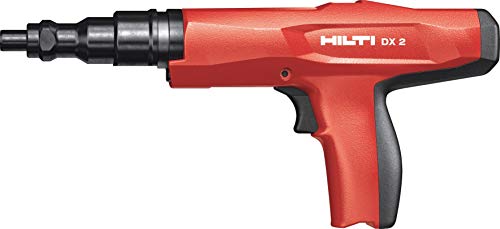
Hilti DX 5 Powder-Actuated Fastening Tool
Best for Professional UsePros
- Adjustable power regulation wheel fine-tunes each shot
- Automatic piston return speeds up repeat fastening
- Built for daily professional use on job sites
Cons
- Higher cost than consumer-grade tools
- Heavier to hold overhead for extended periods
The DX 5 is a fully automatic piston, powder-actuated tool with an adjustable power regulation wheel that fine-tunes each shot to the base material. It runs .27 caliber strip loads and is built for daily professional use. Hilti positions it at the higher end of its fastening lineup for crews running the tool continuously.
Ramset Trakfast TF1100+ Fastening Tool
Best for Track InstallationPros
- Strip-fed magazine speeds up track and runner installs
- Gas actuation avoids handling loose powder loads
- Well suited to repetitive fastening along long wall runs
Cons
- Fuel cells and strips add ongoing consumable cost
- Overkill for occasional single-fastener jobs
The TF1100+ is a gas-actuated tool designed specifically for fastening track and runners to concrete or masonry, using a disposable fuel cell instead of powder cartridges. Its strip-fed magazine holds up to 40 fasteners, cutting reload stops on long wall runs. Ramset markets it toward drywall and metal-stud contractors working along masonry perimeters.
Why Standard Nail Guns Do Not Work on Brick
Framing and finish nail guns rely on compressed air or a gas cartridge to drive a nail through wood fibers, far softer than fired clay brick or cured concrete. Brick and concrete require enough force to displace mineral material, not just fibers, so manufacturers built a separate tool category: powder-actuated and specialized pneumatic concrete nailers. These tools use a small cartridge charge or a dedicated coil-nail mechanism rated for masonry density.
Powder-Actuated vs Pneumatic Concrete Nailers
Powder-actuated tools fire a piston using a small caliber cartridge, similar in size to a blank round, and work without a compressor or power cord. Pneumatic concrete nailers like the Meite MT-C50 instead use shop air and coil-collated nails, trading portability for continuous, high-volume fastening. Choosing between them usually comes down to job volume: occasional fastening favors powder-actuated tools, while daily production work favors pneumatic.
Matching Caliber and Fastener Length to Your Wall
Powder-actuated loads come in calibers such as .22 and .27, each available in multiple power levels to match brick, block, or poured concrete density. Fastener length depends on what is being attached: track and furring strips typically need shorter pins, while structural connections into thick concrete need longer ones. Checking the base material and attachment thickness before buying loads avoids under- or over-driven fasteners.
Safety, Licensing, and Maintenance Basics
Many states and municipalities require operator certification before using powder-actuated tools, since misfires or ricochets can cause injury. Cleaning the barrel and piston after each use prevents residue buildup that can affect firing consistency. Storing loads separately from the tool, wearing eye and ear protection, and inspecting the tool before each session are standard practice across every brand covered here.
FAQs
Can a nail gun shoot into brick?
Standard pneumatic or gas nail guns cannot reliably penetrate brick. Fastening into brick or concrete requires a powder-actuated tool or a dedicated pneumatic concrete nailer built for masonry density.
What type of nail gun is used for brick walls?
Powder-actuated tools, such as the Ramset Cobra+ or Simpson Strong-Tie PTP1, are the standard choice for brick. Pneumatic concrete nailers like the Meite MT-C50 are used for high-volume coil-nail work.
Do you need a license to use a powder-actuated tool?
Many states and local jurisdictions require operator certification before purchasing loads or operating a powder-actuated tool. Requirements vary by location, so checking local rules before buying is recommended.
What is the difference between a powder-actuated tool and a pneumatic nailer?
A powder-actuated tool fires a piston using a small caliber cartridge and needs no compressor. A pneumatic concrete nailer uses shop air and coil-collated nails, favoring continuous high-volume fastening.
What caliber load do I need for concrete or brick?
Most masonry powder-actuated tools use .22 or .27 caliber loads, available in multiple power levels. The right level depends on the density of the brick, block, or concrete being fastened.
How long do fasteners need to be for brick veneer?
Fastener length depends on the thickness of the material being attached plus embedment depth into the brick. Shorter pins around 3/4 inch to 1-1/2 inches suit track and furring strips, while thicker attachments need longer pins.
Is a cordless powder-actuated tool as powerful as a powder cartridge tool?
A battery-actuated tool like the Ramset MasterShot still uses a .22 caliber load for the fastening force; the battery only replaces the hammer strike. Power output is comparable within its shorter fastener range.
Can I rent a powder-actuated nail gun instead of buying one?
Many tool rental centers carry powder-actuated tools along with the required loads, which suits one-time or occasional projects. Buying makes more sense for frequent or ongoing masonry work.
How do I know which power level load to use?
Manufacturers color-code loads by power level and publish charts matching level to base material density. Starting with the lowest level and testing on an inconspicuous spot is the standard approach.
Our verdict
For most brick and concrete jobs, the Ramset Cobra+ offers the best mix of power, control, and repeat-shot speed. Budget-focused DIYers can start with the Simpson Strong-Tie PTP1, while crews running high fastener volumes should look at the Meite MT-C50 pneumatic nailer instead.