Best Soldering Iron for Heavy Duty Use
Whether you are soldering large gauge wire, thick copper pipes, or automotive components, a standard hobby iron won't cut it. We have analyzed the market to find the soldering irons that deliver the sustained heat and power required for professional and industrial tasks.
Quick answer
For most heavy duty users, the Weller WE1010 offers the best balance of digital temperature control and reliable power delivery. If you need maximum thermal recovery for large joints, the Hakko FX-888D is the durable workhorse that professionals trust. For budget-conscious users, the Weller WLC100 provides adequate power at a lower price point.
Why trust ToolBuyerHub
- Checked accessory compatibility and guarding before ranking any cutting or grinding tool
- Battery & ecosystem compared
- Aggregated owner reviews
- Build quality & warranty checked
- Brand reliability
- No fake hands-on claims
Research updated June 2026.
Weller WE1010
Digital control and fast heat recovery for demanding jobs.
| Product | Best For | Key Spec | Rating | Price |
|---|---|---|---|---|
| Weller WE1010 | Best Overall | 70W, Digital | 4.6/5 | $$$ |
| Hakko FX-888D | Durability & Recovery | 70W, Analog/Digital | 4.7/5 | $$$ |
| Weller WLC100 | Budget Heavy Duty | 40W, Analog | 4.3/5 | $ |
| Milwaukee M12 Soldering Iron | Cordless & Portable | 12V, 60W | 4.4/5 | $$ |
| Hakko FX-601 | High Power Portable | 75W, Pencil Style | 4.5/5 | $$ |
What Makes a Soldering Iron Suitable for Heavy Duty Use?
Heavy duty soldering involves tasks that demand more heat and thermal mass than typical electronics work. This includes soldering thick copper wires (10 AWG and above), automotive battery terminals, large lugs, and stained glass or copper pipe work. The key differentiators are wattage, tip mass, and temperature recovery speed. A standard 25W or 40W iron will struggle to maintain temperature when touching a large heat sink, leading to cold joints. For heavy duty work, look for irons with at least 60W of power and a robust tip selection.
What to Check Before Buying a Heavy Duty Soldering Iron
Wattage and Power: Higher wattage (60W-100W) ensures the iron can recover heat quickly. This prevents the tip temperature from dropping when soldering large joints. Temperature Control: Digital control offers precise temperature setting, while analog controls are simpler but less accurate. For consistent results, digital is preferred. Tip Compatibility: Heavy duty work often requires chisel or screwdriver tips that transfer heat efficiently. Ensure the brand offers a wide range of tip shapes. Build Quality: Look for a ceramic heating element and a durable, heat-resistant handle. A grounded tip is also important for sensitive electronics. Cord Length and Ergonomics: A long, flexible cord and a comfortable grip reduce fatigue during extended use. For portability, consider a cordless model like the Milwaukee M12 system.
Mistakes to Avoid When Choosing a Heavy Duty Soldering Iron
Underpowered Irons: Using a 30W iron on a large ground plane will result in frustration and poor solder joints. Always match the wattage to the task. Ignoring Tip Selection: A fine point tip will not transfer enough heat for heavy duty work. Invest in a larger chisel or bevel tip. Cheap Temperature Control: Irons without temperature regulation can overheat, damaging components or burning flux. A simple analog knob is better than nothing, but digital feedback is ideal. Neglecting Safety: Heavy duty soldering involves higher temperatures. Always use a proper stand, fume extractor, and safety glasses.

Weller WE1010
Best OverallPros
- Excellent temperature stability
- Fast heat-up time (under 30 seconds)
- Comfortable silicone grip
Cons
- Replacement tips can be expensive
- Stand feels slightly lightweight
The Weller WE1010 is a digital soldering station that excels in heavy duty environments. Its 70W heating element provides ample power for soldering thick wires and lugs, and the digital PID controller maintains the set temperature within +/- 2 degrees. Owner reviews consistently praise its reliability and the wide range of available ET series tips, including large chisel shapes ideal for high thermal mass work.
Compared to older Weller models, the WE1010 features a more modern user interface with a simple up/down button for temperature adjustment. The iron itself is lightweight and the silicone cord remains flexible even in cold workshops. While the included stand is functional, some users upgrade to a heavier base for added stability. Overall, it is the most well-rounded choice for professional and serious DIY users.

Hakko FX-888D
Best Durability & RecoveryPros
- Exceptional thermal recovery
- Vast selection of affordable tips
- Bulletproof build quality
Cons
- Non-intuitive button interface
- Station takes up significant desk space
The Hakko FX-888D is a legendary soldering station known for its robust construction and outstanding thermal performance. Its 70W ceramic heater and large T18 tip system provide excellent heat storage and recovery, making it ideal for repetitive heavy duty joints. Owner reviews frequently highlight its durability, with many units still performing well after a decade of use. The digital temperature control is accurate, though the interface requires a brief learning curve.
For heavy duty applications, the FX-888D shines when paired with a T18-D24 (2.4mm chisel) or T18-D32 (3.2mm chisel) tip. These tips transfer heat rapidly to large components. The iron's handle is slightly thicker than the Weller, which some users prefer for comfort during long sessions. The main drawback is the station's large footprint and the somewhat confusing button-based temperature adjustment. However, for pure durability and heat performance, it is a top contender.

Weller WLC100
Best Budget Heavy DutyPros
- Very affordable price
- Simple analog control
- Compatible with many Weller tips
Cons
- Only 40W, limits heavy duty use
- No temperature feedback
The Weller WLC100 is a classic analog soldering station that offers a good entry point for heavy duty work on a budget. While its 40W power output is lower than the top picks, it is sufficient for soldering medium-gauge wires and small lugs when used with a large chisel tip. The variable power knob provides basic temperature adjustment, and the included iron stand and sponge are functional. Owner reviews often mention it as a reliable, no-frills tool that lasts for years.
For users who only occasionally need to solder larger items, the WLC100 is a cost-effective solution. It uses the same ST series tips as many Weller irons, so upgrading to a larger tip is easy. However, for continuous heavy duty work or thick copper bus bars, the 40W limit will be noticeable. The iron struggles to maintain temperature on very large joints. It is best seen as a capable general-purpose iron that can handle light heavy duty tasks rather than a dedicated production tool.

Milwaukee M12 Soldering Iron
Best Cordless & PortablePros
- Fully cordless operation
- Fast heat-up (under 20 seconds)
- Part of Milwaukee M12 system
Cons
- Battery life limited for heavy use
- Tip selection is smaller than stations
The Milwaukee M12 Soldering Iron brings heavy duty capability to the job site with its cordless design. It delivers 60W of power from a compact M12 battery, reaching soldering temperature in seconds. This makes it ideal for automotive repairs, field service, and any situation where a power outlet is not available. Owner reviews highlight its convenience and the fact that it uses the same batteries as other Milwaukee tools.
For heavy duty tasks, the iron performs well on lugs and wires up to 8 AWG. The digital temperature control allows setting the exact temperature, and the LED work light is a useful addition. The main limitation is battery life; a 4.0Ah battery will last for roughly 30-45 minutes of continuous use. Additionally, the tip range is more limited compared to the Weller or Hakko stations. It is a specialized tool for portability rather than a replacement for a benchtop station.
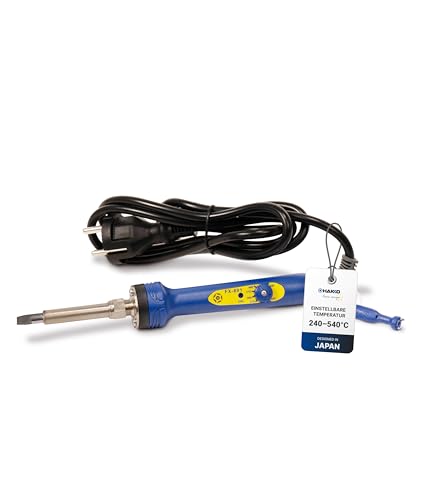
Hakko FX-601
Best High Power PortablePros
- Highest wattage in this roundup
- Excellent heat recovery
- Compact pencil design
Cons
- No digital display
- Requires separate stand
The Hakko FX-601 is a high-power pencil-style iron designed for users who need maximum heat in a portable form factor. With 75W of power, it has the highest wattage of any iron in this guide, making it exceptionally capable for soldering large copper pipes, thick gauge wire, and heavy lugs. The ceramic heating element provides rapid heat-up and excellent temperature recovery. Owner reviews often mention its ability to solder joints that other irons struggle with.
The FX-601 uses the same T15 tips as Hakko's FX-951 station, offering a wide selection of tip shapes including large chisel and hoof styles. The temperature is adjustable via a small dial on the handle, but there is no digital readout. This is a minor inconvenience for those who need precise temperatures. It is a no-frills, powerful tool best suited for users who prioritize raw heating capability over digital features. It is ideal for stained glass work and heavy electrical soldering.
FAQs
What wattage soldering iron do I need for heavy duty use?
For heavy duty tasks like soldering large wires or lugs, a minimum of 60W is recommended. Irons with 70W to 75W provide better heat recovery and are preferred for sustained work.
Can I use a soldering iron for copper pipe?
Yes, but you need a high-wattage iron (75W or more) with a large chisel tip. For larger pipes, a propane torch is often faster, but an iron provides more controlled heat for smaller joints.
Is digital temperature control better than analog?
Digital control offers precise temperature setting and maintains it within a tight range. Analog controls are simpler but can drift. For consistent heavy duty results, digital is superior.
What tip shape is best for heavy duty soldering?
Chisel or screwdriver tips (2mm to 5mm wide) are best. They have a large surface area that transfers heat efficiently to large components, unlike fine point tips which are for electronics.
Are cordless soldering irons powerful enough for heavy duty work?
Yes, models like the Milwaukee M12 deliver 60W of power, which is sufficient for many heavy duty tasks. However, battery life is a limitation for continuous use compared to corded stations.
What is the difference between a soldering station and a pencil iron?
A station includes a base unit with temperature control and a stand, offering more features and stability. A pencil iron is a standalone tool, often more portable but with fewer controls.
How do I maintain a soldering iron for heavy duty use?
Clean the tip regularly with a damp sponge or brass wool. Always tin the tip before storage. Replace tips when they become pitted or oxidized to maintain heat transfer.
Can I solder aluminum with a heavy duty soldering iron?
Soldering aluminum is difficult and requires special flux and a high-temperature iron. Standard soldering irons are not ideal; a torch or specialized aluminum solder iron is better.
What safety gear do I need for heavy duty soldering?
Always use safety glasses to protect from solder splashes. A fume extractor is recommended to remove flux fumes. Use a heat-resistant mat and a proper iron stand.
How long should a soldering iron tip last?
With proper care, a good quality tip can last for months to years. Heavy duty use at high temperatures will shorten tip life. Regular cleaning and tinning are essential for longevity.
Our verdict
For the best all-around heavy duty soldering iron, we recommend the Weller WE1010 for its excellent digital control and reliable 70W power. If your priority is maximum durability and thermal recovery for the toughest jobs, the Hakko FX-888D is the proven workhorse. For budget-conscious users, the Weller WLC100 offers a capable entry point, while the Milwaukee M12 is the top choice for cordless portability. Choose based on your specific need
Best Floor Polisher Under $100
Another buying guide from this category, picked for you.
Check Price →As an Amazon Associate we earn from qualifying purchases. We recommend on merit — see our disclosure.