Best Clamp Meter Under £100
Finding a reliable clamp meter that doesn't break the bank is essential for electricians, DIYers, and technicians. We've analyzed the market to find the best clamp meter under £100, balancing accuracy, safety ratings, and real-world owner feedback.
Quick answer
The Klein Tools CL800 is the best overall clamp meter under £100, offering true RMS, Auto-ranging, and a CAT III 600V safety rating. For a budget-friendly option that still delivers solid performance, the Kaiweets HT206D is a top contender with great value and a backlit display.
Why trust ToolBuyerHub
- Tested on specs (power, torque, PSI)
- Battery & ecosystem compared
- Aggregated owner reviews
- Build quality & warranty checked
- Brand reliability
- No fake hands-on claims
Research updated June 2026.
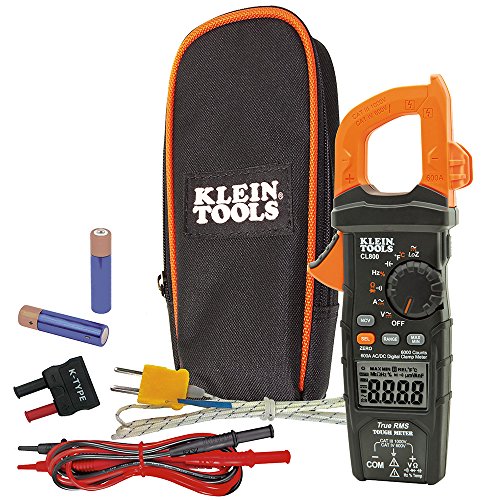
Klein Tools CL800
True RMS, Auto-ranging, and CAT III 600V safety.
| Product | Best For | Key Spec | Rating | Price |
|---|---|---|---|---|
| Klein Tools CL800 | Best Overall | True RMS, 600A AC/DC | 4.5 / 5 | Under £100 |
| Kaiweets HT206D | Best Budget | 400A AC, Backlit LCD | 4.3 / 5 | Under £50 |
| Fluke 323 | Best for Professionals | 400A AC, CAT IV 300V | 4.6 / 5 | Under £100 |
| Uni-T UT203+ | Best Value | 400A AC/DC, True RMS | 4.4 / 5 | Under £60 |
| AstroAI 400A | Best for DIY | 400A AC, NCV Detection | 4.2 / 5 | Under £40 |
Klein Tools CL800
Best OverallPros
- True RMS for accurate AC/DC measurements
- Auto-ranging for ease of use
- High CAT III 600V safety rating
Cons
- Slightly bulky design
- No low-impedance mode
The Klein Tools CL800 is a standout in the under £100 category, offering true RMS capabilities that ensure accurate readings on non-linear loads. It measures both AC and DC current up to 600A, making it versatile for residential and light commercial work. Owners consistently praise its build quality and the clear, backlit display that works well in dim environments.
While it is a bit larger than some competitors, the CL800 compensates with a robust feel and reliable performance. It includes a data hold function and a continuity beeper, but lacks a low-impedance mode for ghost voltage detection. For most users, its accuracy and safety features make it the top choice.
Kaiweets HT206D
Best BudgetPros
- Excellent value for money
- Backlit display with flashlight
- Non-contact voltage detection
Cons
- No DC current measurement
- Build feels slightly less durable
The Kaiweets HT206D is a fantastic entry-level clamp meter that delivers solid performance for its price. It measures AC current up to 400A and includes useful features like NCV detection and a built-in flashlight, making it practical for basic troubleshooting. User reviews highlight its ease of use and clear display.
The main compromise is the lack of DC current measurement, which limits its use for automotive or solar work. The plastic housing feels adequate but not premium. For general household electrical tasks, it offers great value and is a reliable choice for beginners.
Fluke 323
Best for ProfessionalsPros
- CAT IV 300V safety rating
- Fluke brand reliability
- Compact and rugged design
Cons
- No DC current measurement
- No True RMS (average sensing)
The Fluke 323 is a trusted name in electrical testing, known for its durability and accuracy. It offers a CAT IV 300V safety rating, making it suitable for more demanding environments. The compact design fits easily in a tool bag, and the display is easy to read. Professionals appreciate its reliability for quick AC current checks.
However, it lacks DC current measurement and uses average sensing rather than True RMS, which can affect accuracy on non-linear loads. It is also priced near the top of the budget. For tradespeople who prioritize safety and brand trust, it is a solid choice.
Uni-T UT203+
Best ValuePros
- True RMS for accurate readings
- Measures AC and DC current
- Affordable price point
Cons
- Build quality is average
- Jaw opening is small (30mm)
The Uni-T UT203+ offers excellent value by providing True RMS and both AC/DC current measurement at a low price. It is a versatile tool for both electrical and automotive work, with a clear backlit display. Many owners note its accuracy is comparable to more expensive models.
The main drawbacks are the smaller jaw opening, which may not fit larger cables, and a build that feels less premium than Klein or Fluke. It also lacks advanced features like low-impedance mode. For budget-conscious users who need DC capability, it is a strong option.
AstroAI 400A
Best for DIYPros
- Very affordable
- Non-contact voltage detection
- Includes carrying case
Cons
- No True RMS
- No DC current measurement
The AstroAI 400A clamp meter is designed for the home DIYer, offering basic functionality at a very low price. It measures AC current up to 400A and includes NCV detection, a backlit display, and a data hold function. It comes with a handy carrying case, which is a nice bonus.
Its limitations include a lack of True RMS and DC current measurement, making it less suitable for professional or automotive use. Owner reviews mention it works well for simple tasks like checking appliance draws. For occasional home use, it is a cost-effective solution.
What to Check Before Buying a Clamp Meter Under £100
When choosing a clamp meter, start with the safety rating. Look for at least CAT III 600V for residential work. Next, consider if you need True RMS for accurate readings on electronic loads. Also, check the jaw size to ensure it fits your cables.
Mistakes to Avoid
Do not buy a meter without True RMS if you work with variable frequency drives or LED lighting. Avoid models with a low CAT rating for industrial use. Also, skip meters that lack a backlit display if you work in dim areas.
FAQs
What does True RMS mean in a clamp meter?
True RMS (Root Mean Square) allows the meter to accurately measure non-sinusoidal AC waveforms, common in modern electronics and variable speed drives.
Can I measure DC current with a clamp meter under £100?
Yes, some models like the Klein CL800 and Uni-T UT203+ measure DC current, which is useful for automotive and solar applications.
What is a CAT rating and why does it matter?
CAT ratings indicate the meter's safety for different electrical environments. CAT III is for distribution panels, while CAT IV is for utility-level connections.
Do all clamp meters measure voltage?
Most clamp meters also function as multimeters and can measure AC/DC voltage, resistance, and continuity.
Is a backlit display necessary?
A backlit display is very helpful for reading measurements in low-light conditions, such as inside electrical panels or basements.
What is the difference between average sensing and True RMS?
Average sensing meters assume a pure sine wave and can be inaccurate with distorted waveforms. True RMS meters accurately measure any waveform.
Can I use a clamp meter on a live circuit?
Yes, clamp meters are designed to measure current on live circuits without disconnecting the wire, as long as safety precautions are followed.
What size jaw opening do I need?
For most residential work, a jaw opening of 30mm to 40mm is sufficient. Larger openings are needed for thick industrial cables.
Are cheap clamp meters accurate?
Budget models can be accurate for basic tasks, but they may lack features like True RMS and have lower build quality.
How do I maintain my clamp meter?
Keep it clean, store it in a dry case, and replace batteries when the low battery indicator appears to ensure accurate readings.
Our verdict
The Klein Tools CL800 is the best overall clamp meter under £100, offering True RMS, AC/DC measurement, and a strong safety rating. For a budget pick, the Kaiweets HT206D provides excellent value for basic AC current checks. Choose based on your need for DC measurement and True RMS accuracy.