Best Clamp Set
Clamps get bought in the wrong order. Most people start with a bundle of cheap bar clamps, discover they cannot glue up a panel flat, and then buy the clamps they needed in the first place. The order that works is: a set of one-handed bar clamps for holding things, then F-clamps for real pressure, then parallel clamps when you start making panels.
The other thing worth knowing is that clamping force and squareness are separate problems. A trigger clamp that holds a fence in place does not need much force. A panel glue-up needs even pressure and faces that stay parallel, which is a different mechanism and a different price bracket. Each set below is matched to one of those jobs.
Quick answer
If you are buying one set, the Irwin Quick-Grip one-handed bar clamps in the six pack cover the most ground, because most clamping is holding rather than squeezing. Add the Jorgensen steel F-clamps when you need genuine force, and the Bessey K Body REVO kit once you start gluing up panels.
Why trust ToolBuyerHub
- Every set here is a named brand sold on Amazon US, checked against the live listing
- Specifications come from manufacturer and listing data, not from guesswork
- Owner-feedback themes are summarized as feedback, never as our own hands-on testing
- No invented star ratings; the Research Score criteria are visible on each pick
- Clamping force claims are reported as the maker states them, not implied as measured here
- Sets are matched to distinct jobs rather than ranked as seven versions of the same clamp
Research updated October 2026.
What Matters Most When Buying Clamps
Three specifications decide whether a clamp suits the job. Clamping force is the obvious one, and it separates light trigger clamps that hold a workpiece from steel F-clamps and parallel clamps that actually close a joint. Reach and capacity are the limits people hit first: a 6 inch clamp is useless on a 12 inch panel, and a deep throat lets you clamp away from an edge rather than only at it. Jaw geometry is the one that gets overlooked, and it matters most in glue-ups, because a clamp whose jaws tilt under pressure pulls the workpiece out of square. Parallel clamps exist specifically to solve that. Beyond those three, prefer one-handed operation for assembly work, where you need your other hand to hold the piece.
| Model | Best for | Key specs | Research Score |
|---|---|---|---|
| Irwin Quick-Grip One-Handed Bar Clamps for Woodworking, 6 Pack | General holding and assembly | One-handed bar clamp, Trigger, single hand | 91/100 |
| Bessey K Body REVO Clamp Kit, KREK2440, 2 x 24 in and 2 x 40 in | Panel glue-ups and casework | Parallel clamp, 2 x 24 in, 2 x 40 in | 95/100 |
| Jorgensen Steel Bar Clamps Set, 4 Pack, 6 in and 12 in F-Clamps | Real clamping pressure on a budget | Steel F-clamp, Maker-rated 600 lb | 89/100 |
| Pony 3/4 in Black Pipe Clamp Fixture, 2 Pack | Long assemblies on a budget | Pipe clamp fixture, 3/4 in black pipe, bought separately | 87/100 |
| Bessey Trigger and Spring Combination Clamp Set, 6 Piece | A first mixed set | Trigger and spring clamps, 6 clamps | 85/100 |
| Rockler Bandy Spring Clamps, 3 Pair | Edge banding and trim | One-handed nylon spring clamp, 3 pairs | 84/100 |
| DEWALT DWHT83148 Small Trigger Clamp, 4.5 in, 2 Pack | Tight spaces and small parts | One-handed trigger clamp, 4.5 in | 83/100 |

Irwin Quick-Grip One-Handed Bar Clamps for Woodworking, 6 Pack
Best Overall SetPros
- One-handed operation is the right feature for assembly work, where the other hand is holding the piece
- Six clamps is enough to actually hold a carcass together rather than needing a second purchase
- Padded jaws will not mark finished surfaces, so they double as hold-downs for fixtures and jigs
Cons
- Trigger mechanism delivers far less force than a screw clamp, so it will not close a tight joint
- Plastic body flexes under load, which limits them to holding rather than squeezing
These are the clamps you reach for twenty times a day, and that is the case for buying them first. Most clamping in real work is holding: a fence to a bench, a stop block to a jig, two parts in position while you drive a screw. The trigger action handles all of that one handed. What they do not do is generate the pressure a glue line needs, so treat them as the holding half of a clamp collection rather than the whole thing.
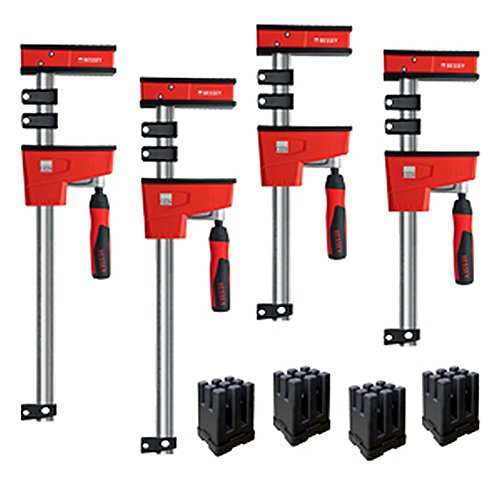
Bessey K Body REVO Clamp Kit, KREK2440, 2 x 24 in and 2 x 40 in
Best for Glue-UpsPros
- Jaws stay parallel under pressure, which is the difference between a flat panel and a twisted one
- Large jaw faces spread load so glue lines close evenly without dents
- Mixed 24 and 40 inch lengths cover both cabinet carcasses and wider panels
Cons
- Significantly more expensive than any other set here
- Heavy and bulky to store, and overkill if you never glue up panels
This is the kit that changes what you can build. The reason panel glue-ups go wrong with ordinary bar clamps is that the jaws tilt as pressure builds, which pulls the boards into a curve or a twist that no amount of sanding fixes afterwards. Parallel clamps hold their faces square to the work, so pressure stays perpendicular to the glue line. If you make cabinets, tabletops or anything from edge-joined boards, this is the right thing to spend money on.

Jorgensen Steel Bar Clamps Set, 4 Pack, 6 in and 12 in F-Clamps
Best ValuePros
- Steel bar and screw mechanism deliver genuine clamping force, unlike a trigger clamp
- Mixed 6 and 12 inch sizes cover small joinery and medium assemblies
- Jorgensen is a long-established clamp name rather than a rotating seller
Cons
- Two hands needed, so they are awkward for holding a part in position while you clamp
- Jaws can tilt under high pressure, so they are not a substitute for parallel clamps in glue-ups
The honest middle of a clamp collection. When a joint actually has to close, a screw-operated steel clamp is what does it, and this four pack is the inexpensive way in. The mix of lengths matters more than the count: 6 inch clamps handle small joinery and jig work, 12 inch covers most box and frame assembly. Expect to add longer clamps later rather than replacing these.
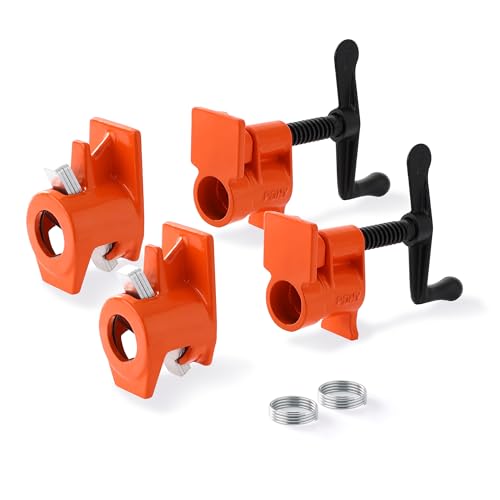
Pony 3/4 in Black Pipe Clamp Fixture, 2 Pack
Best for Long ReachPros
- Capacity is whatever length of pipe you buy, which makes long clamping dramatically cheaper
- Fixtures are cheap enough to own several pairs and swap them between pipe lengths
- Pipe is sold by the foot at any hardware store and can be cut and threaded to size
Cons
- Pipe is not included, so the listed price is not the cost of a working clamp
- Pipe can flex over long spans and the fixtures mark softwood, so cauls are needed
The old trick that still works. A pair of long bar clamps costs serious money; a pair of pipe clamp fixtures plus a length of threaded black pipe does the same job for a fraction of it. The compromise is real: pipe flexes over long spans, so pressure is less even than a parallel clamp, and the jaws will dent softwood without a caul. For occasional long glue-ups, that is an acceptable trade.

Bessey Trigger and Spring Combination Clamp Set, 6 Piece
Best Starter MixPros
- Mix of trigger and spring clamps covers more small jobs than six of one type would
- Spring clamps are instant to apply, which suits holding a workpiece for seconds rather than minutes
- Bessey build quality in a genuinely cheap set
Cons
- All light duty, so nothing in this set will close a glue joint
- Spring clamps have fixed opening, so they only work within a narrow thickness range
A sensible first purchase if you are starting from no clamps at all and are not yet sure what you will build. Spring clamps handle the many short tasks where a trigger clamp is slower than it needs to be: holding a template, pinching a repair, keeping a cord out of the way. Understand the limit, though, which is that this is a set of holders and you will still need F-clamps when a joint has to be squeezed.

Rockler Bandy Spring Clamps, 3 Pair
Best for Edge WorkPros
- Nylon jaws will not dent or mark veneer, edge banding or finished trim
- One-handed operation suits working along an edge where you are feeding material with the other hand
- Light and small enough to sit in a row at close spacing, which is what edge work needs
Cons
- Very light clamping force, strictly for edging and trim
- A specialty clamp, so it is a poor first purchase
A specialist clamp that is genuinely better than improvising. Edge banding and applied trim need many small clamps at close spacing with just enough pressure to hold glue contact, and nothing harder than nylon against the surface. Metal clamps dent, big clamps cannot be spaced closely, and tape is unreliable on anything but a flat run. Buy these when you start doing edge work and not before.
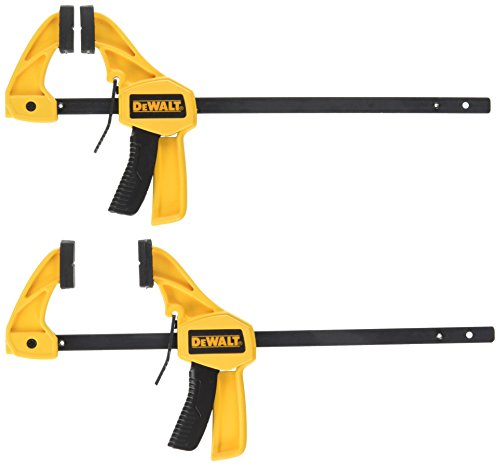
DEWALT DWHT83148 Small Trigger Clamp, 4.5 in, 2 Pack
Best Small ClampsPros
- Small body fits where a full-size bar clamp physically will not
- One-handed trigger action, the same convenience as the larger Quick-Grips
- Useful for jig and fixture work where the clamp must sit out of the way
Cons
- 4.5 inch capacity is limiting, so they are an addition rather than a core set
- Light force, consistent with every trigger clamp here
These earn a place because clamp choice is often decided by available space rather than required force. On a jig, inside a cabinet or around a machine fence, a full-size clamp fouls the work and a small one does not. Two is a sensible quantity; these are the clamps you add to a collection for access, not the ones you build it on.
Buy clamps in the right order
Start with one-handed bar clamps, because holding is the most frequent clamping job and doing it one handed is genuinely useful. Add steel F-clamps next, because at some point a joint has to actually close and trigger clamps cannot do it. Add parallel clamps third, when you start gluing up panels and discover that ordinary clamps pull the work out of flat. Pipe clamps or long bar clamps come fourth, when a project outgrows what you own. Buying in that order means every purchase gets used immediately, instead of a pile of cheap clamps you replace later.
Why parallel clamps exist
A conventional bar clamp applies force through a jaw that can tilt on the bar as pressure rises. On a single joint that rarely matters. Across a panel glue-up it matters a great deal, because tilted jaws apply force at an angle and bow or twist the assembly, and the error is locked in once the glue cures. Parallel clamps hold large jaw faces square to the bar so force stays perpendicular to the glue line. That is the whole reason for the price difference, and it is why panel work is the point at which they become worth buying.
How many clamps do you actually need
More than you expect, and the reason is that clamping pressure has to be spaced along a joint rather than concentrated. A rough working guide for edge gluing is a clamp every 6 to 10 inches along the joint, alternating above and below the panel to balance the pressure. That means a modest 24 inch panel wants three or four clamps, not one. This is also why clamps are usually bought in matched pairs or sets: odd single clamps rarely help.
Protecting the workpiece
Bare metal jaws dent softwood and mark finished surfaces, and iron in contact with wet glue and water can stain oak and other tannin-rich timbers black. The fix is cauls, which are just scrap blocks placed between the jaw and the work, and they also spread pressure along the joint rather than concentrating it at the jaw. Clamps with padded or nylon jaws solve the marking problem for light work, but for serious pressure cauls are still the right answer.
FAQs
What clamps should a beginner buy first?
A set of one-handed bar clamps, such as the Irwin Quick-Grip six pack, because most clamping in practice is holding a part in position rather than squeezing a joint, and doing that one handed is genuinely useful. Add steel F-clamps second for actual clamping pressure, then parallel clamps when you start gluing up panels.
How many clamps do I need for a glue-up?
Space clamps roughly every 6 to 10 inches along the glue line and alternate them above and below the panel to balance pressure. A 24 inch panel therefore wants three or four clamps rather than one or two. Running too few clamps leaves gaps in the glue line that show up as visible seams after sanding.
Are parallel clamps worth the money?
If you glue up panels, tabletops or cabinet carcasses, yes. Ordinary bar clamps tilt their jaws as pressure rises, which bows or twists the assembly, and the error cures into the piece. Parallel clamps keep the jaw faces square so pressure stays perpendicular to the joint. If you never edge-join boards, they are not worth it.
What is the difference between an F-clamp and a bar clamp?
An F-clamp has a sliding jaw on a flat steel bar and a screw to apply force, which generates far more pressure than a trigger mechanism. A one-handed bar clamp uses a trigger or lever and is designed for speed and convenience rather than force. In practice F-clamps close joints and trigger clamps hold parts in place.
Do pipe clamps work as well as bar clamps?
For long glue-ups on a budget they are a reasonable compromise. The fixtures are inexpensive and capacity is set by whatever pipe length you buy, which is far cheaper than long bar clamps. The trade is that pipe flexes over long spans so pressure is less even, and the jaws will mark softwood unless you use cauls.
How much clamping pressure do I need for wood glue?
Enough to close the joint completely with a thin, even glue line, and no more. Over-clamping squeezes glue out of the joint and can starve it, and it can also bow thin stock. A good practical test is a continuous fine bead of squeeze-out along the whole joint. If one area shows no squeeze-out, you need another clamp there rather than more force on the existing ones.
Why do my clamps stain the wood?
Iron in contact with wet glue and water reacts with the tannins in woods such as oak, leaving dark blue-black marks. Use cauls between the jaws and the work, or clamps with non-marring faces, and wipe away excess glue before it sits against bare metal. The stains are deep and usually need planing or scraping out rather than sanding.
What size clamps are most useful?
For general work, 12 inch F-clamps and 12 to 18 inch bar clamps cover the widest range of jobs. Six inch clamps are useful for small joinery and jigs, and 24 to 40 inch clamps are needed for cabinet carcasses and panels. Buying a mix of two sizes is more useful than buying several of one.
Can clamps be left on overnight?
Yes, and for most wood glues leaving the clamps on for an hour or more is sensible, with overnight being common practice before working the joint. Check that clamps are not resting against wet glue on a tannin-rich wood, and release pressure before moving the assembly, since lifting a clamped panel by the clamps can rack the joint.
Our verdict
Start with the Irwin Quick-Grip six pack, since most clamping is holding and one-handed operation earns its keep daily. Add the Jorgensen steel F-clamps for the jobs where a joint has to close. Buy the Bessey K Body REVO kit when you begin gluing up panels, because that is the only clamp type that keeps a glue-up flat, and reach for the Pony pipe clamp fixtures when a project outgrows what you own.