Best Stanley Utility Knife of 2026: Classic 99 vs FatMax
Stanley utility knives are the default choice for scoring drywall, breaking down boxes, and trimming carpet. Stanley splits its knives into two main families: the all-metal Classic 99 line and the newer FatMax line with grippier handles and tool-free blade changes. This guide explains which family fits which job, using published product specs and the themes that come up repeatedly in owner feedback.
Quick answer
The Stanley Classic 99 Retractable Utility Knife (model 10-099) is the best overall pick: a die-cast metal body, a three-position retractable blade, and an interlocking nose that keeps the blade from wobbling. If you change blades constantly, step up to a Stanley FatMax retractable, which opens tool-free instead of needing a screwdriver.
Why trust ToolBuyerHub
- Picks compared on published specs (body material, blade lock, retract mechanism)
- Blade retention and blade-change methods compared side by side
- Owner feedback themes read across major retailers, with no invented review scores
- Model numbers checked against Stanley's own catalog naming
- Brand history: Stanley Works dates to 1843, and the Stanley knife has been a jobsite standard since the 1930s
- No fake hands-on claims
Research updated August 2026.
Stanley Classic 99 Retractable Utility Knife (10-099)
Die-cast metal body and an interlocking nose that holds the blade dead steady.
| Product | Best For | Body | Blade Change | Price |
|---|---|---|---|---|
| Classic 99 Retractable (10-099) | Overall heavy-duty use | Die-cast metal | Screw-open | Budget |
| FatMax Retractable | Frequent blade swaps | Metal with bi-material grip | Tool-free | Mid-range |
| FatMax Auto-Retract Tri-Slide | Blade-exposure safety rules | Composite | Tool-free | Mid-range |
| FatMax Folding Utility Knife | Pocket and belt carry | Metal, folding | Tool-free | Mid-range |
| Classic 99 Fixed Blade (10-175) | Stiffest cut, lowest cost | Die-cast metal | Screw-open | Budget |

Stanley Classic 99 Retractable Utility Knife (10-099)
Best OverallPros
- Die-cast metal body survives drops onto concrete
- Interlocking nose grips the blade so it does not rock in the cut
- Spare blades store inside the handle
- Cheap to replace and sold nearly everywhere
Cons
- Blade change needs a screwdriver or a coin to open the body
- Heavier in a pocket than a plastic knife
The Classic 99 is the knife most people picture when they hear "Stanley knife." The die-cast body has almost nothing in it that can break, and the interlocking nose clamps the blade so it does not flex sideways when you lean into a drywall score. Owner feedback consistently comes back to the same point: these last for years and get replaced only when they get lost.
The one real compromise is the blade change. You loosen the screw on the body, split the two halves, swap the blade, and screw it back together. That is slower than a tool-free knife, but it is also why the blade sits so solidly. Note that this is the retractable version of the Classic 99, not part of the FatMax line, and it does not auto-retract.

Stanley FatMax Retractable Utility Knife
Best for Fast Blade ChangesPros
- Blade swaps in seconds with no screwdriver
- Rubberized grip section is easier to hold with gloves on
- Onboard blade storage keeps spares off the floor
Cons
- Costs noticeably more than a Classic 99
- More moving parts than the screw-together design
FatMax is Stanley's heavier-duty hand tool line, and the retractable FatMax knives exist mainly to solve the Classic 99's one weakness: blade changes. Press the release, the old blade comes out, a fresh one drops in. If you are cutting shingles, carpet backing, or anything else that dulls a blade in minutes, that adds up over a day.
The bi-material handle is the other real difference. It is easier to hold with wet or gloved hands than bare die-cast metal. Because Stanley has sold several FatMax retractable variants over the years under different FMHT part numbers, check the listing photo for the blade-release button before you buy, since some older FatMax models still use a screw.
Stanley FatMax Auto-Retract Tri-Slide Safety Knife
Best SafetyPros
- Blade springs back the instant you let go of the slider
- Meets sites that ban fixed and manually retracted blades
- Three slider positions make it usable left or right handed
Cons
- You must hold the slider through the whole cut, which tires the thumb
- Not suited to long continuous scoring runs
Plenty of commercial sites now require self-retracting knives, and this is Stanley's answer. Release the slider and the blade disappears into the body immediately, so a knife dropped mid-cut or slipped into a pouch is not still open. The tri-slide layout means you are not fighting the tool if you are left handed.
The trade-off is real and worth knowing before you buy: constant thumb pressure gets tiring on long cuts, and some people find it awkward when they need to change grip mid-cut. If your site does not mandate auto-retract, a standard retractable is more comfortable.

Stanley FatMax Folding Utility Knife
Best for Pocket CarryPros
- Folds flat, so nothing sharp is exposed in a pocket
- Belt clip means it is always on you
- Opens one-handed and locks open
Cons
- Shorter handle gives less leverage than a full-size knife
- Pivot can collect grit and stiffen up
A folding utility knife is the answer if the problem is carry rather than cutting power. It clips to a belt or pocket, opens with one hand, and locks so the handle will not fold on your fingers mid-cut. For general trade work where you cut something every twenty minutes, that beats digging a full-size knife out of a bag.
Where it loses to the Classic 99 is leverage and rigidity. The shorter, folding handle is less comfortable for long scoring passes, and grit in the pivot eventually makes it gritty to open. Blow it out with air occasionally and it stays smooth.
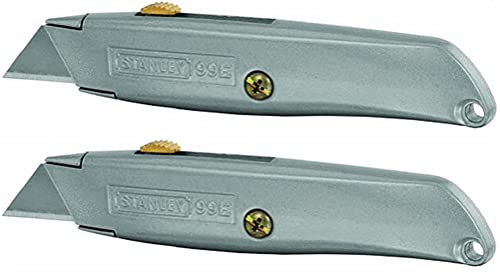
Stanley Classic 99 Fixed Blade Utility Knife (10-175)
Best BudgetPros
- No retract mechanism at all, so nothing to jam or loosen
- Stiffest of the lot for deep scoring cuts
- Usually the cheapest metal knife Stanley sells
Cons
- Blade is always exposed, so it needs a sheath or a dedicated pouch
- Banned on many commercial sites that require retractable blades
The fixed-blade Classic 99 is the simplest knife here. There is no slider and no spring, just a die-cast body clamped around a blade, which is exactly why it is the most rigid option for scoring plywood or cutting deep into insulation. Spare blades still store inside the handle.
Read the safety note seriously though. A permanently exposed blade in a tool bag is how people get cut reaching for a tape measure. Many commercial sites explicitly prohibit fixed-blade knives, so check your site rules first. For a home workshop drawer, it is hard to beat for the money.
What to check before buying a Stanley utility knife
Start with the blade mechanism, because that is the real difference between models. Fixed blades are stiffest and cheapest but are always exposed. Retractable blades are the standard compromise. Auto-retract models retract the moment you release the slider and are required on some commercial sites. Next, check the blade-change method: the Classic 99 line needs a screwdriver or coin to split the body, while FatMax models release the blade with a button. Finally check the body. Die-cast metal survives drops that crack plastic, and onboard blade storage saves carrying loose blades in a pocket.
Understanding Stanley's model numbering
Stanley's naming trips people up, so it is worth being clear. Classic 99 knives use old-style numbers such as 10-099 for the retractable version and 10-175 for the fixed-blade version. These are all-metal knives with screw-together bodies. FatMax is a completely separate, newer line with FMHT-style part numbers, bi-material grips, and tool-free blade changes. There is no such thing as a "FatMax Xtreme 10-099", and FatMax Xtreme part numbers such as 84-648 belong to Stanley pliers, not knives. If a listing mixes the two families in one product name, treat the listing as unreliable.
Mistakes to avoid when choosing a utility knife
The most common mistake is buying a fixed-blade knife for a jobsite that bans them, then not being allowed to use it. The second is ignoring blade type: most Stanley knives take standard 1992 trapezoid blades, but for shingles, carpet backing, and vinyl you want 1996 hook blades, which pull through material instead of skating over it. Third, do not judge a knife by handle looks alone, since a knife with a loose blade lock will chatter and ruin a straight score line. And do not buy a bulk multipack of unbranded knives to save money if the blade lock is the part you actually care about.
FAQs
Which Stanley utility knife is the most durable?
The Classic 99 line, models 10-099 and 10-175, uses a die-cast metal body with very few moving parts, which is why these knives commonly outlast plastic-bodied alternatives.
Do all Stanley utility knives use the same blades?
Most take standard 1992 trapezoid blades, and hook-shaped 1996 blades fit the same knives for carpet and roofing work. Snap-off and specialty knives use different blades, so check the packaging.
What is the difference between the Stanley FatMax and Classic 99 knives?
Classic 99 knives are all-metal with a screw-together body, so blade changes need a screwdriver or a coin. FatMax knives are a newer line with bi-material grips and tool-free blade changes, and they cost more.
Does the Stanley 10-099 retract automatically?
No. The 10-099 is a manually retractable three-position knife, so the blade stays where you set it. For automatic retraction you need a FatMax auto-retract model.
How do I change the blade on a Stanley Classic 99?
Loosen the screw on the side of the body with a screwdriver or a coin, separate the two halves, lift out the old blade, seat a fresh one on the locating posts, then close and retighten.
Can I use a Stanley utility knife for drywall scoring?
Yes. The Classic 99 knives are well suited to it because the interlocking nose holds the blade rigid, which keeps the score line straight.
Are Stanley utility knives made in the USA?
Some Stanley hand tools are made in the USA with global materials, while others are made in Mexico or China depending on the model and production run. Check the packaging if origin matters to you.
What is the warranty on Stanley utility knives?
Stanley offers a limited lifetime warranty on most of its hand tools, including utility knives. Blades are consumables and are not covered.
Which Stanley knife is best for carpet installation?
Any Stanley knife that accepts 1996 hook blades will work, and flooring installers generally prefer a rigid fixed-blade or a locked retractable so the blade cannot shift mid-pull.
Which Stanley utility knives have a belt clip?
The FatMax folding utility knives include a belt clip. The Classic 99 models do not, so they need a tool-belt pouch.
Our verdict
The Stanley Classic 99 Retractable Utility Knife (10-099) is the best overall Stanley utility knife for 2026: all-metal, rigid, cheap, and almost impossible to kill. Step up to a FatMax retractable if you change blades constantly, choose a FatMax auto-retract if your site requires self-retracting blades, and take the fixed-blade 10-175 only if you have somewhere safe to store it.