Best Arc Welders for Professionals: MIG, Multi-Process and Stick
"Arc welder" is an umbrella term. It covers MIG (GMAW), flux-cored, TIG and stick (SMAW) machines, because all of them strike an electric arc to melt metal. Most professionals searching for one are shopping for either a MIG or a multi-process inverter, so this guide covers both, plus a dedicated stick machine for outdoor and structural work. The specs below are the manufacturers' published figures, and the duty cycle numbers are the ones that actually matter.
Quick answer
The Miller Millermatic 211 is the best overall pick for professional MIG and flux-cored work, thanks to Auto-Set and 120V/240V dual voltage. If you need MIG, TIG and stick from one machine, the Lincoln Electric POWER MIG 210 MP is the better buy. For pure stick welding on a budget, the Lincoln Electric AC-225 is still the shop standard.
Why trust ToolBuyerHub
- Compared on published specs (amperage, duty cycle, weight)
- Input voltage and shop power requirements checked
- Owner feedback read across retailers
- Build quality & warranty checked
- Brand parts and service availability
- No fake hands-on claims
Research updated June 2026.
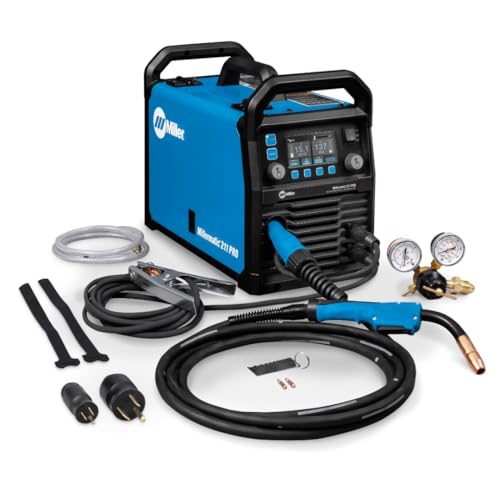
Miller Millermatic 211
Versatile MIG and flux-cored welding with Auto-Set technology.
| Product | Best For | Key Spec | Rating | Price |
|---|---|---|---|---|
| Miller Millermatic 211 | Overall MIG Versatility | 30-230 A, 40% @ 150 A | 4.8/5 | $$$ |
| Hobart Handler 140 | Budget MIG | 25-140 A, 20% @ 90 A | 4.6/5 | $$ |
| Lincoln Electric POWER MIG 210 MP | Multi-Process | Up to 220 A, 25% @ 200 A | 4.7/5 | $$$ |
| ESAB Rebel EMP 215ic | Portability | Up to 215 A, 25% @ 205 A | 4.5/5 | $$$ |
| Lincoln Electric AC-225 (K1170) | Stick Welding | 40-225 A AC, 20% @ 225 A | 4.6/5 | $$ |
Miller Millermatic 211
Best OverallPros
- Auto-Set technology simplifies settings
- Excellent arc stability
- Runs on 120V or 240V
Cons
- High initial cost
- MIG and flux-cored only, no TIG or stick
The Miller Millermatic 211 is a top choice for professionals who need a machine that can handle both MIG and flux-cored welding with ease. Its Auto-Set feature automatically adjusts wire speed and voltage based on material thickness, reducing setup time. Owner reviews consistently praise its smooth arc and its ability to weld materials from 24-gauge sheet metal up to 3/8-inch plate in a single pass.
Miller rates it at 150 amps and 40% duty cycle on 230V power, dropping to 115 amps at 20% on a 120V outlet, so plan your circuit around the work you actually do. Built with a rugged chassis and backed by a 3-year warranty, it is designed for daily use. The dual-voltage capability adds flexibility for job sites with varying power availability, and at 38 lbs it is still liftable by one person.
Hobart Handler 140
Best Budget MIGPros
- Affordable for professional quality
- Strong 5/3/1 Hobart warranty
- Simple, reliable operation
Cons
- Low 20% duty cycle, rated at only 90 A
- 115V only, and heavier than its size suggests
The Hobart Handler 140 is a solid choice for pros who need a reliable 115V MIG welder without breaking the bank. It delivers a clean, stable arc on mild steel up to 1/4-inch thick, making it ideal for light fabrication and repair work. Owner reviews highlight its ease of use and consistent performance straight out of the box.
Read the duty cycle carefully: Hobart rates the machine at 90 amps and 20% duty cycle, not at its 140-amp maximum, so it is built for intermittent work rather than continuous heavy welding. It is also a transformer machine at roughly 57 lbs, so it is portable in the sense that it fits in a truck bed, not in the sense that you will carry it up a ladder. For the money, and with the 5/3/1 warranty behind it, it remains strong value for a small shop.
Lincoln Electric POWER MIG 210 MP
Best Multi-ProcessPros
- MIG, flux-cored, DC TIG and stick in one unit
- Excellent arc control and color display
- Dual voltage, 120V or 230V
Cons
- TIG torch and spool gun cost extra
- Higher price point
The correct model name matters here: it is the POWER MIG 210 MP, and the MP suffix is what makes it multi-process. It lets professionals switch between MIG, flux-cored, DC TIG and stick welding without buying separate units. The wide output range handles everything from thin sheet metal to thicker structural steel, and owner reviews praise its smooth DC TIG arc and reliable wire feeding.
Lincoln rates it at 200 amps and 25% duty cycle on 230V input, and 140 amps at 30% on 120V. That is a realistic fabrication-shop rating rather than a headline number, so expect to pace long runs at full output. At around 40 lbs it is genuinely transportable, and the 3-year warranty plus Lincoln's parts network is a real advantage over no-name multi-process boxes. Budget for the TIG torch and spool gun, which are sold separately.
ESAB Rebel EMP 215ic
Best PortablePros
- Compact case with a real carry handle
- MIG, flux-cored, TIG and stick capability
- Clear TFT screen and sMIG adaptive arc
Cons
- Duty cycle lower than shop-bound machines
- Expensive for the amperage
The ESAB Rebel EMP 215ic is designed for professionals who need a genuinely transportable welder without giving up processes. It handles MIG, flux-cored, TIG and stick, runs on either 120V or 230V, and packs it into a compact case at roughly 40 lbs. Owner reviews highlight the intuitive controls, the sMIG adaptive arc, and consistent arc quality across all four processes.
ESAB rates it at 205 amps and 25% duty cycle on 230V power, which is adequate for most mobile welding tasks but not for continuous production work. The 215-amp ceiling allows welding up to around 3/8-inch steel. For pros who move between sites daily and want one case in the van, it is a strong contender, though you pay a premium for the packaging.
Lincoln Electric AC-225 (K1170)
Best for Stick WeldingPros
- Proven design with decades of parts support
- Full 225 A for heavy stick work
- Low cost per amp
Cons
- AC output only, so electrode choice is limited
- Heavy transformer, needs a 230V circuit
The Lincoln Electric AC-225, often called the Tombstone, is the machine most American shops learned stick welding on, and it is still the honest budget answer for pure SMAW work. Stick is the process you want outdoors, on rusty or painted steel, and in wind where MIG shielding gas simply blows away, and the AC-225 delivers a full 40 to 225 amps for exactly that.
Two caveats matter. It is AC output only, so you are running electrodes such as 6011, 6013 and 7018AC rather than the DC-only rods, and it is a transformer machine at around 100 lbs that needs a dedicated 230V circuit. That makes it a shop welder, not a truck welder. If you want stick on the move instead, look at a small DC inverter stick machine. But for a stationary bench that has to burn heavy rod on structural steel and pipe, nothing at this price is more dependable.
What to Check Before Buying a Professional Arc Welder
Choosing the right arc welder requires evaluating several key specifications that affect performance and suitability for your work. Duty cycle is critical: it indicates how long you can weld at a given amperage before the machine needs to cool down. A 60% duty cycle at 150 amps means you can weld for 6 minutes out of every 10. For professional use, look for at least 40% at your typical welding amperage, and check which amperage the rating applies to. Manufacturers rate duty cycle at a specific output, not at the maximum on the front panel, which is why a 140-amp machine can carry a "20% at 90 A" rating.
Amperage range determines the thickness of metal you can weld. For most professional applications, a machine in the 30 to 220 amp range will handle everything from thin sheet metal up to about 3/8-inch plate in a single pass, with thicker material needing multiple passes or a bevel. Input voltage is also important: 230V machines offer more power and better duty cycles, while 120V units provide greater flexibility on job sites with only a standard outlet. Multi-process capability (MIG, TIG, stick) adds versatility but often increases cost, and torches or spool guns are frequently sold separately.
Mistakes to Avoid When Buying a Welder
A common mistake is buying a welder with too low a duty cycle for the workload. A 20% duty cycle machine will overheat quickly during continuous use, leading to downtime. Always match the duty cycle to your typical welding duration. Another error is ignoring the wire feed system: a poor wire feeder can cause bird-nesting and inconsistent welds. Look for a smooth, adjustable feed mechanism with a metal drive.
Also watch for spec-sheet confusion between processes. A MIG machine is not a stick machine, and a brand you trust for cordless power tools does not necessarily build welders at all, so verify that the model number you are buying is actually a welding machine from a welding manufacturer. Many professionals also overlook brand support and warranty: a welder from Miller, Lincoln Electric, Hobart or ESAB ensures access to parts and service for years. Finally, do not underestimate weight. A 100-pound transformer machine is fine on a bench but is not going up scaffolding, so match the machine to where the work happens.
FAQs
What is the best arc welder for professional use?
For MIG and flux-cored work the Miller Millermatic 211 is the strongest all-round choice. If you need MIG, TIG and stick in one machine, the Lincoln Electric POWER MIG 210 MP is the better pick.
Is an arc welder the same as a stick welder?
Not exactly. Arc welding is the broad family that includes MIG, TIG, flux-cored and stick. In everyday shop talk "arc welder" usually means a stick (SMAW) machine, so check which process a listing actually refers to.
What does duty cycle mean in welding?
Duty cycle is the percentage of a 10-minute period a welder can run at a stated amperage before it needs to cool. It is always quoted at a specific output, so read the amperage attached to the percentage.
Can I use a 120V welder for professional work?
Yes, but it is limited to thinner materials and lower duty cycles. 230V welders are preferred for heavy professional use.
What is the difference between MIG and stick welding?
MIG uses a wire feed and gas shield for cleaner welds on thin metal, while stick uses a consumable electrode and works better outdoors or on dirty, rusty and painted steel.
How much should I spend on a professional arc welder?
Expect roughly $400 to $600 for a capable dedicated stick machine and $900 to $1,700 for a professional MIG or multi-process inverter, depending on features and brand.
Is a multi-process welder worth it?
Yes, if you genuinely use MIG, TIG and stick. It saves space and cost versus separate machines, though the TIG torch and spool gun are usually extra.
What brand of welder is most reliable?
Miller and Lincoln Electric are the most trusted names for professional welding, with Hobart and ESAB close behind, all known for durability and parts availability.
Can I weld aluminum with a MIG welder?
Yes, but you need a spool gun or push-pull system and 100% argon shielding gas.
What safety gear do I need for welding?
Always use an auto-darkening welding helmet, flame-resistant gloves, and a welding jacket to protect from sparks, spatter and UV radiation.
Our verdict
For most professionals doing MIG and flux-cored work, the Miller Millermatic 211 is the best overall arc welder, with a realistic 40% duty cycle at 150 amps and true dual-voltage flexibility. On a tighter budget the Hobart Handler 140 is fine for light 115V fabrication, as long as you respect its 90-amp rated output. If you need several processes from one box, take the Lincoln Electric POWER MIG 210 MP, and if you only ever burn rod in a fixed shop, the Lincoln AC-225 remains the value pick.