Best Heavy Duty Wall Scanners for Studs, Pipes and Wiring
Zircon MultiScanner i520 leads this list for heavy duty use, with Franklin Sensors ProSensor T6 and Bosch GMS120 Digital Multi-Scanner close behind for different scanning needs. Thick walls, concrete and layered construction make stud and pipe detection tricky, since signal strength drops with depth and material. We compared scan depth, detection modes and build quality across owner reports and published specifications to narrow the list to seven scanners suited for demanding jobs.
Quick answer
Zircon MultiScanner i520 is the best overall heavy duty wall scanner, based on specifications combining deep scan and wire detection. Franklin Sensors ProSensor T6 finds multiple studs instantly. Bosch GMS120 Digital Multi-Scanner reaches through concrete and masonry for rebar and conduit. Each targets a different heavy duty scanning need.
Why trust ToolBuyerHub
- We compared published specifications rather than marketing claims.
- Scan depth and detection modes were checked against manufacturer documentation.
- Owner reports were reviewed for real world accuracy issues.
- No sponsored placements influence the ranking order.
- Products span multiple price tiers and technology types.
- Specs are updated when manufacturers revise a model.
Research updated August 2026.
Zircon MultiScanner i520
Switches between StudScan and DeepScan modes to detect wood and metal studs, joists and rebar.
| Model | Best for | Key specs | Rating |
|---|---|---|---|
| Zircon MultiScanner i520 | Best Overall | Up to 1.5 in (DeepScan), StudScan, DeepScan, WireWarning | 4.8/5 |
| Franklin Sensors ProSensor T6 | Best for Multiple Studs at Once | Up to 1.5 in, 13 | 4.7/5 |
| Bosch GMS120 Digital Multi-Scanner | Best for Concrete and Masonry | Up to 4.7 in, Up to 1.5 in | 4.6/5 |
| Walabot DIY In-Wall Imager | Best for Visualizing Pipes and Wires | Up to 4 in, USB to Android device | 4.5/5 |
| Zircon StudSensor HD55 | Best Value | Up to 1.5 in, Wood and metal studs | 4.4/5 |
| CH Hanson 03040 Magnetic Stud Finder | Best Budget | None, magnetic, Rare earth magnets | 4.4/5 |
| Bosch D-tect 150 CNT | Best for Professional Contractors | Up to 6 in, Rebar, metal, plastic pipe, live wire | 4.3/5 |
Zircon MultiScanner i520
Best OverallPros
- Multiple scan modes for different wall types
- Backlit display readable in low light
- Detects both wood and metal studs
Cons
- DeepScan mode requires extra calibration passes
- Bulkier than basic stud finders
Switches between StudScan and DeepScan modes to detect wood and metal studs, joists and rebar. WireWarning detection flags live AC wiring near the surface. LCD screen with backlight helps in dim spaces.
Franklin Sensors ProSensor T6
Fastest DetectionPros
- Shows multiple studs simultaneously
- No calibration step
- Simple one button operation
Cons
- Detects studs only, not wires or pipes
- Wide housing can be awkward near corners
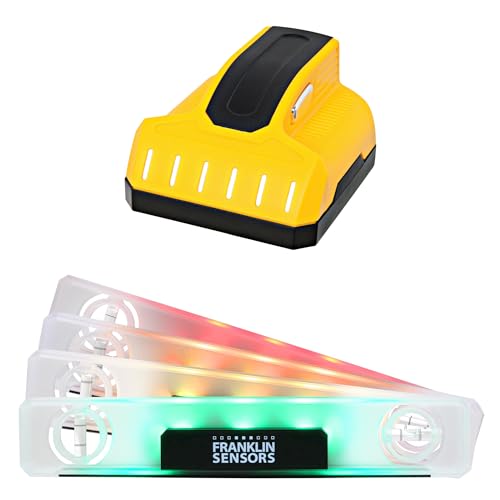
Uses 13 sensors to display every stud location across a wide detection window at once. No calibration or sliding motion is needed before scanning. Lights indicate stud edges directly on the tool.
Bosch GMS120 Digital Multi-Scanner
Best for MasonryPros
- Detects through thick concrete and masonry
- Four selectable detection modes
- Graphic bar display for signal strength
Cons
- Heavier than basic stud finders
- Learning curve to interpret Universal mode readings
Combines Wood, Metal, AC Wire and Universal detection modes. Universal mode reaches through concrete and masonry to locate rebar and conduit. Graphic display shows signal strength as the tool moves across the wall.
Walabot DIY In-Wall Imager
Best for ImagingPros
- Visual imaging instead of beeps or lights
- Deeper scan range than typical stud finders
- Identifies pipe and wire shapes, not just presence
Cons
- Requires a compatible Android phone, no iOS support
- Needs the companion app installed before use
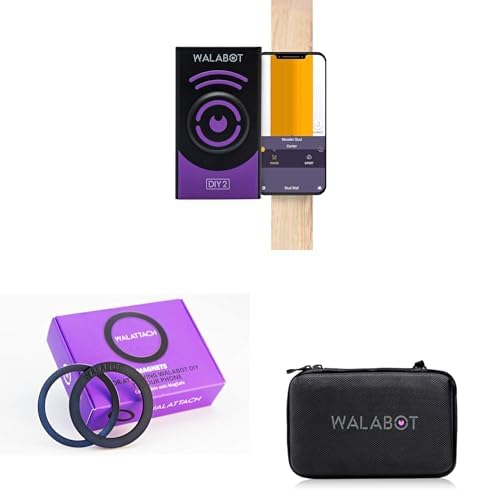
Sends radio frequency signals through drywall and produces a live image of what lies beneath. Renders pipes, wires, wood and metal on a connected Android phone screen. Reaches deeper than most single purpose stud finders.
Zircon StudSensor HD55
Best ValuePros
- Marks stud edges for precise centering
- Simple single button operation
- Includes live wire warning
Cons
- No dedicated deep scan or masonry mode
- Single detection depth setting only
Edge finding sensor marks both sides of a stud for accurate center marking. WireWarning alerts to live AC wiring during a scan. Single button design keeps operation straightforward for occasional use.

CH Hanson 03040 Magnetic Stud Finder
Best BudgetPros
- Never needs batteries or calibration
- Very low cost compared to electronic scanners
- Small enough to keep in a pocket
Cons
- Only finds studs with existing fasteners
- No pipe, wire or masonry detection
Rare earth magnets locate nail and screw heads holding drywall to studs. No batteries or electronics are involved, so it never needs calibration. Pocket sized housing slides along the wall until it grabs.

Bosch D-tect 150 CNT
Best for ProsPros
- Deepest scan range for concrete and masonry
- Detects plastic pipe in addition to metal and wire
- Bluetooth link for jobsite documentation
Cons
- Higher cost than consumer stud finders
- Larger and heavier for one handed use
Detection radar built for heavy duty jobsite use on concrete, drywall and masonry. Locates rebar, metal, plastic pipes and live wiring at greater depth than handheld stud finders. Color display and Bluetooth connectivity support documentation on larger projects.
How Wall Scanners Find Studs, Pipes and Wires
Electronic wall scanners measure changes in capacitance or density as they pass over a wall. Denser material behind drywall, such as a stud, shifts the sensor reading enough to trigger a signal. Magnetic models skip electronics entirely and instead detect the metal fasteners already holding drywall to a stud. Multi-scanners add extra sensors tuned to metal and live AC wiring, letting one pass check for several hazards at once.
Matching Scan Depth to Wall Thickness and Material
Standard drywall runs about half an inch thick, but heavy duty jobs often involve plaster, tile backer or concrete. Deeper scan modes trade some precision for extra range, since the signal weakens the farther it travels. Concrete and masonry need a scanner rated for several inches of depth, like a Universal mode or detection radar, instead of a basic stud setting.
Stud Finder vs Multi-Scanner vs Imaging Radar
Basic stud finders locate wood or metal framing and little else. Multi-scanners add wire and pipe detection modes for a fuller picture before drilling. Imaging radar tools go further, rendering a picture of what lies behind the wall on a screen instead of a beep or light. Heavy duty projects with unknown wall contents benefit most from imaging or multi mode tools.
Avoiding False Positives During a Scan
Textured walls, uneven paint layers or nearby metal fixtures can trigger false readings on sensitive scanners. Sliding the tool slowly and rescanning from the opposite direction helps confirm a stud location before drilling. Calibration free tools like the ProSensor T6 reduce one source of error, while magnetic finders avoid electronic interference entirely.
FAQs
What is the best wall scanner for finding studs behind drywall?
Based on specifications, the Zircon MultiScanner i520 and Franklin Sensors ProSensor T6 both locate wood and metal studs reliably behind standard drywall.
Can a wall scanner detect pipes and electrical wires?
Multi-scanners like the Bosch GMS120 include an AC wire detection mode, and imaging tools such as Walabot DIY can show pipe shapes on screen.
How deep can a wall scanner detect through concrete?
Detection radar tools like the Bosch D-tect 150 CNT reach up to about 6 inches into concrete, far deeper than standard stud finders.
Do magnetic stud finders work as well as electronic scanners?
Magnetic finders like the CH Hanson 03040 only locate existing metal fasteners, so they work well on finished walls but miss pipes, wires and unfastened framing.
Is Walabot DIY compatible with iPhone?
No, Walabot DIY connects only to compatible Android devices over USB and does not support iOS.
How accurate are multi-sensor stud finders like the ProSensor T6?
The ProSensor T6 uses 13 sensors to show stud edges across a wide section at once, and owners report consistent results without calibration.
What is the difference between a stud finder and a wall scanner?
A stud finder typically detects only framing, while a wall scanner adds modes for metal, live wiring or masonry in one device.
Can wall scanners see through tile or plaster walls?
Deep scan and Universal modes on multi-scanners can read through plaster and some tile backer, though thickness and material still affect accuracy.
Do I need a professional detection radar for home projects?
Most home projects only need a standard multi-scanner, but detection radar like the Bosch D-tect 150 CNT helps on concrete or heavy duty renovation work.
Our verdict
Zircon MultiScanner i520 remains the strongest heavy duty pick for general wall scanning, while Bosch GMS120 and Bosch D-tect 150 CNT suit concrete and masonry work. Choose based on wall material and scan depth rather than price alone.