Best Gardening Tools
Most gardening tool lists are seven versions of the same thing. This one is seven different tools, because a garden needs a trowel, a pruner, a weeder, a lopper and a cultivator, and no amount of upgrading one replaces another.
The other thing worth saying is that gift sets are where money gets wasted. A boxed ten piece set usually contains three tools you will use and seven that bend the first time you lean on them. Buying four good tools one at a time beats one set, and the order to buy them in is at the end of this guide.
Quick answer
Start with a Fiskars Ergo trowel and a Corona ClassicCUT bypass pruner, which between them cover planting and cutting. Add a Nisaku hori hori for weeding, which replaces three other tools. Fiskars 28 inch loppers handle anything thicker than a pruner, and a Felco F-2 is the pruner to buy if you prune enough to care.
Why trust ToolBuyerHub
- Every tool here is a named brand sold on Amazon US, checked against the live listing
- Specifications come from manufacturer and listing data, not from guesswork
- Owner-feedback themes are summarized as feedback, never as our own hands-on testing
- No invented star ratings; the Research Score criteria are visible on each pick
- Each pick is a different tool type, not seven variations of one, so the list is actually usable
- Cheap multi-piece gift sets are called out rather than padded into the list
Research updated October 2026.
What Matters Most When Buying Garden Hand Tools
Construction decides lifespan, and the thing to look for is how the blade meets the handle. A tool forged or cast in one piece, or with the shank running through the handle, survives being levered; a thin tang pressed into a plastic handle snaps the first time you use a trowel as a pry bar, which everyone does. Blade material comes next: stainless resists rust and slides through soil, while carbon steel holds a sharper edge and needs drying and oiling. For cutting tools, bypass blades, which pass each other like scissors, make a clean cut on living wood, whereas anvil blades crush the stem and are only for dead growth. Finally, consider whether parts are replaceable, because a pruner whose blade and spring you can replace is a tool you keep for twenty years rather than a disposable.
| Model | Best for | Key specs | Research Score |
|---|---|---|---|
| Fiskars Ergo Garden Trowel | Planting, digging and the job you do most | Hand trowel, Cast aluminium | 92/100 |
| Corona ClassicCUT Forged Bypass Hand Pruner, 3/4 in Capacity | Everyday pruning on a sensible budget | Bypass pruner, 3/4 in | 90/100 |
| Felco F-2 Classic Hand Pruner with Felco 322 Snips | Serious pruning, bought once | Bypass pruner, Fully replaceable | 95/100 |
| Nisaku NJP650 Hori Hori Namibagata Stainless Steel Weeding Knife | Weeding, dividing and cutting roots | Hori hori knife, Stainless, serrated one edge | 93/100 |
| Fiskars 28 in Garden Bypass Loppers, 1.5 in Cut Capacity | Branches too thick for pruners | Bypass loppers, 28 in | 89/100 |
| Corona CT 3344 Premium Stainless Steel ComfortGEL Hoe and Cultivator | Surface weeding and soil prep | Hoe and cultivator, Stainless steel | 87/100 |
| Fiskars 3 Piece Garden Hand Tool Set with Trowel, Transplanter and Cultivator | Starting from nothing | Trowel, transplanter, cultivator, 3 | 85/100 |

Fiskars Ergo Garden Trowel
Buy This FirstPros
- Cast construction means it does not bend when you inevitably lever a root with it
- Aluminium does not rust, so leaving it out overnight is not fatal
- Ergonomic handle angle reduces wrist strain over a long planting session
Cons
- Wider blade than a dedicated transplanter, so it is clumsy in tight spacing
- Not a substitute for a spade on anything bigger than a plant pot
The tool you will pick up more than any other, which is why it is first. The failure mode of cheap trowels is predictable: the thin metal tang pressed into the handle bends or snaps the moment you use the trowel as a lever, and everybody uses a trowel as a lever. A cast one-piece blade removes that. Aluminium is the right material here too, since garden tools get left outside.

Corona ClassicCUT Forged Bypass Hand Pruner, 3/4 in Capacity
Best Value PrunerPros
- Bypass blades cut living stems cleanly instead of crushing them, which matters for plant health
- Forged construction rather than cast, so the handles do not flex under load
- Blades and springs are replaceable, which makes it a long-term tool
Cons
- A 3/4 inch capacity is the limit; thicker stems need loppers, not more force
- Heavier in the hand than a premium pruner over a long session
The pruner to buy if you are not yet sure how much pruning you do. Bypass is the important word: the two blades pass each other like scissors and leave a clean cut that heals, while anvil pruners crush the stem against a flat plate and leave a wound that invites disease. Forged handles and replaceable parts mean this is repairable rather than disposable, which is unusual at the price.

Felco F-2 Classic Hand Pruner with Felco 322 Snips
Best Premium PrunerPros
- Every part is replaceable, blade, spring, nut and handle, so the tool outlives its owner
- Cutting action is noticeably lighter than budget pruners, which matters over hundreds of cuts
- Comes with deadheading snips, which are the right tool for soft stems and flowers
Cons
- Expensive for occasional use, where the Corona does the same job
- Blade needs genuine maintenance, sharpening and cleaning, to stay at its best
The F-2 is the pruner professionals buy and then keep for decades, and the reason is parts. When a budget pruner's spring tires or its blade nicks, the tool is finished. Every component of this is a stocked spare. The cutting action is the other thing: the difference between a light pruner and a stiff one is invisible on one cut and decisive after two hours. Buy it if you prune a lot.

Nisaku NJP650 Hori Hori Namibagata Stainless Steel Weeding Knife
Most VersatilePros
- Replaces a weeder, a transplanter and a root saw with one tool, which saves carrying three
- Serrated edge cuts through roots and rootbound soil that a trowel cannot
- Depth markings on the blade are genuinely useful for consistent bulb planting
Cons
- It is a knife, so it needs to be treated and stored as one around children
- Narrow blade is not a substitute for a trowel when moving volumes of soil
If you only add one tool after a trowel and pruners, make it this. A hori hori does several jobs properly rather than badly: the straight edge slices a dandelion root below the crown, the serrated edge saws through the root mass when you divide a perennial, and the narrow blade plants bulbs at an exact depth. Gardeners who get one tend to stop using half their other hand tools.

Fiskars 28 in Garden Bypass Loppers, 1.5 in Cut Capacity
Best LoppersPros
- A 1.5 inch capacity covers the gap between hand pruners and a pruning saw
- Long handles give the leverage to cut cleanly rather than crushing and twisting
- Bypass blades, so cuts on live wood heal properly
Cons
- Too big for detail work, so it does not replace pruners
- Both hands needed, which makes it awkward reaching into a dense shrub
The tool people skip and then wreck their pruners trying to do without. Forcing a 3 quarter inch pruner through an inch thick branch bends the blade, strains the pivot and leaves a crushed wound on the plant. Loppers give you the leverage to cut it properly. Twenty eight inches is the useful general length; longer handles cut thicker but become unwieldy in a border.
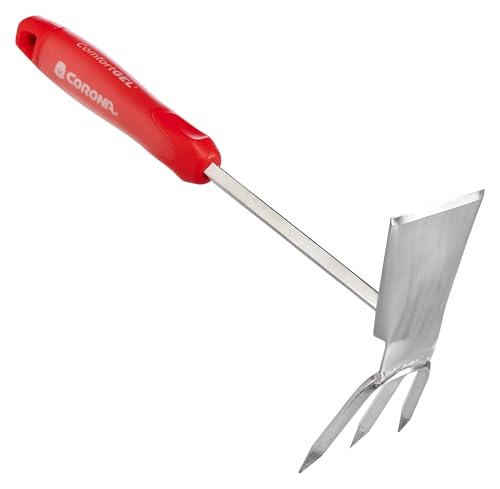
Corona CT 3344 Premium Stainless Steel ComfortGEL Hoe and Cultivator
Best CultivatorPros
- Two tools in one head, hoe on one side and cultivator tines on the other
- Stainless blade slides through soil instead of dragging, and will not rust in a shed
- Cushioned grip makes repetitive hoeing considerably less uncomfortable
Cons
- Hand length rather than long handled, so it is for bed work on your knees
- Tines are not strong enough for compacted or stony ground
The right tool for the weeding most people actually do, which is surface level between plants rather than digging out individual roots. Hoeing severs seedling weeds before they establish, and doing it weekly is far less work than pulling grown weeds monthly. The combination head is genuinely practical since the two jobs alternate constantly. Keep the blade sharp, since a sharp hoe slices and a blunt one drags.

Fiskars 3 Piece Garden Hand Tool Set with Trowel, Transplanter and Cultivator
Best Starter SetPros
- Three tools that are each genuinely useful, rather than a ten piece set with seven fillers
- Same cast aluminium construction as the standalone trowel, so nothing here bends
- Cheaper than buying the three separately
Cons
- No cutting tool, so pruners are still a separate purchase
- The narrow transplanter is the least used of the three for most gardeners
The honest version of a boxed set, and the reason it works is that it stops at three. Large gift sets pad the count with thin stamped tools that fail immediately, which is why they are cheap. This is three tools that do three different jobs with the same construction as the standalone versions. You still need pruners, so budget for the Corona alongside it.
Why cheap garden tools fail, and where to look
Almost every cheap hand tool fails in the same place: the joint between blade and handle. A thin metal tang pushed into a plastic handle has nothing holding it against a sideways load, and a trowel or weeder always gets used as a lever eventually. Look for tools that are cast or forged in one piece, or where the shank runs the full length of the handle. On cutting tools, look at whether the handles flex when you squeeze them, because forged handles stay rigid and cast ones give, which wastes your effort and twists the blade out of alignment.
Bypass or anvil, and why it matters to the plant
Bypass cutting tools have two blades that pass each other like scissors. Anvil tools have one blade closing onto a flat plate. On living wood, bypass makes a clean cut that the plant seals over, while an anvil crushes the stem, leaving damaged tissue that dies back and invites disease. Anvil tools are cheaper and are fine for cutting dead wood. For anything living, buy bypass, which is why every cutting tool recommended here is bypass.
Stainless or carbon steel
Stainless resists rust, needs almost no care and slides through soil with less drag, which makes it the sensible choice for digging and weeding tools that live in a shed and get rained on. Carbon steel takes and holds a keener edge, which matters on cutting tools, but it will rust if left wet and needs wiping and a light oil at the end of the season. Neither is better overall. Choose stainless for soil tools and accept the maintenance on good cutting tools.
What to buy, and in what order
Buy a trowel first, because it is the tool you reach for most. Buy bypass pruners second, because the alternative is tearing stems by hand. Buy a hori hori third, since it covers weeding, dividing and root cutting in one. Buy loppers fourth, as soon as you find yourself forcing pruners through something too thick, which damages both the pruners and the plant. A hoe or cultivator comes fifth and earns its place by making weeding routine rather than occasional. Spreading purchases this way means each tool is bought because a job demanded it, which is how you end up with tools you use instead of a shed full of a gift set.
FAQs
What gardening tools do I actually need?
Five cover almost everything: a trowel for planting, bypass pruners for cutting, a hori hori knife for weeding and dividing, loppers for branches too thick for pruners, and a hoe or cultivator for surface weeding. Buying those one at a time as jobs demand them is better value than any boxed multi-piece set.
Are expensive garden tools worth it?
For cutting tools, often yes, because a pruner like the Felco F-2 has fully replaceable parts and a lighter action that matters over hundreds of cuts. For digging tools, a mid-price cast or forged tool such as the Fiskars trowel is plenty, since what matters is that the blade and handle are one piece rather than how much it cost.
What is the difference between bypass and anvil pruners?
Bypass pruners have two blades that pass each other like scissors and make a clean cut that living wood can seal over. Anvil pruners close one blade onto a flat plate, crushing the stem, which damages tissue and invites disease. Use bypass on anything living and keep anvil tools for dead wood.
What is a hori hori knife used for?
Weeding, dividing perennials, cutting roots and planting bulbs. The straight edge slices a taproot below the crown, the serrated edge saws through rootbound soil, and the depth markings on the blade let you plant at a consistent depth. It replaces a weeder, a transplanter and a small root saw, which is why many gardeners end up using it more than their trowel.
Are garden tool gift sets worth buying?
Usually not. Large sets are cheap because most of the pieces are thin stamped tools that bend on first use, and you typically use three of the ten. A small set of three genuinely useful tools from a real brand, such as the Fiskars trowel, transplanter and cultivator set, is the exception worth considering.
Should garden tools be stainless steel?
For soil tools, yes, because stainless resists rust, needs no care and drags less through soil. For cutting tools, carbon steel holds a keener edge and is often preferred, at the cost of needing to be wiped dry and lightly oiled. Leaving carbon steel wet is what ruins it.
How do I care for garden hand tools?
Knock the soil off and dry them before putting them away, which prevents most rust. Wipe cutting blades clean of sap, since dried sap makes them grab and raises the force needed. Sharpen pruner and hoe blades once or twice a season, as a sharp hoe slices weeds while a blunt one drags. Oil carbon steel lightly before winter storage.
When do I need loppers instead of pruners?
As soon as the stem is thicker than your pruner's stated capacity, usually around three quarters of an inch. Forcing pruners through a thicker branch bends the blade, strains the pivot and leaves a crushed wound on the plant. Loppers give the leverage to cut it cleanly, and a pruning saw takes over above about an inch and a half.
What is the most useful gardening tool to buy first?
A good trowel, because planting, transplanting and potting are the jobs you do most often, and the cheap version fails predictably when used as a lever. Pruners come a close second, since the alternative is tearing stems by hand, which damages the plant.
Our verdict
Buy the Fiskars Ergo trowel and Corona ClassicCUT pruners first and you can garden properly. Add the Nisaku hori hori next, because it quietly replaces several other tools. Buy the Fiskars 28 inch loppers the first time you catch yourself forcing pruners through something too thick, and the Corona hoe and cultivator to make weeding routine. Upgrade to the Felco F-2 only when you prune enough that a lighter action and replaceable parts are worth paying for.