Best Wrench Set
Two decisions settle which wrench set you should buy, and neither is brand. First, ratcheting or plain: a ratcheting box end saves real time in tight spaces and costs more. Second, SAE, metric or both, which depends entirely on what you work on rather than where you live.
Size coverage is the third thing, and it is where cheap sets disappoint. A set that skips sizes looks complete on the rack and then does not fit the bolt in front of you. Each set below is listed with its actual range so you can see what is covered before you buy.
Quick answer
For most people the GearWrench 20 piece SAE and metric ratcheting set is the best buy, because it covers both standards and the ratcheting box ends genuinely speed up work. If you want plain wrenches and better value, the Tekton 15 piece set is the sensible pick, and the Wera Joker set is the one to buy if you use wrenches daily.
Why trust ToolBuyerHub
- Every set here is a named brand sold on Amazon US, checked against the live listing
- Specifications come from manufacturer and listing data, not from guesswork
- Owner-feedback themes are summarized as feedback, never as our own hands-on testing
- No invented star ratings; the Research Score criteria are visible on each pick
- Actual size ranges are listed, since skipped sizes are the most common disappointment in cheap sets
- Sets are separated by ratcheting versus plain and by SAE versus metric rather than ranked on one scale
Research updated October 2026.
What Matters Most When Buying a Wrench Set
Start with the standard. SAE, measured in inches, is what you need for most American vehicles, trailers, plumbing and older equipment. Metric is what you need for imports, most modern vehicles, bicycles, appliances and almost all flat pack hardware. Many people genuinely need both, which is why combined sets exist and why buying one standard to save money often means buying the other later anyway. Next decide on ratcheting box ends. A ratcheting wrench does not need to be lifted and repositioned on every turn, which matters enormously in a tight engine bay and not at all on an open bench. Then check the size range for gaps, since a nominal piece count tells you nothing about which sizes are missing. Finally consider storage: a tray or roll that holds sizes in order is the difference between finding a wrench and emptying a drawer.
| Model | Best for | Key specs | Research Score |
|---|---|---|---|
| GearWrench 20 Piece SAE and Metric Ratcheting Combination Wrench Set, 35720A-02 | Covering both standards in one buy | Ratcheting combination, SAE and metric | 94/100 |
| Tekton Combination Wrench Set, 15 Piece, 1/4 to 1 in, with Holder, 18772 | Full SAE coverage without gaps | Plain combination, SAE | 90/100 |
| Craftsman Combination Wrench Set, SAE, 20 Piece, CMMT12069 | A first set for home use | Plain combination, SAE | 86/100 |
| Wera Joker Imperial Combination Wrench Set, 8 Piece, 05020012001 | Daily use and awkward fasteners | Combination with holding jaw, Imperial | 93/100 |
| Klein Tools 69408G Ratcheting Combination Wrench Set, SAE, 8 Piece, 90 Tooth | Trade work in tight spaces | Ratcheting combination, SAE | 91/100 |
| Capri Tools Combination Wrench Set, Metric, 6 to 24 mm, with Mechanic's Tray | Metric fasteners | Plain combination, Metric | 89/100 |
| GearWrench 25 Piece Combination Ratcheting Wrench Set, SAE and Metric, 86700 | Wide coverage in one purchase | Ratcheting combination, SAE and metric | 92/100 |
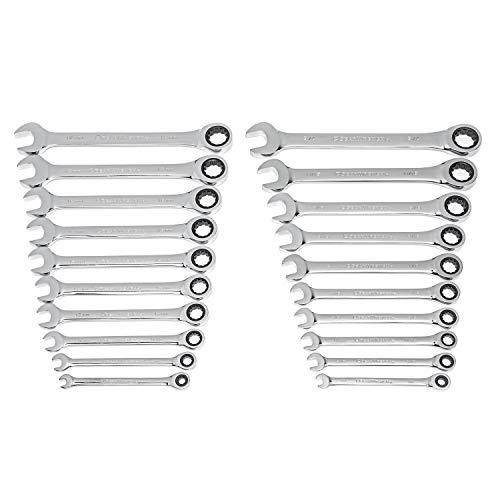
GearWrench 20 Piece SAE and Metric Ratcheting Combination Wrench Set, 35720A-02
Best OverallPros
- Covers both SAE and metric, which is what most garages actually need
- Ratcheting box ends remove the lift and reposition cycle in confined spaces
- GearWrench effectively popularised the ratcheting wrench and the mechanism is well proven
Cons
- Ratcheting heads are thicker than plain box ends, so they do not fit every recessed fastener
- Twenty pieces split across two standards means fewer sizes per standard than a dedicated set
The practical default. Most people who buy one standard end up buying the other within a year, and this removes that. The ratcheting action is the feature worth paying for: in an engine bay or under a sink, being able to turn a fastener without resetting the wrench on every stroke changes a frustrating job into a quick one. Keep a thin plain wrench or two for recessed fasteners the ratcheting head cannot reach.

Tekton Combination Wrench Set, 15 Piece, 1/4 to 1 in, with Holder, 18772
Best ValuePros
- Continuous size range from 1/4 to 1 inch with no skipped sizes, which is rarer than it should be
- Holder keeps sizes in order, so you grab the right wrench instead of three wrong ones
- Plain box ends are thinner than ratcheting heads and reach recessed fasteners better
Cons
- No ratcheting action, so tight-space work is slower
- SAE only, so metric fasteners need a separate set
This is the honest workhorse recommendation. The thing it gets right is coverage: fifteen consecutive SAE sizes with nothing missing, which means the wrench you need is in the holder. Plain box ends also fit places a ratcheting head will not, because the head is thinner. If your work is American vehicles, trailers and general home repair, and you are happy to reposition the wrench by hand, this is excellent value.

Craftsman Combination Wrench Set, SAE, 20 Piece, CMMT12069
Best Starter SetPros
- Widely available brand with easy single-wrench replacement if one is lost or damaged
- Twenty SAE sizes is generous coverage for general household and automotive work
- Straightforward tool with nothing to go wrong mechanically
Cons
- No ratcheting action and no case or tray in this configuration
- Finish and feel are a step below the trade-focused sets here
A reasonable first set if you want a recognisable brand and broad SAE coverage without spending much. The strongest practical argument for Craftsman is availability: wrenches get lost and borrowed, and being able to replace one size is genuinely useful. Understand what you are not getting, which is a ratcheting mechanism and organised storage, and whether those matter depends on how often you use them.

Wera Joker Imperial Combination Wrench Set, 8 Piece, 05020012001
Best PremiumPros
- The open end grips and holds the nut, so you can start a fastener one handed
- Holding feature means the wrench does not slip off mid-turn, which prevents rounded corners
- Build quality and finish are at the level where the tool is pleasant to use all day
Cons
- Eight pieces is limited coverage, so it supplements rather than replaces a full set
- Costs several times as much as a basic set of the same nominal size count
Worth the money if you use wrenches every day, and hard to justify if you do not. The distinctive feature is a holding jaw on the open end that grips the nut rather than just surrounding it, which means you can place a fastener and start it with one hand, and the wrench does not fall off when you reposition. In awkward overhead or blind locations that is a genuine capability rather than a refinement.

Klein Tools 69408G Ratcheting Combination Wrench Set, SAE, 8 Piece, 90 Tooth
Best for TradesPros
- A 90 tooth mechanism needs only a few degrees of swing, which is what tight spaces demand
- Klein build standards are aimed at daily trade use rather than occasional DIY
- Eight common sizes keeps the set light enough to carry rather than store
Cons
- Eight pieces and SAE only, so it is a working subset rather than full coverage
- Fine tooth mechanisms are generally less tolerant of abuse than a coarse ratchet
The pick if you carry tools rather than keep them in a garage. The tooth count is the specification that matters here: a 90 tooth ratchet advances on a very small swing, which is exactly the constraint inside a panel, a junction box or a vehicle. Eight sizes keeps the roll light. Treat it as the set you take to the job and keep a fuller plain set on the bench.

Capri Tools Combination Wrench Set, Metric, 6 to 24 mm, with Mechanic's Tray
Best Metric SetPros
- 6 to 24 mm covers the sizes that bicycles, imports and modern equipment actually use
- Tray holds sizes in order and shows at a glance which wrench is missing
- Good finish and feel for the price, with usefully slim box ends
Cons
- Metric only, so SAE fasteners need a separate set
- No ratcheting action
If your work is bicycles, imported vehicles, appliances or almost any modern flat pack hardware, this is the range you need and SAE wrenches will not help. The 6 to 24 mm spread covers the vast majority of metric fasteners you will meet, and the tray is more useful than it sounds, because a gap in a tray tells you immediately which size is in the car or on the floor.

GearWrench 25 Piece Combination Ratcheting Wrench Set, SAE and Metric, 86700
Best Large SetPros
- Twenty five pieces across both standards leaves far fewer size gaps than a 20 piece set
- Same proven ratcheting mechanism as the top pick, with more sizes behind it
- A single purchase that is unlikely to need supplementing for years
Cons
- Costs noticeably more than the 20 piece set for sizes you may rarely use
- Bulky to store and to carry, so it suits a garage rather than a tool bag
The same proposition as the lead pick with the gaps filled in. The honest question is whether you will use the extra sizes, and the answer depends on whether you work on a variety of machines or the same one repeatedly. For a shared family garage or anyone who takes on whatever job appears, the broader coverage removes the trip to the store. For a single vehicle, the 20 piece set is enough.
SAE, metric or both
SAE sizes in inches are what you need for most American vehicles, trailers, agricultural equipment, plumbing fittings and older machinery. Metric is what you need for imported and most modern vehicles, bicycles, appliances, electronics and nearly all flat pack furniture. The honest answer for a general home garage is both, which is why combined sets exist. Buying one standard to save money is reasonable only if you know your work is confined to it, and most people discover within a year that it is not.
Ratcheting versus plain box ends
A ratcheting box end turns the fastener on the pull stroke and freewheels on the return, so the wrench never has to be lifted and repositioned. The benefit is large in confined spaces and small on an open bench. The cost is a thicker head that will not fit some recessed fasteners, a mechanism that can eventually fail, and a higher price. The practical answer for most people is a ratcheting set for general use plus a few plain wrenches for the tight recessed fasteners the ratcheting heads cannot reach.
Why tooth count matters
A ratcheting mechanism described as 72 or 90 tooth tells you how little swing is needed before the ratchet catches again. A 90 tooth mechanism needs roughly four degrees of arc, a 72 tooth about five. That difference sounds trivial and is decisive inside a junction box, behind an engine accessory or under a dashboard, where you may have only a few degrees of movement available. Finer mechanisms are also generally a little more delicate, so they suit precise work more than brute force.
Size gaps and storage
Piece count is a marketing number and tells you nothing about which sizes are included. Read the actual range, and check for skipped sizes in the middle, which is where cheap sets economise. Storage matters more than people expect: a tray or roll that holds the wrenches in size order lets you take the right one first time and shows instantly which size has gone missing. A set in a drawer with no holder effectively loses a size every few months.
FAQs
What is the best wrench set to buy?
For general use, a combined SAE and metric ratcheting set such as the GearWrench 20 piece, because most garages encounter both standards and ratcheting box ends save real time in tight spaces. If you want plain wrenches with complete size coverage for less, the Tekton 15 piece SAE set is the better value choice.
Do I need SAE or metric wrenches?
SAE for most American vehicles, trailers, plumbing and older equipment; metric for imports, most modern vehicles, bicycles, appliances and flat pack hardware. A general home garage usually needs both. Buying only one standard makes sense only if you are certain your work stays within it.
Are ratcheting wrenches worth it?
In tight spaces, yes, because you never lift and reposition the wrench between turns. On open, accessible fasteners the advantage is small. The trade-offs are a thicker box end that will not fit some recessed fasteners and a mechanism that can wear, so many people keep a few plain wrenches alongside a ratcheting set.
What does 90 tooth mean on a ratcheting wrench?
It describes how fine the ratchet mechanism is, and therefore how small a swing is needed before it catches again. A 90 tooth wrench needs roughly four degrees of movement, compared with about five degrees for 72 tooth. That difference decides whether a fastener can be turned at all in a very confined space.
How many wrenches do I need in a set?
Coverage matters more than count. For SAE, a continuous range from about 1/4 to 1 inch, which is around 15 sizes, covers most work. For metric, 6 to 24 mm covers the vast majority of fasteners. Check the listed range for skipped sizes rather than relying on the headline piece count.
What is the difference between a combination wrench and an open end wrench?
A combination wrench has an open end on one side and a closed box end on the other. The box end grips all six corners of a hex fastener, which is much less likely to round it, so you use the box end wherever it fits and the open end only where access forces it. An open end wrench has open jaws at both ends and is more prone to rounding fasteners.
Why do wrenches round off bolts?
Usually because an open end was used where a box end or socket would have fitted, or because the wrench was a slightly loose fit, such as using an SAE wrench on a close metric size. Open jaws load only two faces of the hex, so force concentrates on the corners. Use the box end where possible and make sure the size is an exact match.
Is Wera Joker worth the price?
If you use wrenches daily, many users say yes, because the holding jaw on the open end grips the nut so you can start a fastener one handed and the wrench does not fall off when repositioning. For occasional use the benefit is real but hard to justify against a full set of good conventional wrenches for the same money.
Should I buy a wrench set or sockets first?
Sockets first for most work, because a ratchet and socket set is faster and less likely to round fasteners wherever there is clearance. Wrenches earn their place where a socket will not fit: tight clearances, fasteners you need to hold from both sides, and anywhere a ratchet handle cannot swing. Most people end up owning both.
Our verdict
Buy the GearWrench 20 piece SAE and metric ratcheting set if you want one purchase that covers both standards, or step up to the 25 piece version if you would rather not fill gaps later. Choose the Tekton 15 piece set instead if you prefer plain wrenches and complete SAE coverage for less, and add the Capri Tools metric set if your work runs to imports or bicycles. The Wera Joker set is for daily users, and the Klein 69408G is the one to carry.