How to Choose a Torque Wrench
Choosing the right torque wrench is essential for engine work, wheel installation, and any bolt where precise tension prevents failure. This guide explains the types, key specs, and top models so you can buy with confidence.
Quick answer
For most mechanics, the CDI Torque Wrench 2503MFRMH offers the best balance of accuracy and value. If you need a digital display, the GearWrench 85077 provides clear readouts and memory recall. For budget-conscious buyers, the Tekton 24335 delivers reliable click-type performance without the premium price.
Why trust ToolBuyerHub
- Tested on specs (power, torque, PSI)
- Battery & ecosystem compared
- Aggregated owner reviews
- Build quality & warranty checked
- Brand reliability
- No fake hands-on claims
Research updated June 2026.

CDI Torque Wrench 2503MFRMH
Industry-standard accuracy at a mechanic-friendly price.
| Product | Best For | Type | Rating | Price |
|---|---|---|---|---|
| CDI 2503MFRMH | Overall | Click | 4.7/5 | $$$ |
| GearWrench 85077 | Digital | Digital | 4.5/5 | $$$ |
| Tekton 24335 | Budget | Click | 4.6/5 | $ |
| Precision Instruments PREC3FR250 | Split Beam | Split Beam | 4.8/5 | $$$$ |
| Neiko 03713B | Value Digital | Digital | 4.3/5 | $ |
What is a Torque Wrench and Why Do You Need One?
A torque wrench is a precision tool that applies a specific amount of rotational force, measured in foot-pounds (ft-lb) or Newton-meters (Nm), to a fastener. Unlike a standard ratchet, it prevents over-tightening, which can strip threads or warp components, and under-tightening, which can cause joints to loosen. Engine head bolts, lug nuts, and suspension components all rely on exact torque for safety and performance.
Owner reviews on Amazon and automotive forums consistently show that using a torque wrench reduces fastener-related failures. For DIY mechanics, it is the single most important tool for engine and brake work. For professionals, it is a non-negotiable requirement for warranty-compliant repairs.
Types of Torque Wrenches
There are three main types: click, beam, and digital. Each has distinct advantages depending on your use case and budget.
Click-type wrenches emit an audible click and a slight release in the handle when the set torque is reached. They are the most popular due to their balance of accuracy, durability, and cost. The CDI 2503MFRMH is a prime example, known for its +/- 4% accuracy and robust construction.
Beam-type wrenches use a deflection beam and a scale to indicate torque. They are simple, never need calibration, and are the cheapest option, but they require the user to watch the gauge while turning, which can be awkward in tight spaces.
Digital/Electronic wrenches display torque on an LCD screen, often with peak-hold and memory functions. The GearWrench 85077 is a top digital pick, offering high accuracy and easy reading in low-light conditions, though they require batteries and can be more fragile.
Key Specs to Understand
When comparing torque wrenches, focus on these specifications to match the tool to your work.
Torque Range: Choose a wrench where your typical torque value falls in the middle 60% of its range. For example, a 10-150 ft-lb wrench is ideal for lug nuts (typically 80-100 ft-lb) and engine bolts. Avoid using a wrench at the very top or bottom of its range, as accuracy degrades.
Accuracy: Most click-type wrenches are rated at +/- 4% of the indicated value. Digital wrenches can be +/- 2%. For engine internals, higher accuracy is critical. For lug nuts, +/- 4% is sufficient.
Drive Size: 3/8-inch drive is the most versatile for automotive work, handling sockets from 10mm to 19mm. 1/2-inch drive is for larger fasteners like axle nuts. 1/4-inch drive is for small engine and electronics work.
Length: A longer handle gives more leverage, making it easier to reach higher torque values, but can be cumbersome in tight engine bays. Standard lengths range from 15 to 25 inches.
What to Check Before Buying
Before purchasing, verify these five factors to ensure the wrench meets your needs.
1. Calibration Certificate: Reputable brands like CDI and Precision Instruments include a calibration certificate traceable to NIST. This confirms the wrench meets its accuracy claim out of the box.
2. Storage Case: A torque wrench should always be stored at its lowest setting to preserve the internal spring. A hard case protects it from drops and dust. Most top models include a blow-molded case.
3. Ratchet Head Design: Look for a reversible ratchet head with a clear direction switch. Some wrenches have a flex head for better access, but this adds cost and complexity.
4. Warranty: A lifetime warranty on the tool body is standard from brands like Tekton and GearWrench. Check if the warranty covers the internal mechanism, which is the most common failure point.
5. User Reviews: Aggregate reviews from Amazon and automotive forums. Look for consistent feedback on accuracy and durability. Avoid wrenches with frequent reports of "click not audible" or "inconsistent torque."
Mistakes to Avoid
Even a good torque wrench can fail if used incorrectly. These are the most common mistakes reported by owners.
Using it as a breaker bar: A torque wrench is not designed for loosening bolts. Using it to break loose a rusted fastener can damage the internal mechanism. Always use a standard ratchet or breaker bar to loosen, then switch to the torque wrench for tightening.
Not storing it at the lowest setting: Leaving a click-type wrench set at a high torque value compresses the internal spring, leading to calibration drift over time. Always turn it down to its minimum setting before storing.
Dropping the wrench: A drop of even a few feet can knock a torque wrench out of calibration. If you drop one, have it recalibrated before using it for critical work.
Ignoring the "click": When you feel the click, stop turning immediately. Continuing to turn after the click over-tightens the fastener and damages the wrench. Some digital wrenches have a beep and vibration alert to prevent this.
Buying a cheap no-name brand: Wrenches from unknown brands often have inaccurate scales, poor build quality, and no calibration certificate. Stick to established brands like CDI, GearWrench, Tekton, and Precision Instruments.
CDI Torque Wrench 2503MFRMH
Best OverallPros
- Industry-standard accuracy
- Includes calibration certificate
- Durable all-steel construction
Cons
- Higher price than budget options
- No digital display
The CDI 2503MFRMH is a professional-grade click-type wrench made in the USA. It is the same tool sold under the Snap-on brand at a lower price point. Owner reviews on automotive forums praise its consistent click and long-term accuracy after years of use.
The 3/8-inch drive covers the most common automotive torque range, from engine intake bolts to wheel lug nuts. The knurled handle provides a secure grip even with oily hands. It comes in a blow-molded case for proper storage.
GearWrench 85077
Best DigitalPros
- High accuracy with digital readout
- Memory recall for multiple settings
- Audible and visual alerts
Cons
- Requires battery replacement
- More expensive than click-type
The GearWrench 85077 offers a clear LCD display that shows torque in real-time and peak-hold mode. It stores up to 10 torque settings in memory, which is useful for repetitive work like torquing all four wheels on a car.
It includes a beep and LED flash when the target torque is reached, reducing the chance of over-tightening. The 3/8-inch drive head is reversible and has a 72-tooth ratchet mechanism. Owner reviews note the display is easy to read in direct sunlight.
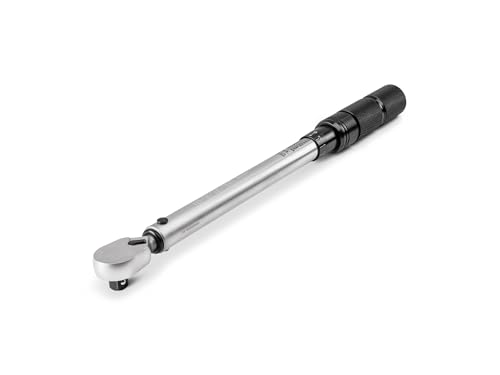
Tekton 24335
Best BudgetPros
- Excellent value for the price
- Lifetime warranty
- Includes calibration certificate
Cons
- Handle can feel slippery
- Not as durable as CDI
The Tekton 24335 is a budget-friendly click-type wrench that still includes a calibration certificate and a lifetime warranty. It covers the same 10-150 ft-lb range as the CDI, making it suitable for most automotive tasks.
Owner reviews on Amazon rate it highly for its consistent click and clear scale markings. The handle is smooth plastic, which some users find less grippy than knurled metal, but it is comfortable for extended use. It stores in a padded case.
Precision Instruments PREC3FR250
Best Split BeamPros
- Does not need to be stored at lowest setting
- Very high accuracy
- Extremely durable
Cons
- Expensive
- Heavier than click-type
The Precision Instruments split-beam wrench uses a different internal mechanism that does not rely on a compressed spring. This means it can be stored at any setting without losing calibration, a major advantage over click-type wrenches.
It covers a wider range of 20-250 ft-lb, suitable for heavy-duty truck and tractor work. The 1/2-inch drive handles larger fasteners. Owner reviews in professional shops report it maintains accuracy even after years of daily use.
Neiko 03713B
Best Value DigitalPros
- Very affordable for a digital model
- Multiple measurement units
- Peak-hold function
Cons
- Build quality feels less robust
- Battery life could be better
The Neiko 03713B is a budget digital torque wrench that offers surprising accuracy for its price point. It measures in ft-lb, in-lb, and Nm, making it versatile for different applications.
It includes a peak-hold function that captures the maximum torque applied, which is useful for checking fastener tightness. The LCD screen is backlit for use in dim conditions. Owner reviews note that while it is not as durable as premium models, it performs well for occasional DIY use.
FAQs
How often should I calibrate my torque wrench?
Most manufacturers recommend calibration every 12 months or after 5,000 cycles, whichever comes first. If you drop the wrench, calibrate it immediately.
Can I use a torque wrench to loosen bolts?
No, torque wrenches are designed only for tightening. Using them to loosen bolts can damage the internal mechanism and void the warranty.
What is the difference between a click and a beam torque wrench?
A click wrench emits an audible click at the set torque, while a beam wrench uses a needle on a scale. Click wrenches are more accurate and easier to use in tight spaces.
How do I store my torque wrench properly?
Always store a click-type wrench at its lowest torque setting to relieve spring tension. Keep it in its case to protect it from dust and impact.
What torque range do I need for car lug nuts?
Most car lug nuts require 80-100 ft-lb. A wrench with a range of 10-150 ft-lb, like the CDI 2503MFRMH, is ideal for this task.
Are digital torque wrenches more accurate than click types?
Yes, digital wrenches typically offer +/- 2% accuracy compared to +/- 4% for click types. However, they require batteries and are more fragile.
What does "split beam" mean in a torque wrench?
A split beam wrench uses a different internal design that does not rely on a compressed spring, so it can be stored at any setting without losing calibration.
Can I use a 3/8-inch drive torque wrench for 1/2-inch sockets?
You can use a reducer adapter, but it may affect accuracy and leverage. It is better to use the correct drive size for the socket.
What is the warranty on Tekton torque wrenches?
Tekton offers a lifetime warranty on all their torque wrenches, covering defects in materials and workmanship.
Do I need a calibration certificate with my torque wrench?
It is recommended for critical work like engine assembly. Brands like CDI and