Best Drip Irrigation Systems
A drip kit is a starter pack, not a finished system. Every kit on the market contains less tubing than your garden needs, and the real question is whether the fittings are a standard size you can buy more of locally, or a proprietary pattern that leaves you stuck.
That is why this guide includes tubing, emitters and a timer as separate picks. Those three are what you will actually be buying again next spring, and getting the sizes right the first time is the difference between a system you extend and one you rip out.
Quick answer
Start with the Rain Bird LNDDRIPKIT, because Rain Bird fittings are a standard you can keep buying. Add an Orbit programmable hose timer, which is what turns drip from a chore into a system. Then buy tubing and emitters separately as the garden grows, and use the DIG ML50 kit instead if your garden is raised beds.
Why trust ToolBuyerHub
- Every item here is a named brand sold on Amazon US, checked against the live listing
- Specifications come from manufacturer and listing data, not from guesswork
- Owner-feedback themes are summarized as feedback, never as our own hands-on testing
- No invented star ratings; the Research Score criteria are visible on each pick
- Tubing, emitters and a timer are listed as separate picks, because a kit alone is never the whole system
- Fitting compatibility is treated as a primary concern rather than an afterthought
Research updated October 2026.
What Matters Most When Buying Drip Irrigation
Fitting compatibility comes first, because it decides whether you can extend the system. Rain Bird and Orbit both use widely stocked sizes, which means a run that comes up short is a trip to the hardware store rather than a redesign. Tubing comes in two roles: half inch mainline that carries water around the garden, and quarter inch distribution tubing that branches off to individual plants. Emitters are rated in gallons per hour, typically 0.5, 1 or 2, and mixing rates on one zone is how people end up with some plants drowned and others dry. Then there is pressure: most domestic drip runs want a pressure regulator and a filter at the tap, because full mains pressure blows emitters off the tubing and grit blocks them. Finally, a timer is the component that makes drip actually work, since the whole benefit is slow watering at the right time of day rather than you standing there with a hose.
| Model | Best for | Key specs | Research Score |
|---|---|---|---|
| Rain Bird LNDDRIPKIT Landscape and Garden Drip Irrigation Kit | Starting a system you can extend | Starter kit, Rain Bird standard | 92/100 |
| Orbit 69500 92-Piece Drip Irrigation Assortment Kit | Fittings, adapters and spares | 92, Assortment of fittings | 89/100 |
| Raindrip R560DP Automatic Drip Watering System | A complete system out of one box | Automatic kit, Timer and drip components | 90/100 |
| DIG ML50 Raised Vegetable Bed Drip Watering Kit | Raised beds and vegetable plots | Raised bed kit, Rows for vegetables | 91/100 |
| Orbit Programmable Digital Hose Watering Timer, 1 Outlet | Making drip actually automatic | 1, Programmable digital | 93/100 |
| Rain Bird SW20-30PS Drip Emitter, 1/4 in, 30 Pack | Matching water to each plant | 1/4 in, 30 | 88/100 |
| Rain Bird T22-250S Drip Distribution Tubing, 1/4 in, 250 ft | The tubing every kit runs out of | 1/4 in, 250 ft | 87/100 |
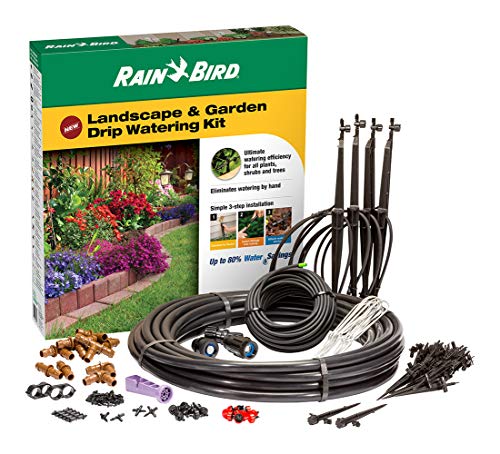
Rain Bird LNDDRIPKIT Landscape and Garden Drip Irrigation Kit
Best OverallPros
- Rain Bird fittings are widely stocked, so extending the system later is straightforward
- Includes the pieces beginners forget, including fittings and emitters rather than just tubing
- Rain Bird is a long-established irrigation brand rather than a seasonal seller
Cons
- Contains far less tubing than a typical garden needs, so budget for more immediately
- No timer included, which is the component that makes drip genuinely useful
The right starting point, and compatibility is the reason rather than contents. Every drip kit runs out of tubing; what separates a good kit from a bad one is whether the fittings match something you can buy more of. Rain Bird sizes are a de facto standard in the US, so a short run is a quick purchase rather than a problem. Buy this, then buy tubing and a timer alongside it.
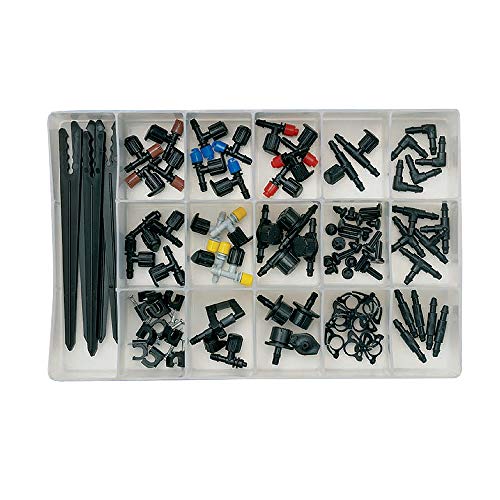
Orbit 69500 92-Piece Drip Irrigation Assortment Kit
Best Parts AssortmentPros
- A broad spread of connectors, tees, elbows and emitters, which is what you run out of mid-install
- Cheaper than buying individual fittings in small packs as you discover you need them
- Orbit parts are widely stocked, so the assortment complements rather than locks you in
Cons
- An assortment rather than a designed kit, so it is not a starting point on its own
- Some pieces in any assortment will never get used
Buy this alongside a kit rather than instead of one. The predictable frustration of installing drip is discovering you need one more tee, or an elbow, or a goof plug, halfway through a Saturday afternoon. A broad assortment removes most of those trips. It is not a system in itself, since there is no plan behind it, which is exactly why it pairs well with a designed starter kit.
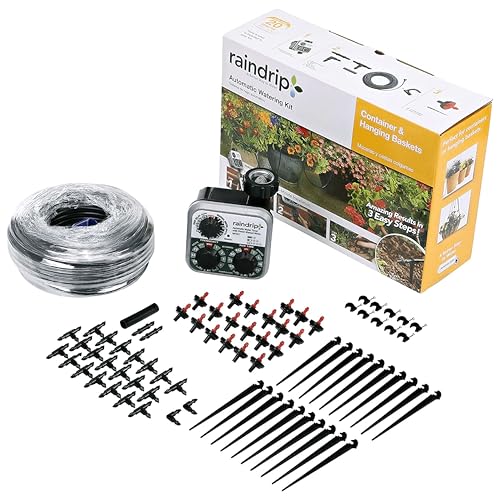
Raindrip R560DP Automatic Drip Watering System
Best Automatic KitPros
- Includes the timer, so the system actually runs without you rather than needing a second purchase
- Designed as a set, so the components are matched instead of assembled from guesswork
- Good choice if you want one box to solve the problem rather than researching parts
Cons
- The included timer is basic compared with a dedicated programmable unit
- Still contains limited tubing, as all kits do
The pick if you want drip working this weekend without reading about pressure regulators. Including the timer matters more than it sounds: a drip system without a timer still needs you to remember, walk out and turn a tap, which is most of the inconvenience you were trying to remove. The timer here is simple rather than sophisticated, and for most gardens simple is sufficient.

DIG ML50 Raised Vegetable Bed Drip Watering Kit
Best for Raised BedsPros
- Laid out for rows rather than scattered shrubs, which is how vegetable beds are actually planted
- Even delivery along a row suits closely spaced crops much better than individual emitters
- DIG is an irrigation specialist, so components are designed rather than generic
Cons
- Row layout is wrong for borders and mixed shrub planting
- Sized for a bed, so a large plot needs multiple kits or extension
Raised beds are a genuinely different watering problem from a mixed border. Vegetables sit in dense rows, so you want even delivery along a line rather than a single emitter per plant, and bed walls limit where tubing can run. A kit designed for that layout saves a lot of improvising. For borders, shrubs and containers, one of the general kits above is the better match.

Orbit Programmable Digital Hose Watering Timer, 1 Outlet
Best TimerPros
- Turns a drip system from something you remember into something that runs itself
- Programmable schedule lets you water early morning, which is when evaporation losses are lowest
- Battery powered and screws onto a standard hose faucet, so no wiring or plumbing
Cons
- Battery powered, so a dead battery means a dry garden, especially during a holiday
- Single outlet, so two zones on different schedules need two timers or a splitter
The component with the biggest effect on whether drip works, and the one most people skip. The point of drip is slow, deep watering at the right time of day, and the right time is early morning, which nobody is reliably out there for. A programmable timer solves that for very little money. Change the battery at the start of each season rather than waiting for it to fail.

Rain Bird SW20-30PS Drip Emitter, 1/4 in, 30 Pack
Best EmittersPros
- Buying emitters separately lets you match flow rate to plant size instead of accepting a kit's mix
- A 30 pack is enough to extend a bed properly rather than rationing emitters
- Rain Bird quarter inch sizing matches the standard tubing most systems use
Cons
- Emitters clog if the system has no filter at the tap, which many kits omit
- Mixing different flow rates on one zone causes uneven watering
Emitters are where a drip system is tuned, and buying them loose is how you do it. A shrub wants more water than a seedling, and the way you deliver that is emitter flow rate, not run time, because run time applies to the whole zone. Keep one flow rate per zone and vary the number of emitters per plant. Fit a filter at the tap, since grit blocking emitters is the most common drip failure.

Rain Bird T22-250S Drip Distribution Tubing, 1/4 in, 250 ft
Best TubingPros
- Two hundred and fifty feet is a realistic amount, unlike the short coils supplied in kits
- Quarter inch distribution tubing is the branch line that runs from mainline to each plant
- Standard Rain Bird sizing, so it works with the kits and fittings above
Cons
- Quarter inch is distribution tubing only; a system also needs half inch mainline
- Bulk tubing holds a coil memory and wants warming in the sun before it lies flat
Buy this at the same time as the kit, because you will need it within an hour of starting. Quarter inch tubing is the branch that runs from the half inch mainline to individual plants, and it is what every kit is short of. One practical tip: leave the coil in the sun for half an hour before laying it, since cold tubing keeps its coil shape and fights you the whole way along the bed.
Kits are starting points, so plan for the extras
Every drip kit on the market contains less tubing than a real garden needs, which is not dishonesty so much as the impossibility of guessing your layout. Treat the kit as the fittings, emitters and instructions, then buy bulk quarter inch distribution tubing and half inch mainline to suit your actual plan. The number that matters when choosing a kit is not the piece count but whether the fittings are a widely stocked standard, because that determines whether extending the system is a quick purchase or a redesign.
Pressure regulator and filter are not optional
Household mains pressure is far higher than drip components are designed for, and the result is emitters popping off the tubing and fittings leaking, usually while you are out. A pressure regulator at the tap fixes it for very little money. A filter matters just as much, because the orifices in drip emitters are small enough to be blocked by the grit and scale that any supply carries, and a blocked emitter is invisible until the plant dies. Many starter kits include one or both; if yours does not, add them before you add anything else.
Emitter flow rates and zones
Emitters are rated in gallons per hour, usually 0.5, 1 or 2. The important rule is one flow rate per zone, because run time applies to the whole zone at once: if you mix rates, a single schedule either drowns the high flow plants or starves the low flow ones. To give a thirsty shrub more water, add more emitters at the same rate rather than a bigger one. If parts of your garden genuinely need different schedules, such as containers versus established shrubs, that is a second zone and a second timer outlet rather than mixed emitters.
Timing, run length and seasonal care
Water early morning, which minimises evaporation and gives foliage time to dry. Drip wants long infrequent runs rather than short daily ones, because the aim is to wet the soil deep enough to encourage deep roots; frequent light watering trains roots to stay at the surface. At the end of the season, drain the system and bring the timer and any above-ground components in before a freeze, since water trapped in tubing and in a timer body will split them. Replace the timer battery at the start of each season rather than waiting for it to fail mid-holiday.
FAQs
What is the best drip irrigation system for a home garden?
Start with the Rain Bird LNDDRIPKIT, because Rain Bird fittings are a widely stocked standard and extending the system later is straightforward. Add a programmable hose timer such as the Orbit single outlet unit, since automation is the actual benefit of drip, and buy bulk quarter inch tubing at the same time because every kit runs short.
Do I need a pressure regulator for drip irrigation?
Yes, in nearly all cases. Household mains pressure is much higher than drip components are rated for, and the result is emitters blowing off the tubing and fittings leaking. A regulator at the tap costs very little and prevents it. Pair it with a filter, since grit blocks emitter orifices and the first sign is usually a dead plant.
How many gallons per hour emitter do I need?
Use 0.5 gallons per hour for small plants and seedlings, 1 for most perennials and vegetables, and 2 for shrubs and small trees. The important rule is one flow rate per zone, because the timer runs the whole zone at once. Give a thirsty plant more emitters at the same rate rather than a higher rate emitter.
What is the difference between 1/2 inch and 1/4 inch drip tubing?
Half inch tubing is the mainline that carries water around the garden, and quarter inch is the distribution tubing that branches off the mainline to individual plants. A system needs both. Kits usually include a short length of each, and quarter inch is the one you run out of first.
How long should I run a drip system?
Longer and less often rather than briefly every day. The aim is to wet the soil deep enough to encourage deep rooting, which typically means runs measured in tens of minutes to an hour two or three times a week, adjusted for soil type and weather. Frequent short watering keeps roots at the surface and makes plants less resilient.
When should drip irrigation run?
Early morning. Evaporation losses are lowest, pressure is usually better before household demand picks up, and foliage has the day to dry, which reduces fungal problems. Evening watering leaves foliage damp overnight. This is exactly why a programmable timer matters, since early morning is the time nobody reliably goes outside.
Why are my drip emitters clogging?
Almost always grit or scale in the supply, which is what a filter at the tap prevents. Hard water deposits build up inside emitter orifices over seasons. Fit a filter, flush the mainline by removing an end cap and running water through it at the start of the season, and keep spare emitters, since a blocked one is usually easier to replace than to clear.
Can I use drip irrigation on raised beds?
Yes, and it suits them well, but the layout differs from a border. Vegetables sit in dense rows, so you want even delivery along a line rather than one emitter per plant, which is what a kit like the DIG ML50 is designed for. General kits with individual emitters are a poor match for closely spaced crops.
Do I need to winterise a drip system?
If you get freezing temperatures, yes. Drain the tubing, remove and store the timer and any above-ground filter or regulator, and leave an end cap open so water does not collect. Water trapped in tubing, in a timer body or in a filter housing will expand when it freezes and split exactly the parts that are most annoying to replace.
Our verdict
Buy the Rain Bird LNDDRIPKIT for the fittings and the compatibility, an Orbit programmable timer so the system actually runs itself, and a 250 foot roll of quarter inch tubing because the kit will not be enough. Add a pressure regulator and filter before anything else, keep Rain Bird emitters in one flow rate per zone, and use the DIG ML50 instead if your garden is raised vegetable beds rather than borders.