Best Leak and Pipe Detection Tools for Blocked Drains
Finding a blocked or leaking drain without digging up the yard or opening a wall is the point of every tool on this page. One thing to be clear about first: no handheld detector sees the clog itself. What these tools do is find the pipe and the water. Wall and concrete scanners map metal, conduit and framing behind the surface, a line locator traces a buried run, and a moisture meter shows where water has already escaped. Confirming the blockage itself still takes a drain camera or a rod down the line.
Quick answer
For most homeowners and tradespeople, the Bosch GMS120-27 is the pick for locating a hidden drain or supply pipe behind drywall before you cut into it. For tracing a buried sewer line across a yard or under a slab, plumbers use a line locator such as the RIDGID SeekTech SR-20, paired with a sonde pushed down the pipe, because plastic waste line carries no signal of its own. Neither tool tells you where the clog is: that is a drain camera job.
Why trust ToolBuyerHub
- Compared on published manufacturer specs
- Battery & ecosystem compared
- Owner feedback read, not counted
- Build quality & warranty checked
- Brand reliability
- No fake hands-on claims
Research updated August 2026.
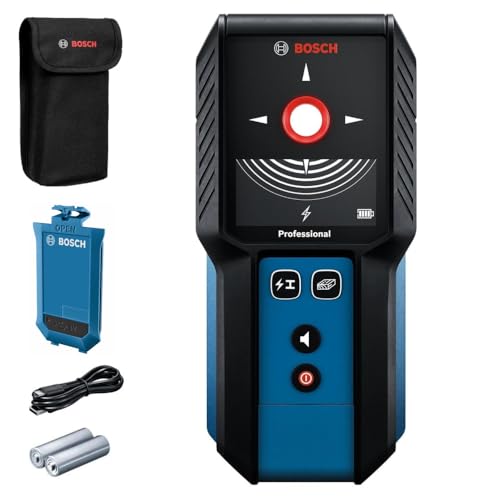
Bosch GMS120-27 Professional
Multi-mode detection of metal, wood framing and live AC wire behind drywall.
| Product | Best For | Key Spec | Rating | Price |
|---|---|---|---|---|
| Bosch GMS120-27 | Finding pipe behind drywall | 4.75 in on ferrous metal | 4.6 / 5 | $$ |
| RIDGID SeekTech SR-20 | Tracing buried sewer lines | Wideband, 512 Hz sonde | 4.5 / 5 | $$$ |
| Milwaukee 2291-20 Sub-Scanner | Scanning concrete slabs | 3 in in concrete | 4.4 / 5 | $$ |
| Wagner Meters Orion 920 | Reading moisture in wood | Pinless, dual depth | 4.3 / 5 | $$$ |
| Fluke 2AC VoltAlert | Quick electrical safety | Non-contact 90-1000V | 4.5 / 5 | $ |
What These Tools Actually Do for a Blocked Drain
A blocked drain usually hides behind a wall, under a slab, or in the ground, and the expensive part of fixing it is opening the wrong spot. These detectors narrow that down. A wall scanner tells you where the pipe and the framing and the live cable run so you cut one clean access hole instead of three. A line locator follows the buried run so you dig over the pipe rather than beside it. A moisture meter shows how far water has already tracked. What none of them do is identify the clog: for that you still push a camera or a rod down the line, and these tools simply tell you where to get in.
How Each Type of Detector Works
Wall scanners such as the Bosch GMS120-27 read changes in the dielectric and magnetic properties of the wall, which is why they find copper, steel, rebar, wood framing and live AC cable but do not see empty PVC or ABS waste pipe. A water-filled plastic pipe can sometimes register as a denser area, but that is a hint, not a reading. Line locators such as the RIDGID SeekTech SR-20 pick up an electromagnetic signal, either induced onto a metal pipe or broadcast by a sonde transmitter pushed down the line, and show its position and depth on screen. Moisture meters such as the Wagner Orion 920 measure how wet a material is, so they map where water has spread rather than where the pipe or the clog is.
What to Check Before Buying a Leak Detector
Start with your pipe material, because it decides the tool. Copper, cast iron and steel can be found directly by a scanner or energized by a locator. Modern plastic waste pipe cannot, so you either trace it with a sonde or you do not trace it at all. Then check the depth figure carefully, because manufacturers quote the best case: the Bosch GMS120-27 reaches 4.75 in on ferrous metal but only around 1.5 in on wood framing and 2 in on live cable, and the Milwaukee Sub-Scanner tops out near 3 in in concrete. Buried line locators work far deeper, but the useful range depends on the sonde and the soil, not on a single headline number. Battery type matters if you already run Milwaukee M12 or Bosch 12V packs, and so does whether the tool self-calibrates when you switch it on.
Mistakes to Avoid When Using a Leak Detector
The biggest mistake is expecting any of these tools to show the clog. They show pipe, framing, cable and damp, and you infer the rest. After that, the common errors are practical: scanning wet or freshly skimmed plaster, which throws false readings until the surface dries; treating a moisture reading as proof of a blocked drain when condensation, a roof leak or a failed shower seal all read the same; leaning on a non-contact voltage tester like the Fluke 2AC for anything beyond a live-cable safety check before you cut; and trying to trace plastic pipe with a locator and no sonde, because there is nothing for the signal to travel along.
Bosch GMS120-27 Professional
Best Overall for Wall/Floor BlockagesPros
- Metal, wood and live-wire modes in one tool
- Self-calibrates when switched on
- Compact, one-handed, marks through the center notch
Cons
- Damp surfaces produce false readings
- Cannot see empty plastic waste pipe
The GMS120-27 is a long-running, widely sold multi-mode detector, and for drain work its job is to keep you from cutting into the wrong thing. It picks out steel and copper pipe, wood studs and live AC cable behind drywall, so you can open one access panel over the pipe instead of exploring. Owner feedback is generally positive on how quickly it settles and how clearly the ring display reads.
Be honest about its limits. The headline 4.75 in figure applies to ferrous metal only: wood framing is found to about 1.5 in and live cable to about 2 in, and empty PVC or ABS waste pipe does not show up at all. It is a wall tool, not an underground one, so buried sewer lines need a locator instead. The 9V battery runs for months of occasional use, and the tool recalibrates itself each time you switch it on.
RIDGID SeekTech SR-20
Best for Underground Sewer LinesPros
- Reaches well past slab and typical yard depth
- Display shows signal strength, direction and depth
- Rugged build for job site use
Cons
- Professional pricing, hard to justify for one blockage
- Needs a separate sonde for plastic pipe
- Older model, now sold alongside newer SeekTech units
The SeekTech SR-20 is a professional wideband line locator. It picks up signal across a broad frequency range, which covers energized metal pipe and the standard 512 Hz sonde used for pushing down drains, and it reports position, direction and an on-screen depth estimate. Plumbers use it to mark a buried sewer run across a yard or under a slab so the dig lands on the pipe.
The trade-offs are cost and workflow. It is a professional purchase, and non-metallic pipe means buying and pushing a sonde as well. It runs on four C-cell alkalines rather than a rechargeable pack, which is old-fashioned but gives long run time and no dead-charger surprises, and the unit weighs around 5.5 lbs. It is also an older model that now sits alongside newer SeekTech receivers, so check what a dealer is actually shipping before ordering. For a homeowner with one blocked drain, hiring a locate is far cheaper than buying one.
Milwaukee 2291-20 M12 Sub-Scanner
Best for Scanning Concrete SlabsPros
- Shares batteries with the M12 tool system
- Backlit graphical display reads well in a crawl space
- Built for concrete, where most wall scanners give up
Cons
- Does not detect wood framing or plastic pipe
- 3 in ceiling in concrete
The 2291-20 is a sub-surface scanner aimed at concrete rather than drywall. It maps rebar, metal conduit and live AC wire to about 3 in deep, which is the scenario a wall scanner handles badly: a cast iron or steel drain buried in a slab, or a wall you are about to core. Running on M12 packs means no 9V hunt mid-job, and the backlit graphical display is readable in a dark crawl space.
Its limits follow from the design. It looks for metal and live cable, so wood framing and PVC or ABS waste pipe do not appear, and 3 in is the practical ceiling. Treat it as the tool that stops you drilling into rebar or a live circuit while opening access to a drain, not as a drain locator in its own right.
Wagner Meters Orion 920
Best for Reading Moisture in WoodPros
- Pinless, so it leaves no holes in trim or flooring
- Two scan depths help separate surface damp from deep damp
- Species-setting calibration for real wood readings
Cons
- Does not locate pipes at all
- Calibrated for wood, so readings on drywall or masonry are comparative only
- Professional price for a secondary tool
The Orion 920 is a pinless moisture meter, not a pipe locator, and it is worth being precise about what it is built for: wood. Set the species and it reads percentage moisture content in timber at two depths, roughly a quarter inch and three quarters of an inch, which is how you tell a wet surface from a joist that has been soaking for weeks. On a blocked and leaking drain that is the trail you follow, sweeping across floorboards and framing to find where the water is actually coming from.
Two honest caveats. Used on drywall, plaster or masonry it gives a relative comparison rather than a calibrated number, so you are hunting the highest reading, not recording a figure. And it is a professional instrument at a professional price, not a cheap add-on, so a budget pinless meter is the sensible buy if you only need to confirm one damp patch.
Fluke 2AC VoltAlert
Best for Electrical Safety Before DrillingPros
- Essential safety check before cutting into a wall
- Pocket-sized, self-tests continuously
- Long-standing reputation for reliability
Cons
- Does not detect pipes or blockages
- Visual indication only, no audible alert
- Only detects live AC voltage, never proves a circuit is dead on its own
The Fluke 2AC VoltAlert is not a leak detector, but it is the tool that belongs in your pocket alongside one. Before cutting into any wall to reach a blocked drain, you check for live cable, and this non-contact tester is the standard way to do it. Owner feedback is overwhelmingly about how simple and dependable it is.
It detects AC voltage from 90 to 1000 volts without touching the conductor, and the tip glows red when voltage is present. Note that the 2AC is a visual-only tester with no buzzer, so keep the tip in sight while you probe. Like every non-contact tester it can miss voltage behind shielding or in deeply buried cable, so treat a dark tip as encouraging rather than as proof and isolate the circuit before you cut. Used that way it is cheap insurance against putting a saw through a live cable while opening access to a drain.
FAQs
Can a leak detector find a blocked drain in a concrete floor?
You can locate the pipe, not the clog. A line locator such as the RIDGID SeekTech SR-20 with a sonde traces the run under a slab, and a concrete scanner like the Milwaukee Sub-Scanner reads about 3 in down. Identifying the blockage itself needs a drain camera.
Do I need a sonde for plastic pipes?
Yes, plastic pipes do not conduct electromagnetic signals, so you must insert a sonde transmitter into the pipe to trace it with a locator.
What is the difference between a wall scanner and a utility locator?
A wall scanner reads a few inches into drywall or concrete and shows metal, framing and live cable in that shallow zone. A line locator picks up an electromagnetic signal on a buried pipe or sonde and follows the run across a yard, far deeper than any scanner reaches.
Can a moisture meter tell me if a drain is blocked?
No. It shows where material is wet, which helps you trace a leak back toward its source, but condensation, a shower seal or a roof leak read the same way.
Is the Bosch GMS120-27 good for finding water pipes?
It finds copper, steel and iron pipe well, along with studs and live cable. Empty plastic pipe does not register, though a water-filled plastic run can occasionally show as a denser area. Treat that as a hint, not a reading.
How deep can a typical wall scanner detect pipes?
Depth depends on the material, not the tool alone. The Bosch GMS120-27 quotes about 4.75 in for ferrous metal, roughly 2 in for live cable and around 1.5 in for wood. The headline number always refers to the easiest target.
Do I need a professional leak detector for a home blockage?
For finding a pipe inside a wall, the Bosch GMS120-27 is enough. For a buried sewer line, a professional locator such as the SeekTech SR-20 is the right tool, and for a one-off job it is usually cheaper to hire a plumber who already owns one.
What battery does the Bosch GMS120-27 use?
A standard 9V battery, which lasts for many months of occasional use. Check the listing for whether a cell is supplied, as this varies by retailer and kit.
Can the Milwaukee M12 Sub-Scanner detect plastic pipes?
No. It reads rebar, metal conduit and live AC wire in concrete. PVC and ABS drain pipe will not appear.
Is the Fluke 2AC VoltAlert necessary for drain work?
Always check for live cable before cutting into a wall. A non-contact tester is the quick first check, but it can miss shielded or deep cable, so isolate the circuit as well.
Our verdict
For most people the Bosch GMS120-27 is the tool to own, because the job in front of you is usually finding the pipe, the studs and the live cable before you cut a hole in a wall. Concrete changes the answer to the Milwaukee 2291-20 Sub-Scanner, and a buried sewer run changes it to a locator such as the RIDGID SeekTech SR-20 with a sonde. Add a moisture meter to follow the damp and a Fluke 2AC to check for live cable. Just keep expectations straight: this kit finds the pipe and the water, and a drain camera finds the clog.