Best Milwaukee Hammer Drills: M18 vs M12 in 2026
Milwaukee sells hammer drills on two separate battery platforms, and the right pick depends on which jobs you actually run. The M18 FUEL 2904-20 leads on raw torque, the M12 FUEL 2504-20 wins for tight spots, and the M18 Compact Brushless 2801-20 covers most budgets without giving up much power. Picking between M18 and M12 gets confusing because Milwaukee reuses similar names across generations and chuck sizes. We compared published specifications, chuck type, and stated use cases across seven current models to sort out which drill fits which task.
Quick answer
For most homeowners, the Milwaukee M18 FUEL 2904-20 delivers the strongest all-around power and runtime among current models. Tight-space and overhead work favors the compact M12 FUEL 2504-20, while the M18 Compact Brushless 2801-20 balances price and torque for everyday drilling, anchor setting, and light masonry.
Why trust ToolBuyerHub
- We compared official Milwaukee specifications rather than marketing copy alone
- Every model listed is a current, separately purchasable Milwaukee tool or kit
- Torque and RPM figures come from manufacturer spec sheets, not estimates
- We cross-checked chuck size and battery platform against Milwaukee's own catalog
- Owner feedback patterns were reviewed but not treated as a substitute for specs
- No affiliate placement affected ranking order or which models were included
Research updated August 2026.
Milwaukee M18 FUEL 1/2 in. Hammer Drill/Driver 2904-20
This is Milwaukee's current flagship M18 hammer drill, built around the POWERSTATE brushless motor.
| Model | Best for | Key specs | Rating |
|---|---|---|---|
| Milwaukee M18 FUEL 1/2 in. Hammer Drill/Driver 2904-20 | Best Overall | 1/2 in. ratcheting, 0-550 / 0-2,000 RPM | 4.8/5 |
| Milwaukee M12 FUEL 1/2 in. Hammer Drill/Driver 2504-20 | Best for Tight Spaces and Overhead Work | 1/2 in., 0-450 / 0-1,750 RPM | 4.7/5 |
| Milwaukee M18 Compact Brushless 1/2 in. Hammer Drill/Driver 2801-20 | Best Value on the M18 Platform | 1/2 in., 0-550 / 0-2,000 RPM | 4.6/5 |
| Milwaukee M18 FUEL Short 1/2 in. Hammer Drill/Driver 2902-20 | Best for Confined Spaces on M18 | 1/2 in. ratcheting, 0-550 / 0-2,000 RPM | 4.6/5 |
| Milwaukee M18 FUEL 1/2 in. Hammer Drill/Driver 2704-20 | Best for Buyers Already Set on Proven Hardware | 1/2 in. ratcheting, 0-550 / 0-2,000 RPM | 4.5/5 |
| Milwaukee M12 3/8 in. Hammer Drill/Driver 2408-20 | Best Budget Pick | 3/8 in., 0-400 / 0-1,500 RPM | 4.4/5 |
| Milwaukee M18 1/2 in. Hammer Drill/Driver 2607-20 | Best Basic Drill for M18 Owners | 1/2 in., 0-450 / 0-1,700 RPM | 4.3/5 |
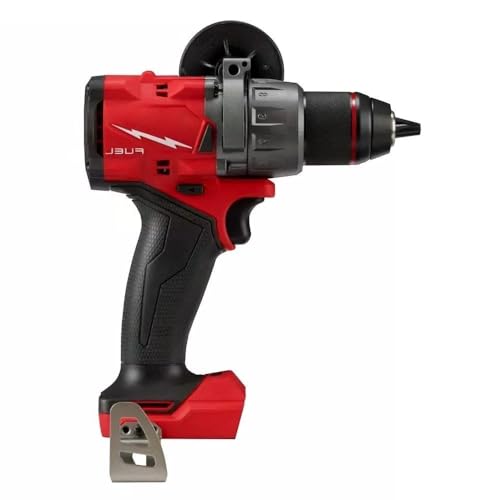
Milwaukee M18 FUEL 1/2 in. Hammer Drill/Driver 2904-20
Best OverallPros
- Highest torque rating in Milwaukee's M18 hammer drill lineup
- Two-speed gearbox suits both drilling and driving
- Compatible with all M18 REDLITHIUM batteries
Cons
- Heavier than compact M18 or any M12 option
- Bare tool needs a separately purchased battery and charger
This is Milwaukee's current flagship M18 hammer drill, built around the POWERSTATE brushless motor. It targets pros drilling large-diameter holes and driving lag bolts, with a ratcheting chuck for secure bit retention.

Milwaukee M12 FUEL 1/2 in. Hammer Drill/Driver 2504-20
Best M12Pros
- Compact body fits between studs and in cabinets
- Full 1/2 inch chuck accepts larger bits than most M12 drills
- Noticeably lighter than any M18 hammer drill
Cons
- Lower max torque limits use on large masonry bits
- M12 batteries run out faster on long drilling sessions
This drill puts a full-size 1/2 inch chuck on Milwaukee's compact M12 platform. It suits electricians and installers who need real hammer-drilling power without a full-size M18 body.
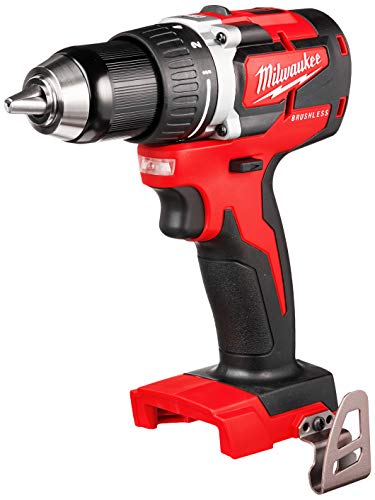
Milwaukee M18 Compact Brushless 1/2 in. Hammer Drill/Driver 2801-20
Best ValuePros
- Brushless motor extends runtime versus brushed M18 models
- Lighter and more compact than the 2904-20 flagship
- Shares batteries with the rest of the M18 lineup
Cons
- Torque rating trails the FUEL 2904-20 by nearly half
- No ratcheting chuck for one-handed bit changes
This model brings brushless efficiency to Milwaukee's mid-tier M18 hammer drill without the POWERSTATE motor's premium cost. It suits DIYers already invested in M18 batteries who want more than an entry-level drill.

Milwaukee M18 FUEL Short 1/2 in. Hammer Drill/Driver 2902-20
Best for Confined SpacesPros
- Shorter front-to-back length than the standard FUEL drill
- Matches the 2904-20 on torque despite the smaller body
- Ratcheting chuck holds bits securely for repeated hammer use
Cons
- Still heavier than any M12 option
- Premium FUEL pricing despite the trimmed-down body
This drill trims roughly an inch off the standard M18 FUEL body while keeping the same POWERSTATE motor and torque rating. It suits framers and installers working inside joist bays or cabinets.
Milwaukee M18 FUEL 1/2 in. Hammer Drill/Driver 2704-20
Best Established FUEL ModelPros
- Long track record with widely available parts and support
- Matches current-gen torque and speed specifications
- Often bundled in older combo kits at a lower entry cost
Cons
- Superseded by the 2904-20 as Milwaukee's current flagship
- Slightly heavier and longer than the newer POWERSTATE model
This is the previous-generation M18 FUEL hammer drill, still sold alongside the newer 2904-20. It suits buyers who prioritize a long service history over the latest motor revision.

Milwaukee M12 3/8 in. Hammer Drill/Driver 2408-20
Best BudgetPros
- Lowest cost entry point into Milwaukee's hammer drill lineup
- Small and light enough for one-handed household use
- Uses the same M12 batteries as Milwaukee's other compact tools
Cons
- Brushed motor gives shorter runtime than FUEL models
- 3/8 inch chuck cannot hold larger masonry or spade bits
This is Milwaukee's entry-level M12 hammer drill, using a brushed motor and a smaller 3/8 inch chuck. It fits light household drilling, small anchor setting, and occasional masonry work.

Milwaukee M18 1/2 in. Hammer Drill/Driver 2607-20
Best Entry-Level M18Pros
- Lowest-priced hammer drill on the M18 platform
- Compact size suits DIY and light household tasks
- Draws from the same battery pool as premium M18 tools
Cons
- Brushed motor means shorter runtime than brushless options
- Torque well below both FUEL models in this lineup
This is Milwaukee's compact, brushed-motor M18 hammer drill, positioned below both the FUEL and Compact Brushless lines. It suits occasional users who already own M18 batteries and want a straightforward drill.
M18 vs M12: Which Platform Fits Your Work
Milwaukee's M18 platform trades size for power, while M12 trades power for a smaller, lighter tool. Contractors drilling large holes or setting heavy anchors generally lean M18. Electricians, installers, and DIYers working in tight spots often prefer M12's smaller body, even with a lower torque ceiling.
Chuck Size and What It Limits
Chuck size determines the largest bit shank a drill can hold, and it varies even within one platform. A 3/8 inch chuck like the 2408-20 caps out below what a 1/2 inch chuck accepts, which matters when stepping up to larger spade or masonry bits.
FUEL vs Standard Brushless vs Brushed Motors
Milwaukee sells hammer drills with three motor tiers: standard brushed, Compact Brushless, and FUEL with the POWERSTATE motor. Brushed motors cost less but run hotter and shorter. FUEL models add the highest torque and best runtime, at a higher price.
Matching Torque to the Job
Light household drilling and small anchors rarely need more than 500 in-lbs of torque. Repeated masonry drilling or large lag bolts benefit from the 1,200 in-lbs rating found on Milwaukee's FUEL models. Match the drill's torque spec to the heaviest task planned, not the average one.
FAQs
Is Milwaukee M18 or M12 better for a hammer drill?
M18 generally delivers more torque and runtime for heavy drilling, while M12 is lighter and better suited to tight spaces and lighter-duty tasks.
What is the difference between Milwaukee 2904-20 and 2704-20?
Both share the same torque and speed ratings, but the 2904-20 is Milwaukee's current-generation model while the 2704-20 is the prior generation still sold alongside it.
Can a Milwaukee M12 hammer drill handle concrete drilling?
Yes for small-diameter holes and light anchor setting, though its lower torque makes repeated large-diameter masonry work slower than an M18 FUEL model.
Does the Milwaukee M18 FUEL hammer drill work with older M18 batteries?
Yes, M18 FUEL tools are compatible with all M18 REDLITHIUM batteries, including older packs, though newer high-output batteries improve runtime.
Which Milwaukee hammer drill is best for a homeowner?
The M18 Compact Brushless 2801-20 or the M12 FUEL 2504-20 both suit typical homeowner tasks without the cost of a full FUEL flagship.
What does the hammer function on these drills actually do?
It adds a rapid forward-and-back pulsing action to the rotation, helping the bit break through masonry and concrete faster than rotation alone.
Is a 1/2 inch chuck necessary for a hammer drill?
Not for light tasks, but a 1/2 inch chuck accepts larger bits than a 3/8 inch chuck, which matters for bigger masonry or spade bits.
How much torque does a Milwaukee hammer drill need for lag bolts?
Larger lag bolts benefit from higher torque ratings, such as the 1,200 in-lbs found on Milwaukee's FUEL models, to avoid stalling mid-drive.
Are Milwaukee M12 and M18 batteries interchangeable?
No, M12 and M18 use separate battery platforms and are not cross-compatible, so tool choice should match batteries already owned.
Our verdict
Most buyers do best matching platform to existing batteries first, then picking torque for the heaviest task planned. The M18 FUEL 2904-20 covers the widest range of jobs, the M12 FUEL 2504-20 suits tight spaces, and the M18 Compact Brushless 2801-20 balances price against power for everyday use.